Blog
Choosing teaching as a career is a meaningful decision. A good teacher does more than explain lessons. A teacher helps children learn new things, build confidence, develop good habits and understand the world around them.
However, becoming a good teacher requires the right knowledge, practical skills, patience and proper training. This is why choosing the right Teachers Training Institute in Kolkata is an important step for anyone who wants to build a career in education.
Today, many students are interested in teaching careers. Some want to teach in nursery schools and preschools, while others want to work in primary schools, private educational institutions or early childhood learning centres. There are different training programmes for these career goals, and understanding them before taking admission is essential.
At Global Technical Institute, we understand that students often have many questions before choosing a teacher training course. They want to know about course types, eligibility, duration, fees, admission procedures, practical training, certificates and future career opportunities.
In this detailed guide, we will explain everything you should know before selecting a teacher training programme in Kolkata. Our aim is to help students make an informed decision and choose a course that matches their educational qualifications and career plans.
1. What Is Teacher Training?
Teacher training is a professional learning process that prepares individuals to teach students effectively. It helps future teachers understand how children learn, how to explain lessons, how to manage classrooms and how to create a positive learning environment.
Teaching is not only about having knowledge of a subject. A teacher must also know how to communicate that knowledge in a simple and understandable way.
A teacher training programme generally focuses on:
- Understanding child psychology and development.
- Learning different teaching methods.
- Preparing lesson plans.
- Managing classrooms.
- Developing communication skills.
- Using teaching aids and educational materials.
- Conducting classroom activities.
- Evaluating students’ learning progress.
- Supporting children with different learning needs.
- Developing confidence as a teacher.
For example, teaching a three-year-old child is very different from teaching a student in Class VIII. Young children learn through stories, pictures, sounds, games and activities. Older students may require subject-based explanations, discussions and structured lessons.
A professional training programme helps aspiring teachers understand these differences.
2. Why Is Teacher Training Important?
A person may have a good educational background, but that does not automatically mean they know how to teach effectively.
Teacher training develops the practical abilities required to handle real classroom situations.
Here are some important reasons why professional training matters.
2.1 Understanding Child Psychology
Every child has a different learning speed, personality and level of understanding.
Some children learn quickly through pictures, while others understand better through activities or verbal explanations.
Teacher training helps educators understand children’s behaviour, emotional development, learning interests and individual needs.
2.2 Developing Communication Skills
A teacher must explain complicated topics in simple language.
Training helps students improve their speaking skills, classroom communication, pronunciation, storytelling and ability to interact with children.
2.3 Learning Classroom Management
Managing a classroom is one of the most important responsibilities of a teacher.
Teachers must maintain discipline, encourage participation, manage group activities and create a friendly learning environment.
Training introduces different techniques to handle these responsibilities.
2.4 Learning Modern Teaching Methods
Traditional teaching methods are not always suitable for every child.
Modern classrooms use activity-based learning, storytelling, visual aids, educational games, digital tools and interactive teaching methods.
A good training programme introduces students to these approaches.
2.5 Building Professional Confidence
Many aspiring teachers feel nervous about speaking in front of students or conducting their first class.
Practice teaching, presentations, workshops and mock interviews help develop confidence.
This is one reason why practical learning should be an important part of a teacher training programme.
3. Different Types of Teacher Training Courses
Before choosing a Teachers Training Institute in Kolkata, students should understand the different types of programmes available.
Each course has a different purpose, qualification requirement and career pathway.
3.1 Nursery Teacher Training (NTT)
Nursery Teacher Training focuses on preparing teachers to work with young children in nursery schools and early childhood learning environments.
The programme generally introduces students to the basic principles of early childhood education.
Important learning areas include:
- Child growth and development.
- Early childhood psychology.
- Rhymes and storytelling.
- Drawing and creative activities.
- Classroom decoration.
- Basic language development.
- Play-based learning.
- Communication with young children.
- Classroom organisation.
Who should choose this course?
Students interested in teaching young children in nursery schools, preschools and early learning centres can explore this type of programme.
Before admission, students should check the awarding organisation, course recognition and the employment requirements of their preferred institutions.
3.2 Montessori Teacher Training
Montessori education is an approach that encourages children to learn through exploration, observation and practical activities.
It gives importance to independent learning, hands-on experiences and a carefully prepared classroom environment.
A Montessori teacher acts as a guide who supports children as they explore different learning materials and activities.
Common learning areas include:
- Montessori teaching philosophy.
- Practical life activities.
- Sensorial education.
- Language development.
- Early mathematics.
- Classroom organisation.
- Teaching materials.
- Child observation.
- Activity-based learning.
Who should choose Montessori training?
This programme can be suitable for people who want to work in Montessori schools, preschools and early childhood education centres.
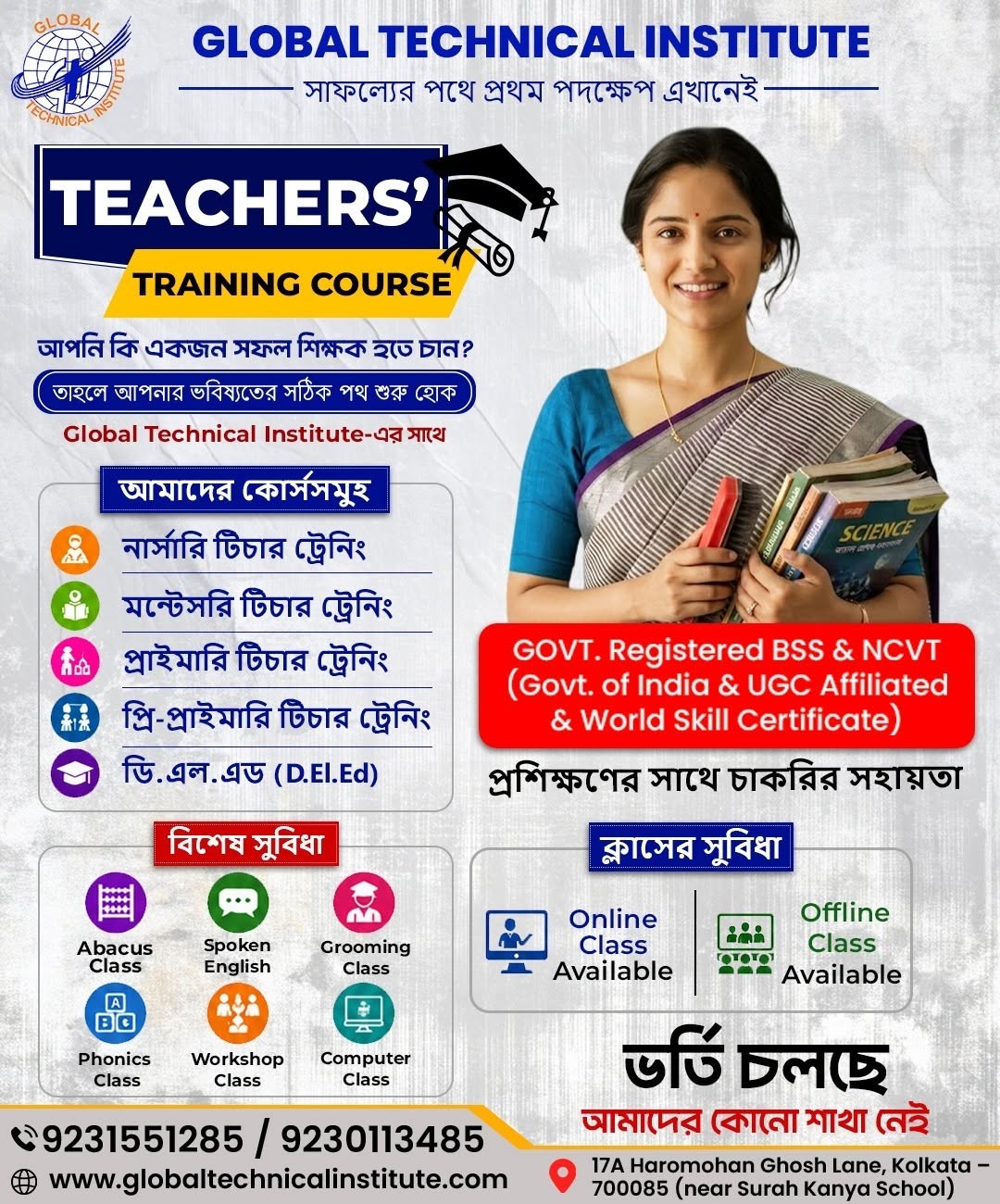
At Global Technical Institute, our primary teacher training programme is based on the Montessori method. It introduces students to child-centred teaching approaches and practical skill development.
3.3 Pre-Primary Teacher Training
Pre-primary teacher training focuses on teaching children before they enter formal primary education.
The main objective is to help children develop basic language, social, emotional, creative and cognitive skills.
The programme may cover:
- Early childhood development.
- Phonics and language learning.
- Rhymes and storytelling.
- Creative activities.
- Number recognition.
- Basic environmental awareness.
- Play-based teaching.
- Classroom management.
- Child safety and care.
Pre-primary teachers need patience, creativity and good communication skills.
3.4 Primary Teacher Training
Primary teacher training focuses on preparing individuals to teach children at the elementary level.
Students learn how to explain basic subjects, prepare lessons, conduct activities and understand the learning needs of children.
Important areas include:
- Teaching methodology.
- Basic mathematics.
- Language teaching.
- Environmental studies.
- Child development.
- Classroom management.
- Lesson planning.
- Teaching-learning materials.
- Practice teaching.
- Student assessment.
Important qualification distinction: A private primary teacher training diploma and a government-recognised D.El.Ed. qualification are not automatically the same. Students planning to apply for government teaching posts must check the applicable recruitment notification and statutory qualification requirements.
3.5 Diploma in Primary Teachers’ Training
A Diploma in Primary Teachers’ Training is a programme designed to introduce students to the knowledge and skills needed for primary-level teaching and educational support roles.
Depending on the awarding organisation and course structure, the programme may include:
- Basic teaching principles.
- Child psychology.
- Montessori-based learning.
- Phonics.
- Classroom management.
- Spoken English.
- Computer knowledge.
- Storytelling.
- Teaching practice.
- Interview preparation.
At Global Technical Institute, the Diploma in Primary Teachers’ Training programme includes additional skill development modules to help students improve their practical abilities.
3.6 Bachelor of Education (B.Ed.)
B.Ed. is a professional teacher education qualification governed by applicable regulatory requirements.
It is designed for graduates who want to pursue teaching at the relevant school levels, subject to the applicable recruitment rules.
The curriculum generally includes:
- Educational psychology.
- Teaching methodology.
- Educational assessment.
- Subject pedagogy.
- School internship.
- Classroom practice.
- Inclusive education.
- Educational technology.
Under the NCTE framework, the regular B.Ed. programme under the 2014 regulations has a two-academic-year duration. Students should check current regulations and admission requirements before applying.
3.7 Diploma in Elementary Education (D.El.Ed.)
D.El.Ed. is a recognised professional teacher education programme intended to prepare teachers for elementary education.
It is different from a privately awarded primary teacher training diploma.
The programme generally focuses on:
- Childhood and child development.
- Educational psychology.
- Language learning.
- Mathematics education.
- Environmental studies.
- Teaching methods.
- School internship.
- Practical teaching experience.
The regular D.El.Ed. programme under the applicable NCTE framework is generally two academic years.
In West Bengal, students should follow the admission notifications and eligibility requirements published by the West Bengal Board of Primary Education.
4. Which Teacher Training Course Should You Choose?
Choosing a course depends on your educational qualification and the type of teaching career you want.
Here is a simple comparison.
| Course | Main focus | Suitable career direction |
| Nursery Teacher Training | Early childhood learning | Nursery and preschool education |
| Montessori Training | Montessori teaching methods | Montessori schools and learning centres |
| Pre-Primary Training | Preschool education | Pre-primary teaching |
| Primary Teacher Training | Primary-level teaching skills | Relevant private educational and learning roles |
| Diploma in Primary Teachers’ Training | Teaching fundamentals and practical skills | Primary education support and suitable teaching roles |
| D.El.Ed. | Regulated elementary teacher education | Eligible elementary teaching positions |
| B.Ed. | Professional school teacher education | Eligible school teaching positions |
Before selecting any programme, consider your long-term career objective.
If you want to work with preschool children, early childhood or Montessori training may be relevant.
If you want to apply for a government teaching position, first check the official eligibility requirements for that position. Do not assume that every teacher training diploma will qualify you for government recruitment.
5. Eligibility Criteria for Teacher Training Courses
Eligibility depends on the course, awarding organisation and applicable regulations.
There is no single eligibility requirement for every teacher training programme.
5.1 Eligibility for Private Primary Teacher Training Programmes
For the Diploma in Primary Teachers’ Training programme listed by Global Technical Institute, the website specifies Madhyamik or Higher Secondary as the minimum educational qualification.
Students should confirm the current admission criteria with the institute before applying.
5.2 Eligibility for D.El.Ed.
Under the relevant NCTE framework and West Bengal admission provisions, candidates generally require Higher Secondary or an equivalent qualification with the prescribed minimum marks.
For the West Bengal D.El.Ed. 2024–2026 admission provisions, the stated minimum was 50%, with a 5% relaxation for specified categories.
The current admission notification should always be checked because eligibility and reservation provisions may be updated.
5.3 Eligibility for B.Ed.
B.Ed. admission generally requires a recognised undergraduate or postgraduate qualification with the prescribed marks and subject-related conditions.
The exact requirements depend on the admission authority and current regulations.
5.4 Can You Join Teacher Training After Madhyamik?
Yes, some private teacher training programmes accept students after Madhyamik.
For example, Global Technical Institute lists Madhyamik/Higher Secondary as the minimum qualification for its Diploma in Primary Teachers’ Training programme.
However, this should not be confused with the eligibility criteria for statutory D.El.Ed. or B.Ed. programmes.
5.5 Can Working Professionals Join?
Some institutes provide flexible schedules that allow working individuals to pursue training alongside their existing responsibilities.
Before joining, check:
- Class timings.
- Attendance requirements.
- Practical training schedule.
- Examination arrangements.
- Course completion requirements.
- Whether the course is available online, offline or in both modes.
6. Course Duration: How Long Does Teacher Training Take?
Course duration depends on the selected programme.
Students should never assume that every teacher training course takes the same amount of time.
For example:
- NCTE-regulated D.El.Ed.: Generally two academic years.
- Regular B.Ed. under the NCTE 2014 framework: Two academic years.
- Private Montessori or primary teacher training diplomas: Duration depends on the institute and awarding organisation.
- Other early childhood training programmes: Duration varies by course structure.
At Global Technical Institute, the course information currently published on the website contains different duration details. Students should contact the admissions team to confirm the applicable duration for their selected batch.
Always request the course schedule in writing before admission.
7. What Subjects Are Taught in Teacher Training?
A comprehensive teacher training programme should cover both theoretical knowledge and practical teaching skills.
The exact syllabus depends on the course.
Some common learning areas are explained below.
7.1 Child Psychology
Child psychology helps future teachers understand how children think, behave and learn.
Students learn about different stages of child development and the factors that influence learning.
7.2 Child Development
This subject focuses on children’s physical, emotional, social, language and cognitive development.
It helps teachers understand age-appropriate learning activities.
7.3 Teaching Methodology
Teaching methodology explains how to present lessons effectively.
Students learn how to select teaching methods according to the subject, age group and learning needs of students.
7.4 Lesson Planning
A lesson plan gives a teacher a clear structure for conducting a class.
It generally includes:
- Learning objectives.
- Topic introduction.
- Teaching materials.
- Explanation.
- Classroom activities.
- Student participation.
- Assessment.
- Lesson conclusion.
7.5 Classroom Management
Classroom management involves maintaining a positive and organised learning environment.
Teachers learn how to handle group activities, encourage discipline and support student participation.
7.6 Phonics
Phonics teaches the relationship between letters and sounds.
It helps young learners develop early reading and pronunciation skills.
7.7 Storytelling and Rhymes
Stories and rhymes make learning enjoyable for young children.
Teachers learn how to use voice modulation, expressions, pictures and simple activities to keep children engaged.
7.8 Educational Technology
Technology is becoming an important part of modern education.
Teachers may use computers, presentations, digital learning resources and smart classroom tools to make lessons more interactive.
7.9 Educational Activities
Art, craft, drawing, music, games and hands-on activities support creative learning.
They also help teachers understand how to make classroom sessions interesting.
8. Practical Training: Why Is It Important?
Theoretical knowledge is important, but teaching is a practical profession.
A student may understand the concept of classroom management but still struggle when handling a real group of children.
Practical training helps bridge this gap.
Important practical activities can include:
Practice teaching: Students practise explaining lessons and conducting classroom sessions.
Lesson presentation: Trainees prepare and present lessons using appropriate teaching aids.
Storytelling: Students practise telling stories with suitable expressions and voice modulation.
Activity preparation: Trainees learn to prepare educational games, charts, flashcards and other materials.
Classroom management exercises: Students practise maintaining discipline and encouraging participation.
Mock interviews: Students develop confidence for teaching-related interviews.
When comparing a Teachers Training Institute in Kolkata, always ask whether practical teaching and skill development are included in the course.
9. Admission Process for Teacher Training in Kolkata
The admission process may differ between private institutes and government-regulated programmes.
However, the following steps will help students understand the general process.
Step 1: Choose Your Course
First, identify the type of teaching career you want.
Decide whether you are interested in Montessori education, nursery teaching, pre-primary education, primary teacher training, D.El.Ed. or B.Ed.
Step 2: Check Your Eligibility
Review the educational qualification, minimum marks and other admission requirements for the selected programme.
Step 3: Select an Institute
Research the institute’s course details, faculty, affiliation, certificate, class schedule and practical training facilities.
Step 4: Collect Course Information
Before applying, request complete information about:
- Course duration.
- Syllabus.
- Total fees.
- Examination arrangements.
- Certificate-awarding organisation.
- Class schedule.
- Practical training.
- Refund policy.
Step 5: Submit the Application
Complete the application form and provide the required documents.
For regulated programmes, follow the admission authority’s official application procedure.
Step 6: Complete Admission Formalities
After confirmation of eligibility, complete the required admission formalities and obtain an official fee receipt.
Step 7: Attend Classes
Attend classes regularly, complete assignments and participate in practical activities.
Step 8: Complete the Course Requirements
Complete the prescribed coursework, assessments, practical activities and examinations.
Step 9: Receive the Certificate
The certificate is issued according to the rules of the relevant awarding organisation after successful completion of the programme.
10. Documents Required for Teacher Training Admission
Document requirements depend on the programme.
The following documents are commonly requested by training institutes:
- Recent passport-sized photographs.
- Madhyamik admit card or age proof.
- Last passed examination marksheet.
- Educational certificates.
- Valid photo identity proof.
- Address proof, where required.
- Category certificate, where applicable.
- Other documents mentioned in the admission notification.
For its Diploma in Primary Teachers’ Training programme, Global Technical Institute lists six passport-sized photographs, an attested copy of the last passed marksheet, Madhyamik admit card and valid photo ID proof.
Students should confirm the latest document checklist before submitting their application.
11. Teacher Training Course Fees in Kolkata
Course fees are one of the most important considerations for students.
However, there is no single fixed fee for all teacher training programmes in Kolkata.
Fees may depend on:
- Course type.
- Course duration.
- Awarding organisation.
- Institution.
- Study materials.
- Practical training.
- Examination charges.
- Registration charges.
- Additional workshops.
- Online or offline learning arrangements.
What Is Included in Teacher Training Fees?
Before paying the admission fee, ask the institute for a complete fee breakdown.
A transparent fee structure should explain:
| Fee component | What to check |
| Registration fee | One-time admission or registration charge |
| Tuition fee | Main course fee |
| Study materials | Books, notes and learning resources |
| Examination fee | Assessment and examination charges |
| Practical training | Whether practical sessions are included |
| Certificate fee | Whether certificate charges are separate |
| Other charges | Any additional compulsory expenses |
How Much Does a Teacher Training Course Cost?
The actual cost varies by institute and programme.
We recommend comparing complete course fees instead of selecting an institute only because it advertises a low admission price.
At Global Technical Institute, students can contact the admissions team to receive the latest course fee, payment schedule and details of any available financial assistance.
Do not make a payment without understanding the complete fee structure and refund conditions.
12. Online vs Offline Teacher Training: Which Is Better?
Students today have different learning preferences and schedules.
Some prefer attending physical classes, while others need flexibility because of work, studies or family responsibilities.
Online Teacher Training
Online learning allows students to attend classes remotely.
Advantages may include:
- Flexible learning arrangements.
- Reduced travel time.
- Access to online learning resources.
- Convenient learning from home.
- Better schedule management.
However, students should check how practical teaching and classroom-based activities are conducted.
Offline Teacher Training
Offline learning allows students to interact directly with trainers and classmates.
Advantages may include:
- Face-to-face communication.
- Direct guidance.
- Classroom demonstrations.
- Group activities.
- Immediate feedback.
- Better opportunities for in-person practice.
Which Option Should You Choose?
Choose a learning mode based on your schedule, course requirements and learning preferences.
For practical teaching skills, direct classroom interaction can be especially useful.
Global Technical Institute lists both online and offline learning options for its primary teacher training programme. Students should confirm the exact availability of each mode for their selected batch.
13. How to Choose the Best Teachers Training Institute in Kolkata
Selecting the right institute is one of the most important decisions in your teaching career.
Do not make your decision based only on advertisements, discounts or attractive course names.
Here are the important factors to consider.
13.1 Check Course Recognition and Affiliation
Always verify which organisation awards the certificate.
If you want a statutory teaching qualification, verify the institution and programme through the relevant regulatory authority.
For example, NCTE recognition is an important consideration for programmes such as regulated D.El.Ed. and B.Ed.
An affiliation or certificate from another organisation should not automatically be treated as equivalent to NCTE recognition.
13.2 Review the Course Syllabus
A good programme should have a clearly explained syllabus.
Check whether it includes child psychology, teaching methods, lesson planning, classroom management and practical learning.
13.3 Understand the Faculty’s Experience
Trainers should have relevant educational knowledge and teaching experience.
Ask about:
- Academic qualifications.
- Teaching experience.
- Subject expertise.
- Practical teaching knowledge.
- Student mentoring.
13.4 Check Practical Training Facilities
Teaching is a skill-based profession.
Look for opportunities to practise lessons, prepare educational materials, conduct activities and develop classroom confidence.
13.5 Compare Fees
Ask for the complete fee structure.
Check whether study materials, assessments, examinations and certificates are included.
13.6 Understand the Class Schedule
If you are working or studying, check whether the institute provides a suitable schedule.
Ask about weekly classes, weekend batches and attendance requirements.
13.7 Check Student Feedback
Speak to former students where possible.
Ask about teaching quality, course content, trainer support and the certificate process.
13.8 Ask About Career Guidance
An institute may offer interview preparation, communication training and career guidance.
However, students should understand that training and career support do not guarantee employment.
14. Why Consider Global Technical Institute for Teacher Training in Kolkata?
At Global Technical Institute, we focus on developing practical skills and introducing students to the fundamentals of effective teaching.
We understand that aspiring teachers need more than theoretical information. They also need communication skills, confidence, classroom understanding and practical exposure.
Our Diploma in Primary Teachers’ Training programme is designed around the Montessori teaching approach and includes additional skill development modules.
14.1 Montessori-Based Teaching Approach
Our programme introduces students to the Montessori method and child-centred learning principles.
This helps trainees understand the importance of activities, observation and interactive learning.
14.2 Flexible Learning Options
We list online and offline learning options to help students choose a suitable mode.
Students can enquire about the current class schedule and available batches.
14.3 Multiple Admission Sessions
Our published course information mentions three admission sessions:
- March.
- July.
- November.
Students should contact the institute to confirm upcoming admission dates.
14.4 Skill Development Modules
Along with the primary teacher training curriculum, our programme includes additional modules designed to improve practical and professional skills.
These modules include:
Computer: Basic computer knowledge for educational and administrative activities.
Spoken English: Communication practice to help students improve their speaking confidence.
Grooming and Personality Development: Professional presentation, confidence and interpersonal skills.
Phonics: Understanding letter sounds and early reading methods.
Abacus: Introduction to number-based learning activities.
Practice Teaching: Opportunities to practise teaching methods and classroom presentation.
AI-Based Smart Class: Introduction to technology-supported classroom learning.
Interview Sessions: Preparation for teaching-related interviews.
Workshops: Learning through demonstrations and interactive activities.
Storytelling Classes: Developing the ability to engage children through stories.
Class Management: Understanding classroom organisation and student interaction.
The availability and structure of individual modules should be confirmed for the current batch.
14.5 Student Support
We understand that students may need guidance throughout their training journey.
Our team can help students understand the course structure, admission requirements, learning options and other course-related information.
14.6 Convenient Kolkata Location
Global Technical Institute is located at:
Beliaghata, 17A Haramohan Ghosh Lane, Kolkata – 700085.
Students can contact the institute for course details and admission enquiries.
15. Career Opportunities After Teacher Training
Teacher training can help students prepare for different education-related career paths.
However, the actual employment opportunities depend on the qualification, certificate, employer requirements and applicable recruitment regulations.
Some possible career directions include:
15.1 Nursery Teacher
Nursery teachers work with young children and introduce them to basic learning through games, activities, rhymes and storytelling.
15.2 Pre-Primary Teacher
Pre-primary teachers help children develop basic communication, social and learning skills before formal schooling.
15.3 Montessori Teacher
Montessori teachers use activity-based and child-centred teaching methods to support independent learning.
15.4 Primary Education Roles
Students with the appropriate recognised qualifications may pursue primary teaching opportunities, subject to applicable recruitment requirements.
15.5 Preschool Learning Centre
Trained individuals may explore suitable opportunities in preschool and early childhood learning centres.
15.6 Teaching Assistant
Teaching assistants support classroom activities, lesson preparation and student learning under the guidance of teachers.
15.7 Educational Activity Instructor
Individuals with relevant skills may explore roles involving storytelling, phonics, creative activities and early learning programmes.
15.8 Private Educational Institutions
Private schools and educational organisations may recruit candidates according to their individual qualification and experience requirements.
15.9 Educational Entrepreneurship
Experienced individuals may explore starting educational activity centres or other learning-related services, subject to applicable laws, permissions and business requirements.
16. What Skills Should a Good Teacher Develop?
A successful teacher needs a combination of professional knowledge and personal qualities.
Here are some essential skills.
Patience: Children may take time to understand a topic. Teachers must explain concepts calmly.
Communication: Clear communication helps students understand lessons and express their questions.
Creativity: Creative teaching methods make learning interesting.
Confidence: Teachers should feel comfortable conducting classes and speaking in front of students.
Time Management: Teachers need to plan lessons, manage activities and complete the syllabus within the available time.
Problem-Solving: Teachers must understand classroom challenges and respond appropriately.
Observation: Observing students helps teachers identify learning difficulties and individual needs.
Empathy: Understanding children’s feelings and experiences helps create a supportive classroom.
Technology Skills: Basic digital knowledge helps teachers use modern educational tools.
17. Common Mistakes to Avoid Before Taking Admission
Many students select a teacher training programme without checking all the important details.
Avoid these common mistakes:
- Choosing an institute only because it offers a low fee.
- Not checking the certificate-awarding organisation.
- Confusing a private diploma with a statutory teaching qualification.
- Not checking the course duration.
- Ignoring practical training opportunities.
- Not understanding the examination process.
- Assuming that every course qualifies candidates for government teaching jobs.
- Not asking for a complete fee breakdown.
- Ignoring attendance and course completion requirements.
- Believing that admission guarantees employment.
A careful decision before admission can prevent confusion later.
18. Important Things to Verify Before Paying Course Fees
Before completing your admission, make sure you receive clear answers to these questions:
- What is the exact name of the course?
- Who awards the final certificate?
- Is the institute affiliated with the stated organisation?
- What is the course duration?
- What are the minimum educational qualifications?
- What subjects are included?
- Are practical classes included?
- What is the complete course fee?
- Are examination and certificate charges included?
- What is the class schedule?
- Are online and offline options available?
- What are the attendance requirements?
- What is the examination process?
- What is the refund policy?
- What career opportunities are relevant to this certificate?
A trustworthy institute should be able to explain these details clearly.
19. Why Is Kolkata a Good Place to Explore Teacher Training?
Kolkata has a wide range of educational institutions, schools, preschools and learning centres.
Students interested in education can explore different training programmes according to their qualifications and career interests.
The city also offers access to educational resources, professional networks and opportunities to interact with people working in the education sector.
For students living in and around Beliaghata, Salt Lake, Sealdah, Phoolbagan, Kankurgachi, Ultadanga and other parts of Kolkata, comparing nearby teacher training options can help them find a convenient institute.
However, location should not be the only deciding factor. Course quality, eligibility, certificate validity, faculty and practical training are equally important.
20. How to Start Your Teaching Career with Global Technical Institute
If you are interested in becoming a teacher, the first step is to identify the type of education in which you want to work.
At Global Technical Institute, we encourage students to understand their career goals before selecting a programme.
Our Diploma in Primary Teachers’ Training programme is designed to introduce students to Montessori-based teaching and additional professional skill development.
You can follow these steps:
- Contact our admissions team.
- Discuss your educational qualifications.
- Understand the course syllabus.
- Confirm the course duration.
- Ask for the complete fee structure.
- Review the certificate and affiliation details.
- Choose the available learning mode.
- Complete the admission process.
- Begin your teacher training journey.
We believe that good teachers help create better learning experiences for children. With the right training, dedication and continuous learning, you can take meaningful steps towards a career in education.
21. Frequently Asked Questions About Teachers Training in Kolkata
Q1. Which is the best Teachers Training Institute in Kolkata?
The best institute depends on your career goals, course requirements, faculty, practical training, course fees and certificate recognition. Before selecting an institute, compare the syllabus, affiliation and student support facilities. Global Technical Institute offers a Diploma in Primary Teachers’ Training based on the Montessori approach.
Q2. What is the minimum qualification for primary teacher training?
Eligibility depends on the programme. Global Technical Institute lists Madhyamik or Higher Secondary as the minimum qualification for its Diploma in Primary Teachers’ Training programme. Regulated programmes such as D.El.Ed. have separate eligibility requirements.
Q3. Can I join a teacher training course after Madhyamik?
Yes. Some private teacher training diploma programmes accept students after Madhyamik. Global Technical Institute lists Madhyamik/Higher Secondary as the minimum qualification for its primary teacher training programme. However, this does not mean that the candidate automatically qualifies for D.El.Ed. or government teaching recruitment.
Q4. How long does a primary teacher training course take?
The duration depends on the institute and course. Some private programmes have their own course structures, while regulated programmes have prescribed durations. Contact the institute and confirm the exact duration of the current batch before admission.
Q5. What is the difference between NTT and Montessori teacher training?
Nursery Teacher Training generally focuses on preparing individuals to work with young children in nursery and preschool environments. Montessori training focuses on the Montessori educational approach, which encourages hands-on learning, independence and child-centred activities.
Q6. Is Montessori teacher training a good career option?
Montessori training can be useful for people interested in early childhood education. It introduces teaching methods that support independent learning, classroom activities and child development. Career opportunities depend on the course certificate and the requirements of individual employers.
Q7. What is the difference between D.El.Ed. and a Diploma in Primary Teachers’ Training?
D.El.Ed. is a regulated professional teacher education qualification under the applicable NCTE framework. A private Diploma in Primary Teachers’ Training may be offered by a different awarding organisation. They should not be treated as equivalent unless the relevant authorities establish that equivalence.
Q8. What is the difference between B.Ed. and D.El.Ed.?
D.El.Ed. is designed for elementary teacher education, while B.Ed. is a professional teacher education programme for the relevant upper-primary and secondary school teaching levels. The applicable qualification and recruitment rules must be checked for each teaching post.
Q9. Can I pursue teacher training while working?
Some institutes provide flexible class schedules and online learning options. Global Technical Institute lists three classes per week or weekend classes, with online and offline options. Confirm the actual schedule and attendance requirements before enrolling.
Q10. Does Global Technical Institute offer online teacher training?
The institute’s published course information lists both online and offline learning options for its primary teacher training programme. Contact the admissions team to confirm the availability and structure of the current batch.
Q11. What documents are required for admission?
The documents listed by Global Technical Institute include six passport-sized photographs, an attested copy of the last passed marksheet, Madhyamik admit card and valid photo ID proof. Additional documents may be required depending on the programme.
Q12. What is the fee for teacher training in Kolkata?
Course fees vary according to the programme, institute, duration and awarding organisation. Global Technical Institute can provide the latest fee details and payment structure directly through its admissions team.
Q13. What subjects are covered in primary teacher training?
Depending on the course, subjects may include child psychology, teaching methodology, classroom management, lesson planning, communication, phonics, storytelling, educational activities and practice teaching.
Q14. Is practical teaching included in teacher training?
Practical training is an important part of developing teaching skills. It may include lesson presentations, storytelling, educational activities and practice teaching. Students should confirm the exact practical components included in their selected programme.
Q15. Can I get a government teaching job after completing a private teacher training diploma?
A private diploma does not automatically qualify a candidate for a government teaching position. Government recruitment follows prescribed academic and professional qualification requirements, along with applicable examinations such as TET where required. Always check the official recruitment notification.
Q16. What is the difference between a private teacher training diploma and an NCTE-recognised course?
An NCTE-recognised teacher education programme follows the relevant statutory recognition and regulatory requirements. A private diploma may be awarded under a different organisation’s affiliation or certification framework. Students must check the recognition and employment applicability of each qualification separately.
Q17. Does teacher training help with interview preparation?
Some teacher training programmes include communication development, presentation practice and mock interviews. Global Technical Institute lists interview sessions as one of the additional skill development modules in its programme information.
Q18. Where is Global Technical Institute located in Kolkata?
Global Technical Institute is located at 17A Haramohan Ghosh Lane, Beliaghata, Kolkata – 700085, near Surah Kanya Vidyalaya.
Q19. When can I take admission at Global Technical Institute?
The institute’s published information lists three admission sessions: March, July and November. Contact the institute to confirm the upcoming batch and current admission availability.
Q20. How can I contact Global Technical Institute for teacher training admission?
You can contact Global Technical Institute through the following details:
Name: Global Technical Institute – Teacher Training Institute in Kolkata
Address: 17a, Hara Mohan Ghosh Ln, Phool Bagan, Beleghata, Kolkata, West Bengal 700085
Phone Number: 9231551285
Map:
Conclusion: Choose the Right Teachers Training Institute in Kolkata for Your Future
Teaching is a profession that requires knowledge, patience, communication and a genuine interest in helping children learn.
Choosing the right training programme is an important first step. Before taking admission, understand the course structure, eligibility, duration, fees, certificate, practical training and future career opportunities.
If you are searching for Teachers Training in Kolkata, take time to compare different programmes and select one that matches your educational qualifications and career goals.
At Global Technical Institute, we aim to help aspiring educators develop teaching knowledge and practical skills through our Montessori-based Diploma in Primary Teachers’ Training programme and additional skill development modules.
Whether you are starting your professional journey after Madhyamik or looking to develop new skills for the education sector, make an informed decision and take your next step towards teaching.
Start your teacher training journey with Global Technical Institute. Contact our admissions team today to learn about the current course structure, fees and admission process.
Read More: Career Opportunities After Completing a Teacher Training Course in Kolkata