Lab Technician Training in Kolkata
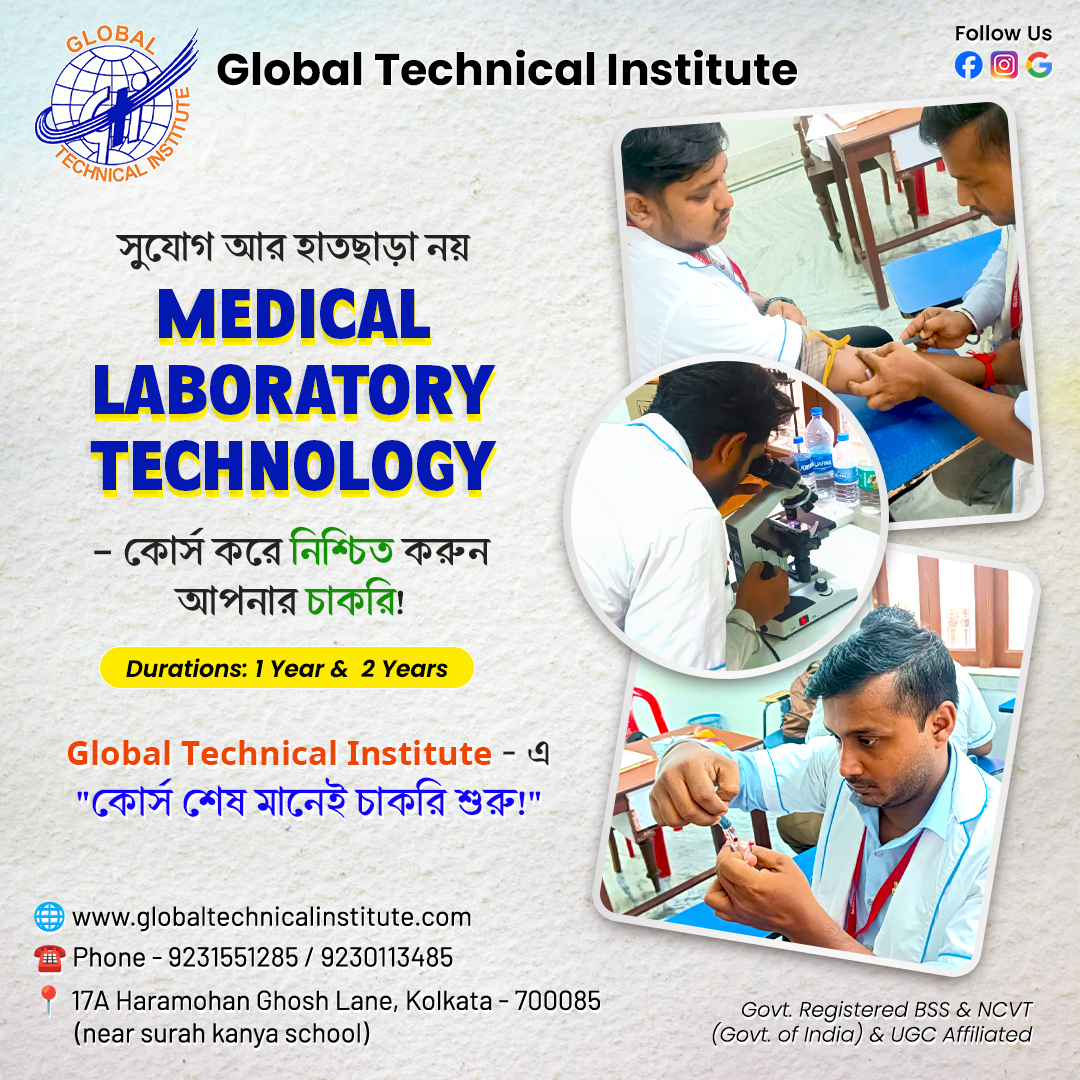
Choosing the right healthcare career is an important decision. If you are interested in medical science, laboratory work and patient care, a career as a medical lab technician may be a good option. Medical laboratories play an important role in modern healthcare. Doctors depend on laboratory reports to understand a patient’s health condition, identify diseases and plan treatment.
A medical lab technician works behind the scenes to support this process. The technician helps collect, handle, prepare and test patient samples such as blood, urine and other body fluids. The work requires scientific knowledge, practical skills, attention to detail and a strong understanding of laboratory safety.
If you are searching for a Lab Technician Training Institute in Kolkata, you should understand more than just the course name. You should know which types of courses are available, what qualifications are required, how long the training takes, what subjects you will study, how much practical experience you will receive and what career opportunities may be available after completion.
At Global Technical Institute, we believe that students should understand these details before taking admission. In this guide, we explain the important information about lab technician training in simple language. We also explain the difference between a short-term training course and a formally recognised Medical Laboratory Technology qualification.
1. What Is a Medical Lab Technician Course?
A Medical Lab Technician course is a healthcare training programme that teaches students how to work in a medical diagnostic laboratory. The course introduces students to laboratory science, sample handling, testing methods, equipment, safety rules and reporting procedures.
Medical laboratories examine different types of samples to help doctors understand a patient’s health. These samples may include:
- Blood
- Urine
- Stool
- Sputum
- Tissue samples
- Swab samples
- Cerebrospinal fluid and other body fluids
A trained laboratory professional follows approved procedures to process samples and perform assigned tests. The results are recorded and passed through the laboratory’s reporting system for review and authorisation by the appropriate qualified professional.
A course in Medical Laboratory Technology may include both classroom learning and practical training. Students learn the scientific principles behind laboratory tests and how to follow standard procedures while working with samples and equipment.
The exact course content depends on the programme, awarding body and qualification level. A short certificate course should not automatically be treated as equal to a recognised Diploma in Medical Laboratory Technology (DMLT) or a bachelor’s degree.
2. Why Is Medical Laboratory Technology Important in Healthcare?
Medical laboratory services support doctors, hospitals, clinics and diagnostic centres. Many medical decisions depend on laboratory investigations. A laboratory report can help a doctor assess a patient’s condition, monitor treatment and identify changes in health.
For example:
- A blood test can help assess haemoglobin levels and blood cell counts.
- A blood glucose test can help monitor blood sugar.
- A urine test can help identify signs of urinary tract problems.
- A liver function test can help assess liver health.
- A kidney function test can help assess kidney performance.
- A microbiology test can help identify certain bacteria or other microorganisms.
- A blood grouping test can support safe blood transfusion procedures.
Medical laboratory professionals contribute to these services by following correct sample collection, processing, testing, quality-control and reporting procedures.
The Ministry of Health and Family Welfare’s model curriculum describes medical laboratory science as a discipline covering areas such as clinical biochemistry, haematology, microbiology, histopathology and laboratory operations. It also highlights the importance of practical competence and accurate laboratory work.
3. What Does a Medical Lab Technician Do?
A medical lab technician performs technical duties under the supervision and professional responsibilities defined by the laboratory and applicable regulations. The exact responsibilities depend on the technician’s qualification, training, experience and workplace.
Common duties may include:
3.1 Sample Collection and Receiving
The technician may assist with receiving or collecting patient samples according to the laboratory’s approved procedure. The sample must be correctly identified and labelled.
Wrong patient identification or incorrect labelling can create serious errors. Therefore, students must learn how to follow identification and documentation procedures.
3.2 Sample Preparation
Different tests require different sample preparation methods. A technician may need to separate serum or plasma, prepare slides, dilute samples or arrange specimens for testing.
The correct method depends on the test and the laboratory’s standard operating procedure.
3.3 Performing Laboratory Tests
A trained technician may perform assigned routine tests in areas such as haematology, clinical biochemistry and microbiology. The work must follow the approved testing method and quality requirements.
3.4 Operating Laboratory Equipment
Medical laboratories use different types of equipment. Depending on the workplace, a technician may work with:
- Microscope
- Centrifuge
- Haematology analyser
- Biochemistry analyser
- Incubator
- Autoclave
- Micropipette
- Laboratory refrigerator
- Spectrophotometer
- Blood cell counting equipment
Students should receive proper training before operating any equipment independently.
3.5 Maintaining Laboratory Records
Laboratory work requires accurate documentation. A technician may record sample details, test information, equipment maintenance details, quality-control results and other required records.
3.6 Following Safety Rules
Laboratory staff may come into contact with blood, body fluids, chemicals and potentially infectious materials. They must follow safety procedures, use appropriate protective equipment and handle biomedical waste according to applicable rules.
3.7 Supporting Quality Control
Quality control helps a laboratory check whether its testing process is working correctly. Technicians may assist with control samples, equipment checks, documentation and reporting problems to the responsible supervisor.
A medical lab technician does not independently diagnose a patient or prescribe treatment. The role is to perform assigned laboratory duties and support accurate diagnostic services.
4. Types of Lab Technician Courses in Kolkata
Students may find different types of laboratory training programmes in Kolkata. The course name alone does not tell you whether a qualification is formally recognised. Always check the awarding body, approval and scope of the programme.
4.1 Certificate Course in Lab Technician Training
A certificate course is generally a short-term programme. It may introduce students to basic laboratory procedures, sample handling, equipment and safety.
It may be suitable for students who want introductory knowledge or specific entry-level skills. However, a certificate course may not provide the same academic depth, clinical training or professional recognition as a formal diploma or degree.
Before taking admission, students should ask:
- Who issues the certificate?
- Is the course approved for the intended job role?
- What practical training is included?
- Does the programme include supervised clinical exposure?
- Which employers accept the qualification?
- Does it meet the current professional registration requirements, if applicable?
4.2 Diploma in Medical Laboratory Technology (DMLT)
DMLT is a structured diploma-level qualification in medical laboratory technology. It generally covers the main areas of diagnostic laboratory work.
The State Medical Faculty of West Bengal lists its Diploma in Medical Laboratory Technology covering Pathology, Microbiology and Biochemistry. Its published course duration is two years, followed by six months of compulsory post-examination training.
The current national competency-based DMLT curriculum released by the National Commission for Allied and Healthcare Professions (NCAHP) is also designed as a two-year programme. It emphasises knowledge, practical skills, patient safety and laboratory quality.
Students should confirm that the institution and the specific programme are approved or recognised for the qualification they intend to pursue.
4.3 Bachelor in Medical Laboratory Science (BMLS) or Related Degree
A bachelor’s degree provides a broader and more detailed education in medical laboratory science. It may include advanced laboratory subjects, practical work, clinical exposure and research-related learning.
The exact duration, admission requirements and degree title depend on the applicable university and regulatory framework. Students planning a degree should check the current course structure and recognition status directly with the university or authorised admission body.
4.4 Specialised Laboratory Skill Courses
Some institutions offer training in specific laboratory skills or departments. Examples may include:
- Phlebotomy and blood sample collection
- Clinical biochemistry
- Haematology
- Microbiology
- Histopathology
- Blood bank procedures
- Laboratory equipment handling
- Laboratory quality control
These courses may help students develop additional skills. However, a specialised short course does not automatically replace the main qualification required for a regulated professional role.
5. Difference Between Certificate, Diploma and Degree Courses
Students should understand the difference before selecting a course.
| Course type | General purpose | Important point |
| Certificate course | Basic or specific laboratory skills | Recognition and job eligibility depend on the issuing body and course approval |
| Diploma in Medical Laboratory Technology | Structured education in laboratory technology | Check the awarding body, approval, duration and practical training |
| Bachelor’s degree in Medical Laboratory Science | Broader academic and professional education | Check the university, current curriculum and applicable recognition requirements |
| Specialised skill course | Training in a particular laboratory activity | Usually supplements rather than replaces a main qualification |
Important: Course duration or the word “diploma” does not prove that a qualification is government-recognised. Students must verify the exact qualification and its awarding authority.
6. Eligibility for Lab Technician Training in Kolkata
Eligibility depends on the course and the institution offering it. A short-term certificate course may have different entry requirements from a recognised DMLT or bachelor’s programme.
For a formal DMLT programme under the current national competency-based curriculum, the stated entry route is Class 12 in the Science stream with Physics, Chemistry and Biology from a recognised board.
The Ministry of Health and Family Welfare’s model curriculum also describes 10+2 with Biology or a relevant vocational course as an entry requirement and mentions a minimum aggregate percentage in that model. However, students should follow the current admission notice of the relevant authority rather than relying on an older general curriculum document.
6.1 Educational Qualification
For a recognised DMLT programme, students should check whether they need:
- Higher Secondary or Class 12 qualification
- Science stream
- Physics, Chemistry and Biology
- A recognised education board
- A minimum percentage of marks, if prescribed
The exact requirements must be checked in the current admission notification.
6.2 Eligibility at Global Technical Institute
Global Technical Institute’s published Medical Lab Technician Training page states that applicants must have passed the Higher Secondary examination.
The page lists both one-year and two-year training options. It does not clearly state all subject-specific requirements or a minimum percentage. Students should contact the institute to confirm which academic stream and marks are accepted for the particular programme they wish to join.
Please do not assume that the entry requirements for a private training course are the same as those for a formal DMLT programme.
6.3 Is Biology Necessary?
Biology is an important subject for medical laboratory science because students learn about the human body, blood, microorganisms, tissues and disease-related investigations.
For the current NCAHP competency-based DMLT route, Class 12 Science with Physics, Chemistry and Biology is specified. Other private or skill-based programmes may publish different requirements, so students should check the exact course before applying.
6.4 Can Students from Other Streams Apply?
This depends on the course. A student from a non-science background should not assume that they are eligible for every medical laboratory programme.
Ask the institution for written confirmation of eligibility and check whether the qualification is accepted for the intended career path.
7. Lab Technician Course Duration
Course duration varies according to the type of programme and awarding body.
| Programme | Duration |
| Short-term certificate course | Depends on the institution and course |
| GTI one-year Medical Lab Technician programme | 1 year, as published by GTI |
| GTI two-year Medical Lab Technician programme | 2 years, as published by GTI |
| State Medical Faculty of West Bengal DMLT | 2 years + 6 months compulsory post-examination training |
| NCAHP competency-based DMLT | 2 years |
| Bachelor’s degree in Medical Laboratory Science | Depends on the current university and regulatory framework |
Global Technical Institute lists one-year and two-year programmes on its course page. The State Medical Faculty of West Bengal publishes a different formal DMLT structure of two years plus six months of compulsory post-examination training.
These programmes should not be treated as equivalent without checking their approval and awarding arrangements.
8. Subjects Covered in a Medical Lab Technician Course
The syllabus depends on the course level and the applicable curriculum. A structured medical laboratory programme may include the following subjects.
8.1 Human Anatomy and Physiology
Students learn about the structure and functions of the human body.
Topics may include:
- Cells and tissues
- Blood and blood circulation
- Respiratory system
- Digestive system
- Urinary system
- Nervous system
- Endocrine system
- Basic human organ functions
This subject helps students understand why different laboratory tests are required.
8.2 Basic Pathology
Pathology introduces students to disease-related changes in the body. Students learn basic concepts about cells, tissues, inflammation and common pathological conditions.
8.3 Haematology
Haematology is the study of blood and blood-related disorders.
Topics may include:
- Blood composition
- Red blood cells
- White blood cells
- Platelets
- Haemoglobin
- Complete blood count
- Blood smear preparation
- Basic coagulation tests
- Anaemia-related investigations
Students learn why correct sample handling and accurate testing are important.
8.4 Clinical Biochemistry
Clinical biochemistry deals with the chemical analysis of blood and other body fluids.
Common topics include:
- Blood glucose
- Liver function tests
- Kidney function tests
- Cholesterol and lipid profile
- Enzymes
- Electrolytes
- Protein estimation
- Reagent preparation
- Basic laboratory calculations
These investigations help doctors assess different aspects of a patient’s health.
8.5 Medical Microbiology
Microbiology focuses on microorganisms such as bacteria, fungi and other infectious agents.
Students may learn about:
- Basic microbiology
- Microbial structure
- Sterilisation and disinfection
- Culture methods
- Staining techniques
- Specimen handling
- Infection prevention
- Laboratory safety
8.6 Histopathology and Cytopathology
These subjects introduce students to the examination of tissue and cell samples.
Topics may include:
- Tissue processing
- Fixation
- Section preparation
- Staining
- Slide preparation
- Basic microscopic examination
The exact responsibilities of a technician depend on their training and the laboratory’s approved procedures.
8.7 Immunology and Serology
Students learn basic concepts about the immune system and tests used to detect certain antibodies, antigens or immune responses.
8.8 Clinical Laboratory Management
A good programme should also introduce students to:
- Laboratory documentation
- Sample identification
- Quality control
- Equipment maintenance
- Inventory management
- Biomedical waste management
- Laboratory ethics
- Patient confidentiality
The Ministry of Health and Family Welfare’s model curriculum includes subjects such as anatomy and physiology, microbiology, haematology, clinical biochemistry and their practical components. The current NCAHP DMLT curriculum places additional emphasis on competency-based learning and quality practices.
9. Practical Training in a Lab Technician Course
Practical training is one of the most important parts of medical laboratory education. Students need to understand how laboratory procedures are performed, not just memorise their theory.
A useful practical programme should provide supervised opportunities to learn the following activities.
9.1 Microscope Handling
Students learn the parts of a microscope, focusing methods, slide handling and basic microscopic observation.
9.2 Blood Sample Handling
Students learn the importance of patient identification, sample labelling, correct containers, sample transport and safe handling.
9.3 Centrifuge Operation
Students learn the purpose of centrifugation, basic equipment handling and the need to follow the correct speed and time specified for a procedure.
9.4 Haematology Practical
Practical learning may include blood smear preparation, staining, basic blood cell observation and working with haematology equipment under supervision.
9.5 Biochemistry Practical
Students may learn how routine biochemical investigations are performed using laboratory methods and analysers.
9.6 Microbiology Practical
Students may be introduced to staining, culture-related procedures, sterilisation, disinfection and safe handling of laboratory materials.
9.7 Laboratory Safety
Students should learn to use gloves, laboratory coats and other protective equipment. They should understand spill management, sharps safety, waste segregation and exposure reporting.
9.8 Documentation and Reporting
Students learn how to maintain records, enter test information and follow the laboratory’s reporting process.
What students should ask before admission: How many practical hours are included? Which equipment is available? Are practical sessions conducted regularly? Is there supervised clinical training? Will students receive a logbook or practical assessment record?
A course that provides only classroom theory may not give students enough practical preparation for laboratory work.
10. Admission Process for Lab Technician Training in Kolkata
The admission process varies between institutions and awarding bodies. The following is a general guide.
Step 1: Select the Correct Course
First, decide whether you want a certificate course, a formal DMLT qualification or a bachelor’s degree.
Think about your educational background and your long-term career plans.
Step 2: Check Eligibility
Read the current admission requirements. Confirm the accepted subjects, minimum marks and any age or entrance examination conditions.
Step 3: Verify the Institute and Awarding Body
Ask who will issue the final certificate or diploma. If the programme is advertised as a recognised DMLT, ask for the exact affiliation or approval details for that course and academic session.
Step 4: Understand the Course Structure
Ask for the syllabus, duration, class schedule, practical hours, examination method and training arrangements.
Step 5: Submit the Application
Complete the admission form and submit the required documents.
Step 6: Confirm the Fees
Ask for a written fee structure. Confirm the total amount, payment schedule, examination charges and any additional costs.
Step 7: Collect Admission Confirmation
After completing the admission process, collect the receipt, enrolment details, course information and written terms.
11. Documents Required for Admission
The documents required depend on the institute and course. Common documents may include:
- Recent passport-size photographs
- Class 10 marksheet
- Class 10 admit card or age proof, where required
- Class 12 marksheet
- Class 12 certificate
- Valid photo identity proof
- Address proof, if required
- Caste or category certificate, where applicable
- Transfer or migration certificate, if required
- Other documents mentioned in the admission notice
Documents Listed by Global Technical Institute
Global Technical Institute’s published course page lists the following documents:
- Six passport-size photographs
- Attested copies of the last passed marksheet
- Madhyamik admit card
- Any valid photo identity proof
Students should confirm the final document checklist with the admission office before visiting or submitting an application.
12. Lab Technician Course Fees in Kolkata
Course fees are an important factor when choosing a training institute. However, there is no single fixed fee for every lab technician course in Kolkata.
The total cost may depend on:
- Type of qualification
- Course duration
- Awarding body
- Practical laboratory facilities
- Clinical or hospital training
- Examination charges
- Registration or enrolment charges
- Study materials
- Laboratory consumables
- Internship arrangements
- Certificate or diploma issuance charges
12.1 What Is the Fee at Global Technical Institute?
Global Technical Institute’s published Lab Technician Training page does not display a confirmed course fee. Therefore, students should contact the institute directly for the latest fee quotation for the one-year or two-year programme.
We recommend asking for a written breakdown before paying any amount.
12.2 What Should Be Included in the Fee?
Before admission, ask whether the quoted fee includes:
- Admission fee
- Tuition fee
- Practical training fee
- Examination fee
- Study materials
- Laboratory consumables
- Certificate or diploma fee
- Internship or clinical training charges
- Any other compulsory charges
12.3 Is There an Instalment Option?
Some institutions may offer instalment-based payment. Students should ask whether instalments are available, what the due dates are and whether any additional charges apply.
12.4 Ask About Refund Rules
Before making payment, read the refund and cancellation policy. Keep the payment receipt and a copy of the written fee structure.
Our advice: Do not choose a course only because it has a low fee. Compare the qualification, practical training, recognition, faculty, equipment and total course cost.
13. Career Opportunities After Lab Technician Training
After completing an appropriate qualification and meeting the employer’s requirements, students may explore different roles in the healthcare and diagnostic sector.
The available job title and permitted duties depend on the qualification, employer and applicable professional requirements.
13.1 Medical Lab Technician
A medical lab technician may perform assigned laboratory tests, prepare samples, operate equipment and maintain records under the required supervision.
13.2 Laboratory Assistant
A laboratory assistant may support sample receiving, labelling, preparation, equipment cleaning and other routine laboratory activities.
13.3 Phlebotomy Technician
A phlebotomy technician focuses on blood sample collection. This role requires training in patient identification, sample collection, infection prevention and safe handling.
13.4 Haematology Laboratory Assistant
This role may involve supporting blood-related investigations, sample preparation and routine laboratory procedures.
13.5 Biochemistry Laboratory Assistant
This role may involve supporting biochemical tests, preparing samples and handling assigned equipment.
13.6 Microbiology Laboratory Assistant
A microbiology laboratory assistant may support specimen preparation, staining, culture-related work and laboratory safety procedures, according to the employer’s requirements.
13.7 Blood Bank Support Roles
Some trained professionals may work in blood bank support roles if they meet the required qualification and workplace criteria. Blood banking has specific safety and procedural requirements.
13.8 Research Laboratory Assistant
Research laboratories may employ trained assistants to support sample preparation, documentation, equipment handling and routine laboratory work.
14. Where Can a Qualified Lab Technician Work?
Depending on the qualification and employer requirements, opportunities may be available in:
- Government hospitals
- Private hospitals
- Diagnostic centres
- Pathology laboratories
- Medical colleges
- Nursing homes
- Blood banks
- Public health laboratories
- Research laboratories
- Clinical research organisations
- Specialised testing laboratories
Some roles require a recognised diploma or degree, practical experience or professional registration. A short-term certificate may not meet the requirements for every position.
Students should check job advertisements and employer eligibility criteria before selecting a course.
15. Lab Technician Salary in Kolkata
Salary is one of the common questions students ask before choosing a course. However, there is no fixed salary for every medical lab technician.
Pay depends on several factors:
- Educational qualification
- Recognition of the qualification
- Practical skills
- Work experience
- Type of laboratory
- Employer
- Job responsibilities
- Working hours and shifts
- Location
- Additional technical skills
A fresher may begin in an entry-level position. With experience, a suitable qualification and additional skills, a professional may become eligible for more responsible roles.
Current job listings in Kolkata show that advertised pay can vary considerably by employer and experience. For example, some listings show entry-level or experienced technician roles at different monthly pay levels. These are individual job advertisements, not a guaranteed salary range for every graduate.
Before making a career decision, students should compare current job advertisements and check the qualification and experience required for each position.
Important: No training institute should guarantee a particular salary simply because a student completes a course.
16. Skills Required to Become a Good Lab Technician
A successful laboratory professional needs both technical and personal skills.
16.1 Attention to Detail
A small mistake in sample identification, measurement or documentation can affect a test result. Students must develop careful working habits.
16.2 Scientific Knowledge
A technician should understand the basic principles behind laboratory tests and the purpose of different procedures.
16.3 Equipment Handling
Students should learn how to operate, clean and maintain laboratory equipment according to the manufacturer’s instructions and laboratory procedures.
16.4 Communication Skills
Laboratory professionals communicate with colleagues, supervisors, doctors and other healthcare staff. Clear communication helps prevent mistakes.
16.5 Time Management
Some samples need to be processed within a specific time. Technicians must manage their assigned work carefully.
16.6 Safety Awareness
Students must follow infection prevention, protective equipment, waste disposal and chemical safety procedures.
16.7 Computer Skills
Modern laboratories use computers and laboratory information systems. Basic computer knowledge is useful for data entry, documentation and reporting.
17. How to Choose the Best Lab Technician Training Institute in Kolkata
Choosing an institute is one of the most important steps in your career journey. Do not select a training centre only because its advertisement uses words such as “best”, “top” or “government approved”.
Check the following points before admission.
17.1 Verify the Awarding Body
Ask who issues the final qualification. Confirm whether the course is affiliated with the relevant authority for the exact programme and academic session.
17.2 Check Recognition and Approval
If an institute advertises a DMLT qualification, ask for the approval or affiliation documents. Check the institution’s name, course name, duration, intake and validity.
A private certificate, vocational affiliation or ISO certification should not automatically be treated as equivalent to a recognised DMLT qualification.
17.3 Review the Syllabus
Ask for the full syllabus. It should explain the theory subjects, practical components, assessment method and training requirements.
17.4 Check Practical Facilities
Visit the laboratory if possible. Ask which equipment students can use and how practical sessions are conducted.
17.5 Ask About Clinical Training
Find out whether the course includes hospital or diagnostic laboratory exposure. Ask where the training takes place, how long it lasts and whether it is supervised.
17.6 Understand the Faculty’s Experience
Ask about the academic and professional background of the teachers. Medical laboratory subjects should be taught by suitably qualified professionals.
17.7 Ask About Examination and Certification
Understand who conducts the examinations and who issues the final certificate or diploma.
17.8 Check Placement Support Carefully
If the institute offers placement assistance, ask what support is provided. Ask whether it includes interview preparation, job referrals or actual recruitment opportunities.
Placement assistance is not the same as a guaranteed job.
17.9 Compare the Total Fee
Compare the full course fee, examination charges, practical costs and any additional payment.
17.10 Read the Admission Terms
Read the attendance rules, refund policy, examination rules and certificate conditions before paying.
18. Why Consider Global Technical Institute for Lab Technician Training in Kolkata?
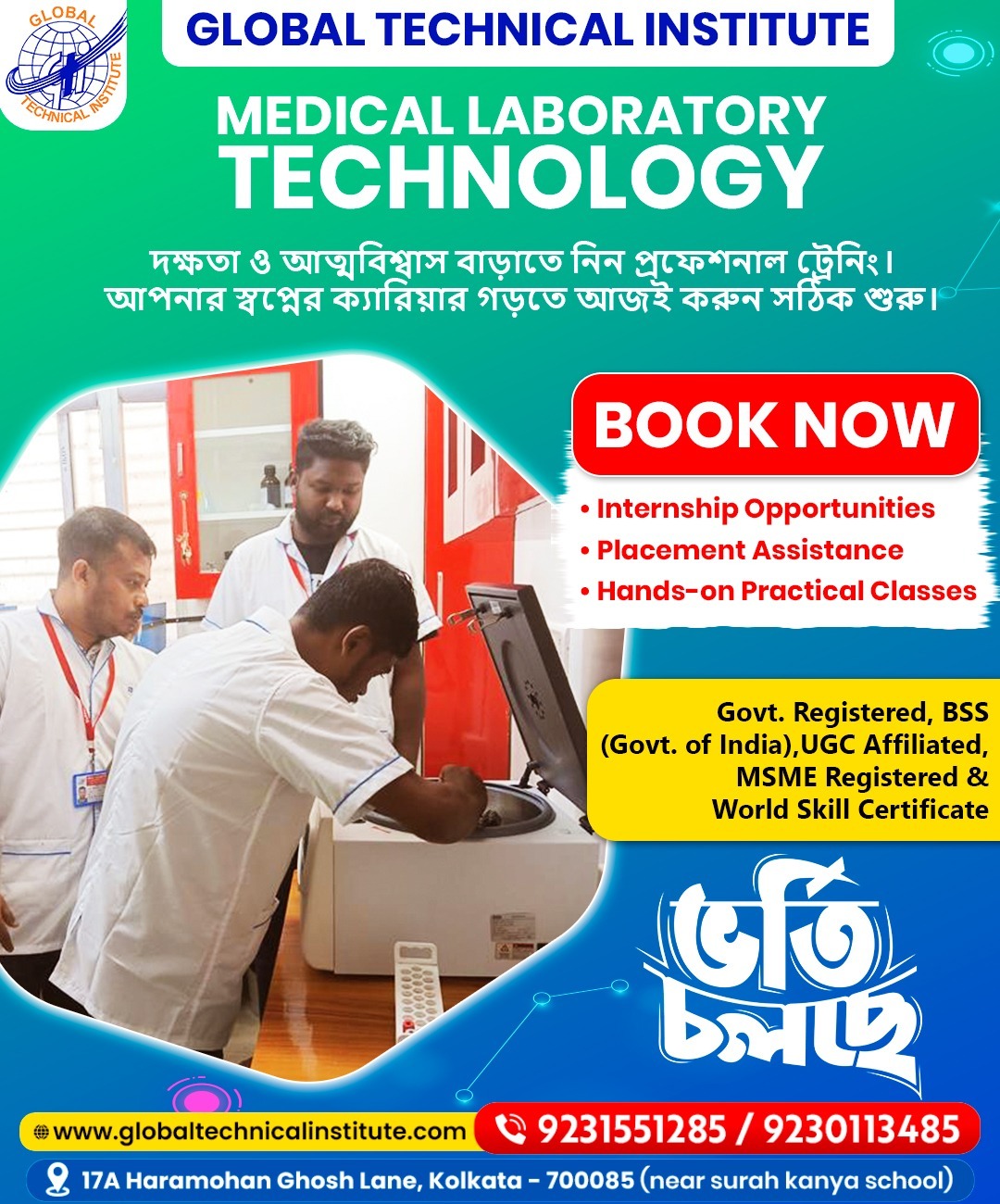
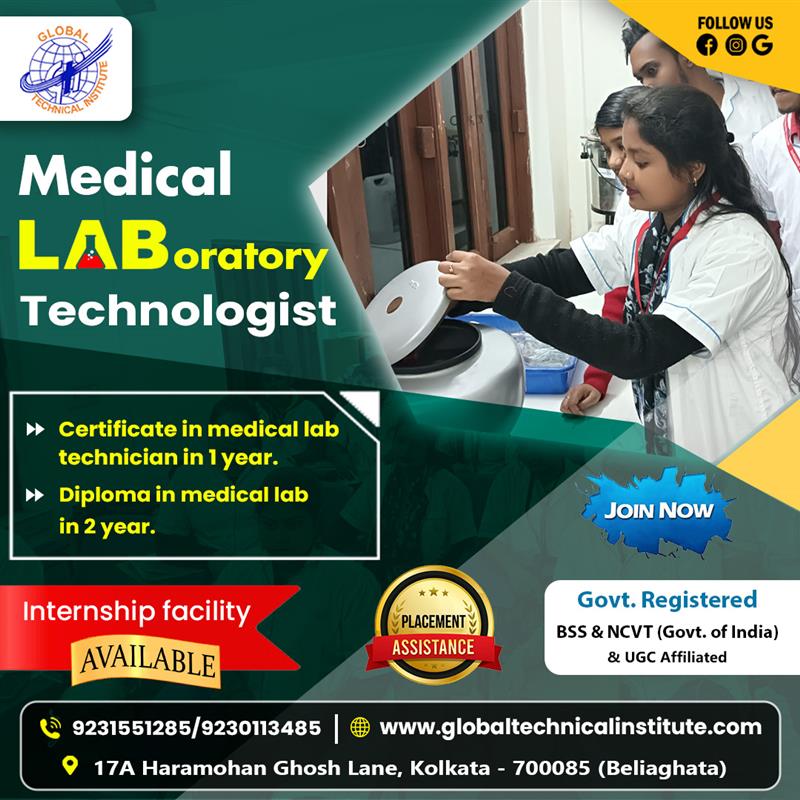
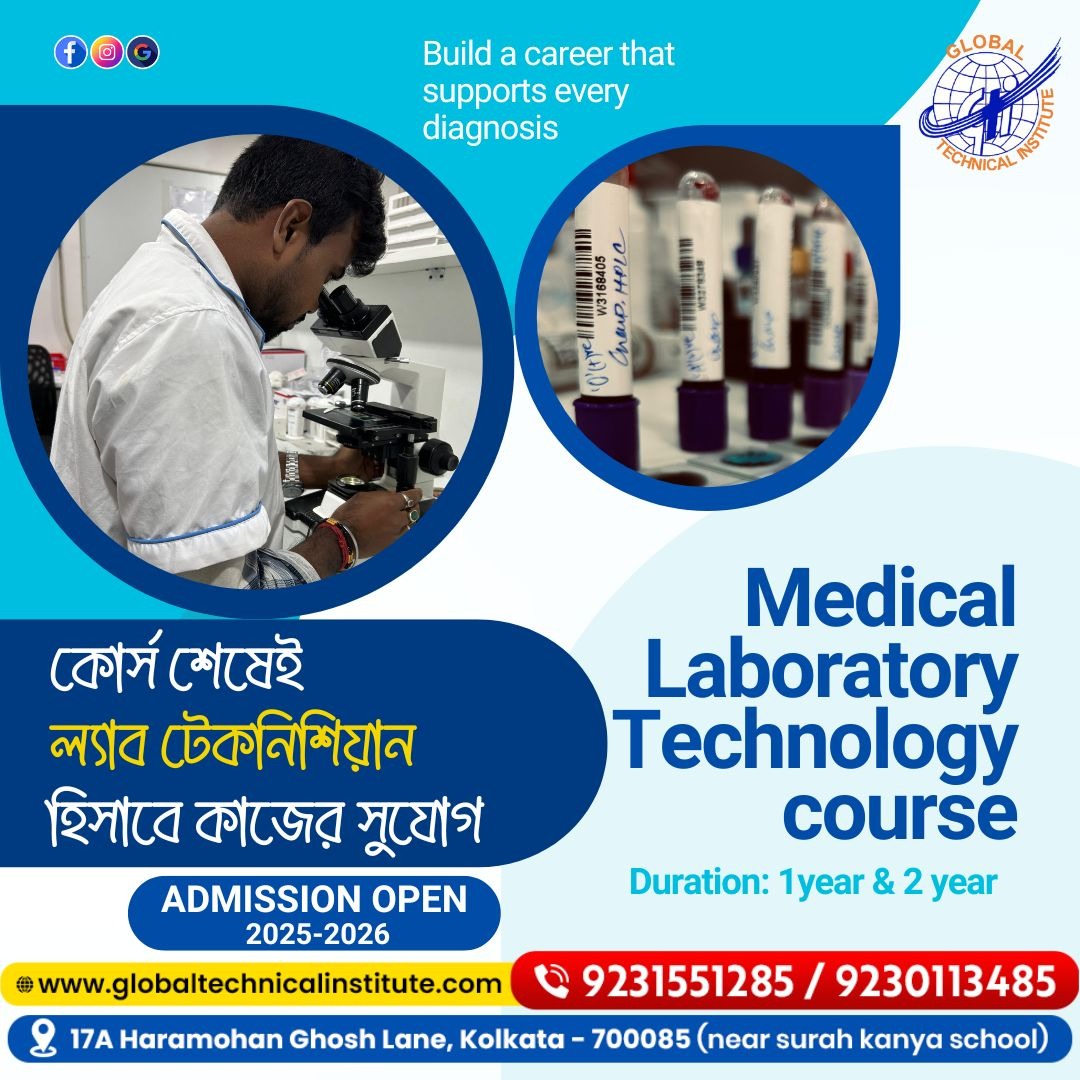
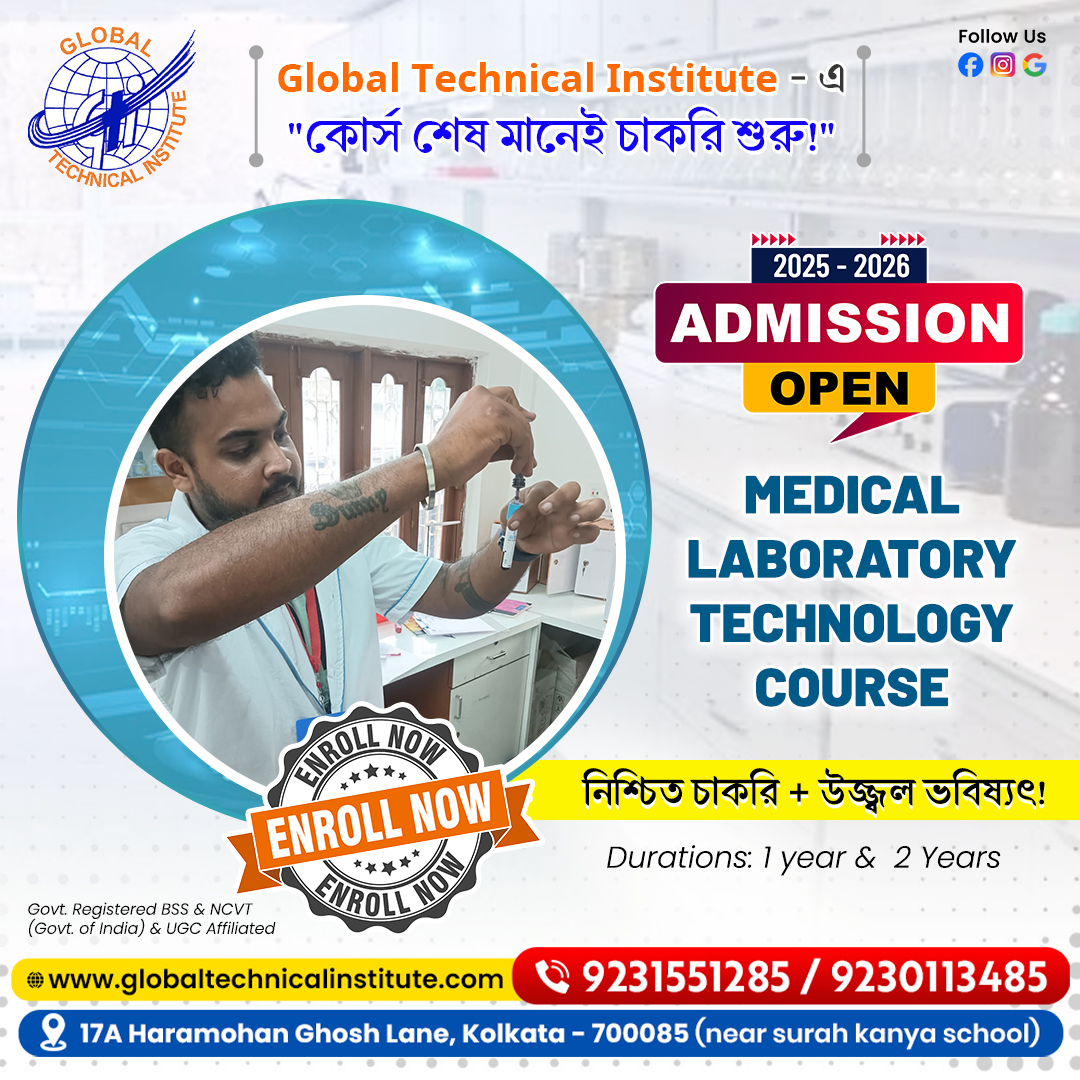
Global Technical Institute offers Medical Lab Technician Training in Kolkata for students interested in developing laboratory-related skills and knowledge.
According to the institute’s published course page, the programme is listed under the name Medical Lab Technician Training and the certificate is described as a Diploma in Medical Lab Technician.
The page currently publishes the following information:
| Course detail | Information published by GTI |
| Course name | Medical Lab Technician Training |
| Programme duration | 1 year and 2 years |
| Classes | 2 classes per week |
| Admission sessions | January, May and September |
| Minimum qualification | Higher Secondary pass |
| Special module | Personality development and grooming |
| Documents | Six photographs, last marksheet, Madhyamik admit card and photo ID |
18.1 Two Course Duration Options
GTI lists one-year and two-year training options. Students should contact the institute to understand the syllabus, practical hours, examination method and certificate details for each option.
18.2 Regular Class Schedule
The course page states that students attend two classes per week. Students should confirm the current timetable, class duration and practical schedule before admission.
18.3 Personality Development and Grooming
The institute lists personality development and grooming as a special skill-development module. Communication and professional behaviour can be useful in a healthcare workplace.
18.4 Admission Sessions
The published admission sessions are January, May and September. Students should contact the institute to confirm the next available batch and seat availability.
18.5 Affiliation and Certificate Verification
GTI’s page mentions BSS, ISO certification and an NSDC affiliated-partner relationship. Students should request the relevant documents and verify what each claim covers.
These details should be checked carefully. ISO certification relates to a management system; it does not by itself establish academic recognition of a medical qualification. Similarly, a vocational affiliation or skill-development partnership should not automatically be treated as approval to award a State Medical Faculty DMLT qualification or another regulated professional qualification.
The institute’s one-year and two-year course options should therefore be evaluated according to their actual awarding body, recognition, syllabus and practical training arrangements.
18.6 Contact Global Technical Institute
Students who want to know more about the programme can contact the institute directly.
Name: Global Technical Institute | Lab Technician Training Institute in Kolkata
Address: 25, Hara Mohan Ghosh Ln, Phool Bagan, Beleghata, Kolkata, West Bengal 700085
Phone Number: 9230113485
Map:
We recommend that students visit the institute, discuss their career goals and collect the latest course and fee details before taking admission.
19. Is a Lab Technician Course the Same as DMLT?
No. The terms are sometimes used together in advertisements, but they do not always refer to the same qualification.
“Lab technician training” is a broad description. It may refer to a certificate course, a private training programme, a vocational course or a formal diploma.
DMLT is a specific diploma qualification. The State Medical Faculty of West Bengal publishes its DMLT course with a two-year duration and six months of compulsory post-examination training.
The NCAHP’s 2026 competency-based DMLT curriculum also sets out a two-year programme. The exact recognition and eligibility requirements must be checked for the relevant admission route.
Before joining a course, ask:
- Is the course formally called DMLT?
- Which authority awards the diploma?
- Is the institution approved for this exact course?
- Does the programme follow the applicable curriculum?
- What is the official course duration?
- Are practical and clinical training included?
- Does the qualification meet the current professional requirements for the job I want?
These questions can help students avoid confusion between a private training certificate and a formally recognised qualification.
20. Future Scope of Medical Laboratory Technology
Medical laboratory technology continues to be an important part of healthcare. Hospitals, diagnostic centres and specialised laboratories need trained staff to support laboratory operations.
Technology is also changing the way laboratories work. Many laboratories use automated analysers, digital records and laboratory information systems.
Future learning may involve:
- Automated laboratory equipment
- Digital laboratory records
- Quality assurance
- Advanced sample processing
- Molecular diagnostic methods
- Laboratory information systems
- Infection prevention
- Specialised testing procedures
However, technology does not remove the need for trained professionals. Staff must understand testing principles, follow procedures, identify errors and maintain quality.
Students who want to grow in this field should continue learning after completing their initial qualification. Higher education, recognised additional training and practical experience may help them develop their careers.
21. Frequently Asked Questions About Lab Technician Training in Kolkata
Q1. What is the best Lab Technician Training Institute in Kolkata?
The best institute depends on the student’s career goal, qualification requirement, practical training needs and budget. Students should check the awarding body, recognition, syllabus, practical facilities and faculty before admission. Global Technical Institute offers Medical Lab Technician Training in Kolkata and publishes one-year and two-year course options.
Q2. What is the eligibility for a lab technician course in Kolkata?
Eligibility depends on the course. The current NCAHP competency-based DMLT route specifies Class 12 Science with Physics, Chemistry and Biology. Some private training programmes may publish different requirements. Always check the exact admission criteria.
Q3. Can I join a lab technician course after Class 10?
Some basic or skill-based courses may have different entry requirements. However, students should not assume that a short certificate is equivalent to a recognised DMLT qualification. Check the entry criteria of the specific course and the qualification it awards.
Q4. Can I join DMLT after Class 12?
The current NCAHP competency-based DMLT curriculum specifies Class 12 in the Science stream with Physics, Chemistry and Biology from a recognised board. Students should check the current admission notification of the relevant authority.
Q5. Is Biology compulsory for DMLT?
For the current NCAHP competency-based DMLT entry route, Biology is specified along with Physics and Chemistry. Check the applicable admission rules before applying.
Q6. What is the duration of a DMLT course?
The State Medical Faculty of West Bengal publishes a two-year DMLT course followed by six months of compulsory post-examination training. The current NCAHP competency-based DMLT programme is two years. Other private courses may have different durations and qualifications.
Q7. What is the duration of lab technician training at Global Technical Institute?
Global Technical Institute’s published course page lists one-year and two-year Medical Lab Technician Training options. Contact the institute to confirm the syllabus and certificate details for each option.
Q8. What subjects are taught in a medical lab technician course?
Common subjects include anatomy and physiology, pathology, haematology, clinical biochemistry, microbiology, immunology, histopathology, laboratory safety and laboratory management. The exact syllabus depends on the course.
Q9. Does a lab technician course include practical training?
A structured medical laboratory programme should include practical learning. Students should confirm the number of practical hours, equipment access, supervised training and clinical exposure before admission.
Q10. What is the difference between DMLT and a certificate course?
DMLT is a specific diploma qualification with defined academic and practical requirements. A certificate course may be shorter and may focus on basic or specific skills. The two should not be treated as equivalent unless the relevant authority confirms equivalence.
Q11. What is the fee for a lab technician course in Kolkata?
Fees vary according to the course, duration, awarding body and practical facilities. Global Technical Institute’s published page does not display a confirmed fee. Students should contact the institute for the latest written fee structure.
Q12. Can I pay the course fee in instalments?
Instalment facilities depend on the institution. Ask the admission office about payment schedules, due dates and any additional charges before admission.
Q13. What documents are required for admission?
Common documents include photographs, Class 10 and Class 12 marksheets, identity proof and other documents required by the institution. GTI’s published page lists six photographs, the last marksheet, Madhyamik admit card and photo ID.
Q14. What jobs can I get after lab technician training?
Depending on the qualification and employer requirements, possible roles include laboratory assistant, medical lab technician, phlebotomy technician and support roles in haematology, biochemistry or microbiology laboratories.
Q15. Can I work in a hospital after completing a lab technician course?
You may apply for suitable hospital roles if your qualification meets the employer’s requirements. Some positions require a recognised diploma or degree, practical experience or professional registration.
Q16. Can I work in a pathology laboratory?
Yes, qualified candidates may apply for suitable roles in pathology and diagnostic laboratories. The permitted duties depend on the qualification, training and employer’s requirements.
Q17. What is the salary of a lab technician in Kolkata?
Salary varies according to qualification, experience, employer and job responsibilities. Students should review current job advertisements and compare the requirements and offered pay. No course can guarantee a particular salary.
Q18. Is a lab technician responsible for diagnosing diseases?
A lab technician performs assigned laboratory procedures and supports diagnostic services. Medical diagnosis and treatment decisions are the responsibility of appropriately qualified healthcare professionals.
Q19. Is a lab technician course suitable for students interested in healthcare?
It may be suitable for students who enjoy science, laboratory work, careful procedures and healthcare support services. Students should understand the course requirements and daily work before applying.
Q20. What equipment should students learn to handle?
Depending on the syllabus, students may learn about microscopes, centrifuges, haematology analysers, biochemistry analysers, incubators, autoclaves, micropipettes and other laboratory equipment.
Q21. Is hospital training important?
Supervised clinical exposure helps students understand real laboratory workflows, sample handling, documentation and workplace safety. Students should ask whether the course includes clinical training and how it is organised.
Q22. What is the difference between a medical lab technician and a phlebotomist?
A phlebotomist mainly focuses on collecting blood samples. A medical lab technician may have broader training in sample processing, laboratory testing and equipment handling. Job responsibilities depend on the qualification and workplace.
Q23. Can I study further after DMLT?
Further study options depend on the qualification, institution and current admission rules. Students should check recognised progression routes into bachelor’s-level medical laboratory science programmes.
Q24. Is an ISO certificate enough to prove that a DMLT course is recognised?
No. ISO certification alone does not prove that a medical qualification is academically recognised. Students should check the awarding authority and course-specific approval.
Q25. Does NSDC affiliation automatically make a course equivalent to DMLT?
No. A skill-development partnership or affiliation should not automatically be treated as equivalent to a formally recognised DMLT qualification. Students should verify the exact qualification and awarding authority.
Q26. Does Global Technical Institute offer one-year and two-year courses?
Yes. Its published Medical Lab Technician Training page lists both one-year and two-year options. Students should contact the institute for the detailed course structure and certificate information.
Q27. When can I take admission at Global Technical Institute?
The GTI course page lists January, May and September admission sessions. Contact the institute to confirm the next batch and current seat availability.
Q28. How many classes are held each week at GTI?
The published course page states that students attend two classes per week. Confirm the current timetable and practical schedule with the institute.
Q29. What should I check before paying admission fees?
Check the full fee structure, awarding body, recognition, course duration, syllabus, practical hours, clinical training, examination method and refund policy. Collect written confirmation and a payment receipt.
Q30. How can I contact Global Technical Institute?
You can contact Global Technical Institute at 9231551285, 9230113485 or 8961008489. The institute is located at 17A, Haramohan Ghosh Lane, Beliaghata, Kolkata – 700085. You can also visit its website at https://globaltechnicalinstitute.com/lab-technician-training-institute.
22. Final Checklist Before Taking Admission
Before selecting a Lab Technician Training Institute in Kolkata, use this checklist:
- I have selected the correct course for my career goal.
- I have checked the eligibility requirements.
- I know the exact name of the qualification.
- I have verified the awarding body.
- I have checked course-specific recognition or approval.
- I have received the full syllabus.
- I understand the course duration.
- I know the number of practical hours.
- I have checked laboratory equipment and facilities.
- I understand the clinical training arrangements.
- I have received a written fee structure.
- I have checked examination and certificate charges.
- I have read the refund policy.
- I understand the career options available after the course.
Conclusion
Medical laboratory technology is an important part of modern healthcare. A trained laboratory professional supports doctors and healthcare teams by helping laboratories process samples, perform assigned tests and maintain accurate records.
If you are planning to join a Lab Technician Training Institute in Kolkata, take time to understand the course, eligibility, duration, syllabus, fees and practical training. Most importantly, check the awarding body and recognition of the exact qualification. A short-term training certificate and a formally recognised DMLT qualification may have different academic and professional value.
At Global Technical Institute, we encourage students to understand the course details before admission. Our published Medical Lab Technician Training programme includes one-year and two-year options, two classes per week, January, May and September sessions, and a personality development and grooming module.
For the latest course details, eligibility, fee structure and admission information, contact Global Technical Institute directly. Make an informed decision and choose a training path that matches your education and future career goals.