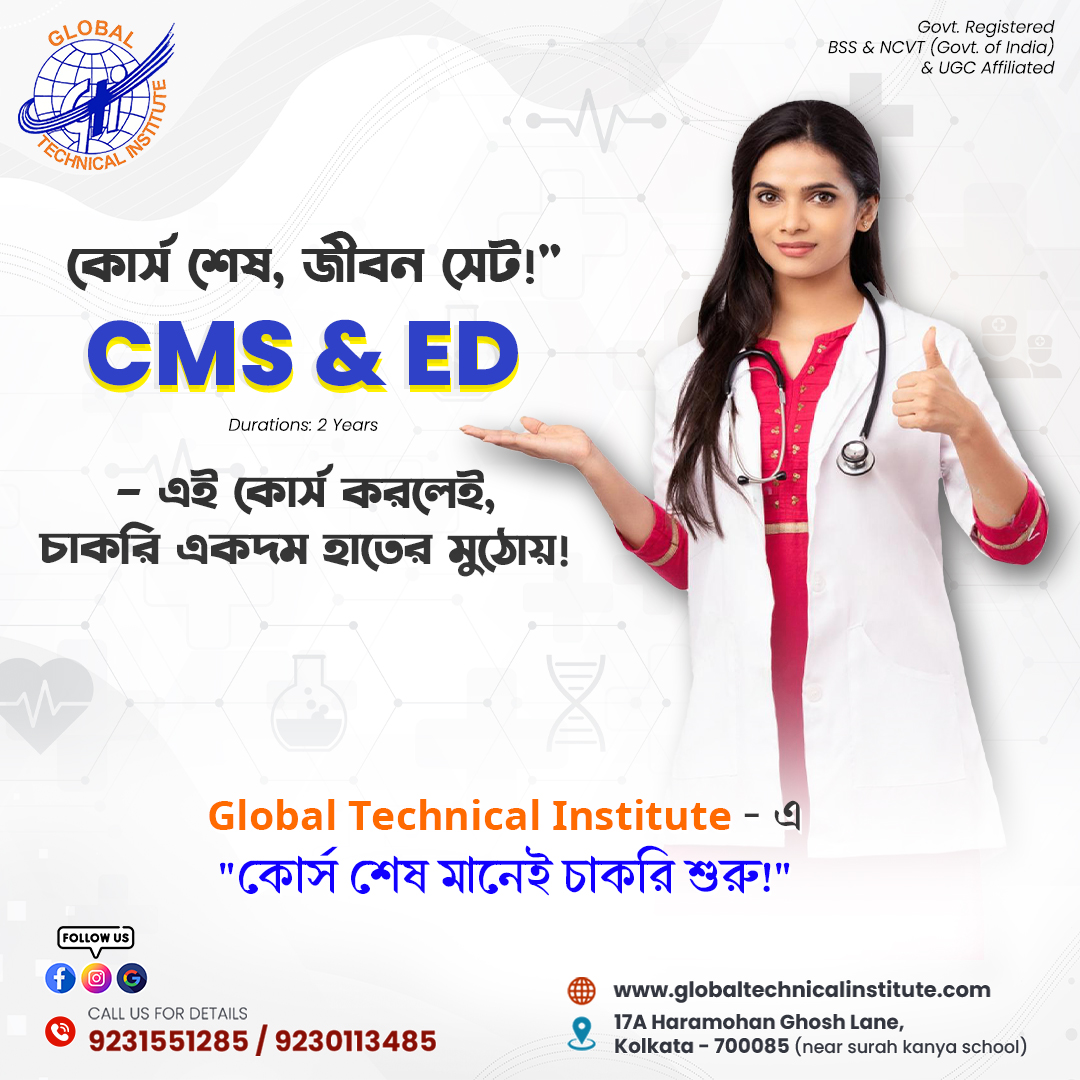
CMS & ED Training in Kolkata

Are you interested in the healthcare sector and looking for a CMS & ED training institute in Kolkata? Before choosing a course, it is important to understand what CMS & ED means, what you will learn, how long the course takes, what the fees may include and what career options are actually available after completion.
Healthcare education is a serious responsibility. Students need proper knowledge, practical understanding and clear information about the professional limits of their qualifications. A course certificate alone does not automatically give someone the right to work as a doctor, prescribe medicines or independently treat patients.
CMS & ED stands for Community Medical Services and Essential Drugs. The course title is used by different training providers and organisations. Its syllabus, duration, certificate, awarding body and professional scope may differ from one provider to another.
At Global Technical Institute (GTI), Kolkata, we provide information about our CMS & ED training programme so that interested students can understand the course structure and admission requirements before making a decision.
In this complete guide, we explain the important details, including course meaning, eligibility, duration, syllabus, learning areas, practical training, admission process, fees, certificates, career possibilities and frequently asked questions.
1. What Is CMS & ED?
CMS & ED stands for Community Medical Services and Essential Drugs.
It is a course title associated with community healthcare education and basic healthcare-related learning. Depending on the training provider, the programme may cover topics related to community health, health awareness, patient communication, basic first aid, hygiene, essential medicines and healthcare support.
The main idea behind community healthcare education is to improve people’s understanding of health and encourage appropriate access to qualified healthcare services.
For example, community healthcare education may help learners understand:
- Basic health and hygiene.
- Common health concerns.
- The importance of nutrition.
- Safe drinking water and sanitation.
- Basic first-aid awareness.
- Maternal and child health awareness.
- Prevention of communicable diseases.
- The importance of vaccination.
- When a person should seek medical attention.
- Why serious medical conditions need referral to qualified healthcare professionals.
The exact subjects and professional outcomes depend on the course curriculum and the organisation awarding the certificate.
Important: CMS & ED should not be confused with MBBS, ANM, GNM, a recognised nursing qualification or a recognised medical practitioner qualification. A private CMS & ED certificate does not automatically provide a licence to practise modern medicine.
2. What Is the Full Form of CMS & ED?
The full form of CMS & ED is:
CMS – Community Medical Services
ED – Essential Drugs
The course title combines two broad areas of learning.
Community Medical Services
Community healthcare focuses on health awareness, prevention, basic health education and access to appropriate healthcare services.
It includes understanding how health problems affect individuals, families and communities.
Essential Drugs
Essential medicines are medicines considered important for meeting the priority healthcare needs of a population.
Students may learn introductory concepts about medicines, their general uses, safe storage, labelling, medicine information and the importance of following qualified medical advice.
Knowledge of medicines does not give a student the legal authority to prescribe or dispense prescription medicines independently.
3. Why Is Community Healthcare Education Important?
Healthcare is not limited to hospitals and medical colleges. People also need health information and guidance in their homes, schools, workplaces and communities.
Community healthcare education helps people understand how to protect their health and when to seek professional medical support.
Some important areas include:
3.1 Health Awareness
People should understand basic health practices such as handwashing, personal hygiene, safe food preparation and clean surroundings.
3.2 Disease Prevention
Health education can help people understand how some diseases spread and how preventive steps can reduce risks.
Examples include:
- Hand hygiene.
- Safe drinking water.
- Proper sanitation.
- Vaccination awareness.
- Food safety.
- Mosquito-control awareness.
- Respiratory hygiene.
3.3 Maternal and Child Health Awareness
Community health education can introduce learners to important topics related to pregnancy, newborn care, child nutrition and the importance of regular medical check-ups.
These topics are educational. Clinical care and treatment must be provided by appropriately qualified professionals.
3.4 Nutrition Awareness
Nutrition plays an important role in general health.
Students may learn basic concepts about balanced diets, food groups, nutrition deficiencies and healthy eating habits.
3.5 Early Identification of Warning Signs
Community health education can help people understand when symptoms may require urgent medical attention.
Examples include:
- Difficulty breathing.
- Chest pain.
- Severe bleeding.
- Unconsciousness.
- Seizures.
- Severe dehydration.
- Sudden weakness or difficulty speaking.
- Serious injuries.
Recognising warning signs and arranging timely referral can be important. It does not mean that a learner is authorised to diagnose or treat these conditions.
4. Who Should Consider CMS & ED Training?
Students interested in healthcare education may explore CMS & ED to understand community health and related subjects.
It may be of interest to:
- Students who have completed Higher Secondary education.
- Learners interested in community health awareness.
- People interested in healthcare support activities.
- Individuals who want to understand basic first-aid concepts.
- Students exploring different healthcare education options.
- People interested in public-health awareness and community outreach.
However, students should first identify their actual career goal.
If your goal is to become a registered nurse, doctor, radiographer, pharmacist or other regulated healthcare professional, you should choose the qualification prescribed for that profession.
CMS & ED should not be selected as a substitute for a regulated professional qualification.
5. CMS & ED Course Options: Certificate and Diploma
Different institutes may offer different course formats under the CMS & ED name.
Students should understand the difference between a certificate and a diploma before admission.
5.1 Certificate in CMS & ED
A certificate programme generally provides a defined set of learning modules.
Depending on the provider, the subjects may introduce learners to:
- Community health awareness.
- Basic healthcare concepts.
- Hygiene and sanitation.
- First-aid awareness.
- Health communication.
- Introduction to essential medicines.
- Patient communication.
- Basic healthcare documentation.
The actual duration and syllabus must be confirmed with the awarding organisation.
A certificate is not automatically a recognised medical qualification.
5.2 Diploma in CMS & ED
A diploma programme may provide a longer and more structured course.
Depending on the curriculum, it may include classroom learning, assignments, practical demonstrations and assessments.
Students should ask for:
- The complete syllabus.
- The total course duration.
- The number of teaching hours.
- The practical-training schedule.
- The examination method.
- The name of the awarding organisation.
- The certificate format.
- The qualification’s recognised professional scope.
A course described as a diploma is not automatically equivalent to a government-approved medical or allied-health diploma.
5.3 Certificate vs Diploma: Key Differences
| Point | Certificate | Diploma |
| Learning structure | Usually a defined set of modules | Usually a longer structured programme |
| Duration | Depends on the provider | Depends on the provider |
| Assessment | Depends on the provider | Depends on the provider |
| Awarding authority | Must be verified | Must be verified |
| Professional recognition | Not automatic | Not automatic |
| Career eligibility | Depends on the accepted qualification | Depends on the accepted qualification |
Our advice: Do not choose a course only because its name includes the word “diploma”. Always check the awarding body and whether the qualification is accepted for your intended career.
6. CMS & ED Course Eligibility in Kolkata
Eligibility requirements can differ between training providers.
Some organisations may accept students with different educational backgrounds, while others may require Higher Secondary education.
Eligibility at Global Technical Institute
According to the current GTI CMS & ED course page:
- Minimum qualification: Higher Secondary pass.
- Students must provide the required educational documents.
- Admission is subject to the institute’s admission requirements.
Students should confirm the latest eligibility conditions with the admissions team before applying.
6.1 Can I Join CMS & ED After Class 10?
The GTI course page currently lists Higher Secondary pass as its minimum qualification.
Therefore, students who have completed only Class 10 should not assume that they meet the eligibility requirements for this particular GTI programme.
Always check the latest admission information.
6.2 Can Arts Students Apply?
The GTI course page lists Higher Secondary pass but does not specify a compulsory Science stream.
Students from Arts, Commerce or Science backgrounds should confirm their eligibility directly with the admissions team.
6.3 Is Biology Compulsory?
The current GTI page does not list Biology as a compulsory subject.
However, eligibility for other recognised healthcare qualifications can be different. For example, nursing, radiography and other regulated programmes may have specific subject requirements.
6.4 Is There an Age Limit?
The current GTI CMS & ED page does not publish a specific age limit.
Students should contact the institute to confirm whether any age-related admission condition applies.
7. CMS & ED Course Duration in Kolkata
Course duration is an important factor when planning your education.
It affects the time required for classroom learning, assessments and other course activities.
Course Duration at Global Technical Institute
The current GTI CMS & ED course page lists:
- Course duration: 2 years.
- Classes: 1 class per week.
- Admission sessions: February, June and October.
The page lists both Certificate in CMS & ED and Diploma in CMS & ED under the course information, while the stated duration is two years.
Students should ask the admissions team to confirm whether the two-year duration applies to both options or whether the certificate and diploma have separate completion requirements.
What Should Students Confirm About Duration?
Before admission, ask:
- What is the exact starting date?
- What is the final completion date?
- How many teaching hours are included?
- How many classes take place each month?
- Are practical sessions included?
- Are examinations conducted during the course?
- Is there any compulsory attendance requirement?
- What happens if a student misses a class?
- Is additional time required for examinations or project work?
- When is the final certificate issued?
These details will help you understand the complete academic schedule.
8. CMS & ED Course Syllabus: What Will You Learn?
The syllabus is one of the most important parts of any professional course.
Before enrolling, students should request the complete written syllabus from the institute.
The following subjects explain the broad learning areas associated with community healthcare education. They are educational topics, not a confirmation that every subject is included in GTI’s current syllabus.
8.1 Introduction to Community Healthcare
Students may learn about the meaning of community health and the importance of healthcare awareness.
Topics may include:
- Meaning of community health.
- Basic healthcare services.
- Health awareness.
- Preventive healthcare.
- Community participation.
- Healthcare access.
- Referral to appropriate medical facilities.
8.2 Basic Human Anatomy
Anatomy is the study of the structure of the human body.
Introductory anatomy may cover:
- Skeletal system.
- Muscular system.
- Respiratory system.
- Circulatory system.
- Digestive system.
- Nervous system.
- Urinary system.
- Reproductive system.
Understanding basic anatomy helps learners understand general health information.
8.3 Basic Human Physiology
Physiology explains how the body functions.
Students may be introduced to:
- How the heart works.
- How breathing takes place.
- How digestion works.
- How blood circulates.
- How the nervous system functions.
- How the body maintains temperature.
- How the kidneys help remove waste.
8.4 Basic Health and Hygiene
Personal and community hygiene are important parts of preventive healthcare.
Topics may include:
- Personal cleanliness.
- Handwashing.
- Safe food handling.
- Drinking-water safety.
- Waste disposal.
- Environmental cleanliness.
- Sanitation.
- Prevention of infection.
8.5 First-Aid Awareness
First aid refers to immediate basic assistance provided before professional medical care is available.
Introductory learning may include:
- Understanding emergency situations.
- Recognising serious warning signs.
- Basic wound-care awareness.
- Bleeding-control awareness.
- Burn-safety awareness.
- Understanding when emergency services are required.
- Basic emergency communication.
Practical first-aid skills should be taught and assessed by suitably qualified instructors.
8.6 Introduction to Essential Medicines
Students may learn the basic meaning of essential medicines and why safe medicine practices matter.
Topics may include:
- Meaning of essential medicines.
- Medicine labels.
- Storage requirements.
- Expiry dates.
- Basic medicine safety.
- Adverse-reaction awareness.
- Prescription requirements.
- Importance of qualified medical advice.
This subject does not authorise students to prescribe medicines independently.
8.7 Communicable Diseases
Communicable diseases can spread from one person to another or through other routes.
Students may learn about:
- Modes of disease transmission.
- Hygiene and prevention.
- Vaccination awareness.
- Respiratory infections.
- Waterborne diseases.
- Vector-borne diseases.
- Importance of early medical attention.
8.8 Non-Communicable Diseases
Non-communicable diseases do not spread from one person to another.
Examples include:
- Diabetes.
- High blood pressure.
- Heart disease.
- Some respiratory conditions.
- Certain cancers.
Students may learn about health awareness, lifestyle risks and the importance of regular medical check-ups.
8.9 Nutrition and Public Health
Nutrition education may include:
- Balanced diet.
- Food groups.
- Protein, carbohydrates and fats.
- Vitamins and minerals.
- Malnutrition awareness.
- Child nutrition.
- Safe food practices.
8.10 Maternal and Child Health Awareness
This area may introduce learners to:
- Maternal health awareness.
- Antenatal check-ups.
- Newborn care awareness.
- Child nutrition.
- Immunisation awareness.
- Family health education.
Clinical procedures and treatment must remain within the scope of appropriately qualified professionals.
8.11 Healthcare Communication
Clear communication is important in every healthcare setting.
Students may learn how to:
- Communicate respectfully.
- Listen carefully.
- Maintain privacy.
- Record basic information.
- Explain general health information.
- Communicate concerns to qualified professionals.
- Support appropriate referrals.
8.12 Healthcare Documentation
Accurate records help healthcare facilities maintain organised information.
Introductory documentation may cover:
- Patient registration information.
- Appointment records.
- Basic administrative documentation.
- Record organisation.
- Confidentiality.
- Data accuracy.
Students must follow applicable privacy and record-management rules.
9. Practical Learning in CMS & ED
Practical learning can help students understand how classroom concepts relate to real healthcare environments.
However, practical training must be appropriate to the course and the student’s legal scope.
Possible learning activities include:
9.1 First-Aid Demonstrations
Students may observe or practise basic first-aid concepts under qualified supervision.
9.2 Health Education Activities
Students may learn how to explain hygiene, nutrition and disease-prevention information in simple language.
9.3 Communication Exercises
Role-play activities can help students understand how to communicate with people in different situations.
9.4 Documentation Practice
Students may practise maintaining sample records and understanding the importance of accurate information.
9.5 Emergency Awareness Sessions
Students may learn how to recognise warning signs, communicate an emergency and arrange referral to an appropriate medical facility.
Questions to Ask About Practical Training
Before joining, ask the institute:
- Are practical sessions included?
- How many practical hours are provided?
- Who supervises the sessions?
- Are the instructors suitably qualified?
- Are practical assessments conducted?
- Is there any hospital or community exposure?
- Is a written internship arrangement available?
- Will students receive documentation of completed practical hours?
Do not assume that an advertised course includes a hospital internship unless the institute confirms it in writing.
10. What Is the Admission Process for CMS & ED in Kolkata?
The admission process may vary between institutes.
Students can generally follow these steps.
Step 1: Understand the Course
Read the course details and understand the subjects, duration and qualification.
Step 2: Check Eligibility
Confirm whether your educational qualification meets the current admission requirements.
Step 3: Contact the Institute
Ask for the latest batch schedule, fee details and admission availability.
Step 4: Request the Syllabus
Read the complete syllabus and ask about practical training and examinations.
Step 5: Verify the Awarding Body
Ask which organisation will issue the final certificate or diploma.
Step 6: Submit the Application
Complete the admission form and provide the required documents.
Step 7: Confirm the Fee
Obtain a written breakdown of the total course fee and additional charges.
Step 8: Receive Admission Confirmation
Collect your admission receipt and course information.
Step 9: Attend Classes
Follow the timetable, attendance requirements and assessment schedule.
Step 10: Complete the Course Requirements
Complete the required learning activities and examinations.
Step 11: Collect the Final Documents
Collect the certificate or diploma issued by the stated awarding organisation, subject to successful completion.
11. Documents Required for CMS & ED Admission at GTI
The current Global Technical Institute CMS & ED page lists the following documents:
- Six copies of passport-size photographs.
- Madhyamik result and certificate.
- Higher Secondary result and certificate.
- Madhyamik admit card.
- Any valid photo identity proof.
- Migration certificate.
Students should confirm whether original documents, photocopies or attested copies are required.
It is also advisable to keep a copy of the admission form, fee receipt and course information for future reference.
12. CMS & ED Course Fees in Kolkata
Course fees are an important consideration for students and parents.
However, fees are not the same across all institutes. The total cost depends on the course, awarding organisation, duration, teaching arrangements and other services.
What Factors Affect the Course Fee?
The total cost may include:
- Admission fee.
- Tuition fee.
- Study materials.
- Examination fee.
- Practical-training charges.
- Certificate or diploma charges.
- Administrative charges.
- Other applicable expenses.
Not every institute includes all these items in its advertised fee.
What Is the CMS & ED Course Fee at GTI?
The current Global Technical Institute CMS & ED course page does not publish a specific fee amount.
We recommend contacting the institute directly for the latest fee structure.
Questions to Ask Before Paying
- What is the complete course fee?
- Is the admission fee included?
- Are examination charges separate?
- Are study materials included?
- Are practical sessions included?
- Are there any additional certificate charges?
- Is an instalment facility available?
- What is the payment schedule?
- What is the refund policy?
- Will the institute provide an official payment receipt?
Important: Always request the full fee structure in writing. Do not rely only on a verbal fee quotation.
13. What Certificate Will You Receive After CMS & ED?
The certificate depends on the programme and the organisation responsible for awarding it.
Before admission, students should ask:
- What is the exact name of the certificate?
- Who issues it?
- Is the institute authorised to conduct the programme?
- Is there a separate examination body?
- Is the certificate independently verifiable?
- What is the certificate’s stated purpose?
- Is the qualification accepted by any specific employer or regulatory authority?
- Does it provide eligibility for professional registration?
What Does ISO Certification Mean?
ISO certification relates to a particular management system or standard within its stated scope.
An institute’s ISO certification does not automatically mean that every course offered by that institute is a government-recognised professional qualification.
Students should check the actual certificate, the certification body and the scope of certification.
What Does UGC Approval Mean?
The University Grants Commission regulates higher education within its statutory framework.
If an institute states that a course is awarded by a UGC-approved university, ask for:
- The university’s full legal name.
- The university’s official website.
- The specific affiliation or collaboration document.
- The academic session covered by the approval.
- The exact course name.
- The authority responsible for issuing the final qualification.
A general statement referring to UGC-approved universities is not enough to establish that a particular CMS & ED programme is a recognised university qualification.
14. Important Legal and Recognition Information About CMS & ED
This is one of the most important sections students should read before admission.
CMS & ED is a course title used by different organisations. Its existence as a course does not automatically establish that the qualification permits someone to practise modern medicine.
14.1 Medical Council of India Public Notice
The Medical Council of India issued a public notice dated 1 February 2019 concerning CMS & ED/CMS diploma courses.
The notice stated that CMS & ED/CMS diploma courses were not prescribed under the relevant postgraduate medical education regulations and had not received the required Central Government permission as medical qualifications in modern medicine.
It also stated that these qualifications were not recognised for registration as additional medical qualifications with the concerned Medical Council.
14.2 What Did the Supreme Court Say in the Subhasis Bakshi Case?
The Supreme Court decided Subhasis Bakshi and Others v. West Bengal Medical Council and Others on 14 February 2003.
The case concerned a specific Diploma in Community Medical Service created under a 1980 West Bengal government notification for institutions recognised by the State Medical Faculty of West Bengal.
The judgment discussed the rights of those particular diploma holders under the relevant historical notification and legal framework.
It should not be interpreted as a blanket approval for every CMS & ED certificate or diploma issued by a private institute or private council today.
14.3 Does a CMS & ED Certificate Allow Someone to Practise as a Doctor?
A private CMS & ED certificate does not, by itself, provide the right to practise modern medicine as a registered medical practitioner.
It should not be advertised or understood as equivalent to an MBBS qualification or another recognised medical qualification that provides registration rights.
14.4 Can a CMS & ED Certificate Holder Prescribe Medicines?
Students must not assume that a CMS & ED certificate gives them the legal authority to prescribe medicines independently.
The authority to prescribe depends on a legally recognised qualification, registration and the applicable laws.
14.5 Can Someone Open a Clinic After CMS & ED?
A private CMS & ED certificate alone does not establish the right to open and operate an independent medical practice or prescribe allopathic medicines.
Clinical establishments are subject to applicable laws, registration requirements and professional rules.
Before planning a clinic or patient-treatment service, obtain written clarification from the relevant government authority and qualified legal counsel.
14.6 Is CMS & ED the Same as MBBS?
No.
MBBS is a recognised medical degree with a prescribed curriculum, approved medical education pathway and professional registration requirements.
CMS & ED is not equivalent to MBBS.
14.7 Is CMS & ED the Same as ANM or GNM?
No.
ANM and GNM are nursing qualifications governed by specific nursing education and registration requirements.
A CMS & ED certificate should not be presented as an equivalent nursing qualification.
Our commitment: At Global Technical Institute, we encourage students to understand the actual scope of any course before admission. Students should choose a qualification based on their long-term career goals and verify its recognition independently.
15. Career Opportunities After CMS & ED Training
Career options depend on the actual qualification, awarding authority, employer requirements and applicable laws.
A CMS & ED certificate should not be treated as a medical licence.
Students interested in healthcare may explore suitable non-clinical, educational or support-related opportunities where the employer accepts their qualification and the duties remain within their permitted scope.
Possible areas to investigate include:
15.1 Healthcare Administration Support
Some healthcare facilities have administrative work related to registration, appointment scheduling, documentation and record organisation.
Eligibility depends on the employer and the job description.
15.2 Community Health Awareness
Community organisations may conduct activities related to hygiene, nutrition, sanitation and general health education.
Students may explore suitable support roles where they meet the organisation’s requirements.
15.3 Health Education Projects
Non-governmental organisations and community groups sometimes conduct health-awareness programmes.
The role may involve communication, awareness activities and administrative support.
15.4 Healthcare Documentation Support
Healthcare facilities need accurate administrative records.
Some entry-level roles may involve organising documents, managing appointments or supporting record systems.
15.5 Further Education
Students who want to build a recognised healthcare career should investigate the prescribed admission route for a suitable professional qualification.
Examples include:
- ANM.
- GNM.
- B.Sc. Nursing.
- Medical Laboratory Technology.
- Radiography.
- Operation Theatre Technology.
- Other recognised allied and healthcare programmes.
Each qualification has its own eligibility, course structure and regulatory requirements.
Important: These are possible areas to explore, not guaranteed placements or automatic job entitlements after CMS & ED. Students should check individual job advertisements and employer criteria.
16. CMS & ED vs Other Healthcare Courses
Students often compare CMS & ED with other healthcare programmes.
The following table explains the broad differences.
| Course | Main learning area | Important point |
| CMS & ED | Community health-related education and essential-medicine concepts | Does not automatically provide medical practice rights |
| ANM | Auxiliary nursing education | Requires the prescribed nursing qualification and registration |
| GNM | General nursing education | Requires the recognised nursing pathway |
| DMLT | Medical laboratory technology | Requires the appropriate recognised qualification |
| Radiography | Medical imaging | Requires the prescribed radiography qualification |
| OT Technology | Operation theatre support and technology | Requires the appropriate recognised training |
| BPT | Physiotherapy | Requires the recognised physiotherapy education pathway |
Which Course Should You Choose?
Your choice should depend on the job you want.
If you want to become a registered nurse, explore ANM or GNM according to eligibility.
If you are interested in laboratory testing, explore recognised DMLT programmes.
If you want to work in medical imaging, investigate the recognised radiography pathway.
If you want to study physiotherapy, check the recognised BPT admission requirements.
If you are interested in community health education, understand the actual scope and recognition of the CMS & ED programme before enrolling.
17. How to Choose the Best CMS & ED Training Institute in Kolkata
Choosing an institute is not only about finding a nearby location or an affordable fee.
Students should check the following points carefully.
17.1 Check the Awarding Organisation
Ask who issues the final certificate or diploma.
Do not rely only on a logo or a statement about affiliation.
17.2 Verify Course Recognition
Ask for documentary evidence of any claimed government approval or university affiliation.
Verify whether it applies to the exact course and academic session.
17.3 Review the Syllabus
A proper syllabus should clearly list the subjects, learning outcomes and assessment methods.
17.4 Understand the Course Duration
Check the total duration, teaching hours, class frequency and examination schedule.
17.5 Check Practical Training
Ask what practical activities are included and who supervises them.
17.6 Ask About Faculty
Find out who teaches the course and whether the instructors have relevant qualifications and experience.
17.7 Compare the Fee Structure
Ask for the total fee and all additional charges in writing.
17.8 Understand the Certificate
Check the exact certificate name, issuing organisation and verification process.
17.9 Ask About Career Support
If placement assistance is advertised, ask for details of the support offered.
Do not treat placement assistance as a guaranteed job.
17.10 Understand the Legal Scope
This is particularly important for CMS & ED.
Ask the institute to explain clearly what the qualification permits and what it does not permit.
A responsible training provider should not make unsupported promises about medical practice rights, government employment or guaranteed earnings.
18. CMS & ED Training at Global Technical Institute, Kolkata
At Global Technical Institute (GTI), we offer a CMS & ED training programme for students interested in exploring community healthcare-related education.
Our course page provides information about the course name, certificate options, duration, admission sessions, class frequency, eligibility and required documents.
Course Details Published by GTI
| Particular | Published details |
| Institute | Global Technical Institute |
| Course name | CMS & ED |
| Certificate options | Certificate in CMS & ED; Diploma in CMS & ED |
| Course duration | 2 years |
| Minimum qualification | Higher Secondary pass |
| Classes | 1 class per week |
| Admission sessions | February, June and October |
| Institute information | ISO Certified Global Technical Institute |
| University information | The page mentions UGC-approved universities |
| Course fee | Not published on the page |
Students should contact the institute to confirm the separate duration and completion requirements for the certificate and diploma options.
What Does the Course Page Describe?
The GTI CMS & ED page describes healthcare-related learning areas such as:
- Patient triage concepts.
- Medical documentation.
- Electronic health record awareness.
- Patient communication.
- Healthcare workflow awareness.
- Emergency-situation simulations.
- Case-based learning.
- Team communication.
Students should request the complete current syllabus to understand the exact subjects and practical activities included in their chosen programme.
Admission Sessions at GTI
The published admission sessions are:
- February.
- June.
- October.
Students should confirm the next available batch before visiting the institute.
Class Schedule
GTI’s published page lists one class per week.
Contact the admissions team to confirm the current timetable, class hours and attendance requirements.
Eligibility
The current GTI course page lists Higher Secondary pass as the minimum educational qualification.
Students should confirm their eligibility before submitting the admission form.
Documents Required
Students should prepare:
- Six passport-size photographs.
- Madhyamik result and certificate.
- Higher Secondary result and certificate.
- Madhyamik admit card.
- Valid photo identity proof.
- Migration certificate.
Course Fee
The current GTI course page does not display a specific fee.
Students can contact the institute to receive the latest fee quotation and payment details.
Important Recognition Information
GTI’s page mentions ISO certification and UGC-approved universities. However, it does not identify the exact university awarding the CMS & ED qualification or provide course-specific government recognition details on the page.
Students should request the full name of the awarding organisation and written documentary evidence of any claimed affiliation or recognition before admission.
We encourage students to make an informed decision and understand the professional limitations of the qualification.
Contact Global Technical Institute
Name: Global Technical Institute – CMS-ED Training Institute
Address: 17A, Hara Mohan Ghosh Ln, Phool Bagan, Beleghata, Kolkata, West Bengal 700085
Phone Number: 9230113485
Map:
Students can contact our admissions team to ask about the latest batch schedule, fee structure, course syllabus and admission requirements.
19. Frequently Asked Questions About CMS & ED Training in Kolkata
Q1. What is the full form of CMS & ED?
CMS & ED stands for Community Medical Services and Essential Drugs. It is a course title used by different training providers for programmes related to community healthcare education and essential-medicine concepts.
Q2. Which is the best CMS & ED training institute in Kolkata?
The best institute depends on the syllabus, faculty, course duration, awarding organisation, practical learning, fee structure and the recognition of the qualification. Global Technical Institute is one institute students can contact to understand its CMS & ED programme.
Q3. What is the eligibility for CMS & ED at Global Technical Institute?
The current GTI course page lists Higher Secondary pass as the minimum qualification. Students should confirm the latest admission requirements before applying.
Q4. Can I join the CMS & ED course after Madhyamik?
GTI’s current CMS & ED page lists Higher Secondary pass as the minimum qualification. Therefore, students with only Madhyamik should confirm eligibility before applying.
Q5. Can Arts students apply for CMS & ED?
GTI’s published page lists Higher Secondary pass but does not specify a compulsory Science stream. Students from Arts, Commerce and Science backgrounds should confirm their eligibility directly with the institute.
Q6. What is the duration of CMS & ED training at GTI?
The current GTI course page lists a duration of two years. Students should confirm whether this duration applies separately to both certificate and diploma options.
Q7. How many classes are conducted per week?
GTI’s published course page lists one class per week. Contact the institute for the current class timetable.
Q8. When does admission start at Global Technical Institute?
The published admission sessions are February, June and October. Confirm the next available batch with the admissions team.
Q9. What documents are required for CMS & ED admission?
GTI lists six photographs, Madhyamik and Higher Secondary results and certificates, Madhyamik admit card, valid photo identity proof and migration certificate.
Q10. What is the CMS & ED course fee in Kolkata?
Fees vary by institute and programme. GTI’s current course page does not publish a specific fee. Contact the institute for the latest fee structure.
Q11. Does CMS & ED include practical training?
Practical training depends on the programme’s actual syllabus and delivery arrangements. Students should request the written practical schedule and details of supervision before admission.
Q12. What subjects are taught in CMS & ED?
Depending on the provider, learning areas may include community health, basic anatomy, hygiene, nutrition, first-aid awareness, health communication and essential-medicine concepts. Always request the actual course syllabus.
Q13. Is CMS & ED a medical degree?
No. A CMS & ED certificate or diploma should not be treated as equivalent to an MBBS degree or another recognised medical qualification.
Q14. Can a CMS & ED certificate holder become a doctor?
No. A CMS & ED certificate alone does not qualify someone as an MBBS doctor or a registered medical practitioner.
Q15. Can CMS & ED students prescribe medicines?
Students must not assume that the course provides independent prescribing rights. Prescribing authority depends on the applicable laws, recognised professional qualification and registration.
Q16. Can I open my own clinic after CMS & ED?
A private CMS & ED certificate alone does not establish the legal right to operate an independent medical practice or prescribe allopathic medicines. Students should check applicable clinical-establishment and professional requirements.
Q17. Is CMS & ED recognised by the Government of India?
Do not assume that every CMS & ED certificate or diploma is government-recognised. The Medical Council of India issued a public notice in 2019 stating that CMS & ED/CMS diploma courses were not recognised medical qualifications for registration to practise modern medicine. Students must verify the exact qualification and awarding body.
Q18. What was the Subhasis Bakshi Supreme Court case?
The 2003 Supreme Court case concerned holders of a specific historical Diploma in Community Medical Service established under a West Bengal government notification and offered through institutions recognised by the State Medical Faculty. It should not be treated as blanket recognition of every modern CMS & ED course.
Q19. Is CMS & ED the same as ANM?
No. ANM is a nursing qualification with its own recognised education and registration requirements. CMS & ED should not be treated as an equivalent qualification.
Q20. Is CMS & ED the same as GNM?
No. GNM is a separate nursing programme. Its eligibility, syllabus, recognition and professional registration requirements are different.
Q21. Can I get a government job after CMS & ED?
A job is not guaranteed. Eligibility depends on the exact recruitment notification and accepted qualification. A private CMS & ED certificate does not automatically make a candidate eligible for government medical or nursing posts.
Q22. What are the career opportunities after CMS & ED?
Depending on the qualification and employer requirements, students may investigate suitable community-health awareness, administrative or healthcare-support opportunities. The certificate does not automatically qualify someone for clinical practice.
Q23. Does Global Technical Institute provide placement assistance?
Students should contact the institute for current information about career guidance or placement support. Any placement claim should be checked through written details and verifiable records.
Q24. Is the CMS & ED course available in Bengali?
The current GTI course page does not clearly specify the teaching language. Students should contact the admissions team to confirm whether classes and learning materials are available in Bengali, English or both.
Q25. Does GTI offer a certificate and diploma in CMS & ED?
Yes. The published course page lists Certificate in CMS & ED and Diploma in CMS & ED. Confirm the separate course requirements and certificate-awarding details before admission.
Q26. What is the difference between CMS & ED and a paramedical course?
The term paramedical covers different healthcare-support and technical programmes. Each course has its own recognition and professional scope. CMS & ED should not automatically be treated as equivalent to a recognised allied-health diploma.
Q27. Does ISO certification mean the course is government-approved?
No. ISO certification relates to a management-system standard within its stated scope. It does not automatically establish government recognition of every course offered by an institute.
Q28. What does UGC-approved university mean?
It refers to a university recognised within the UGC framework. Students should ask for the exact university name and course-specific affiliation or awarding documents rather than relying on a general statement.
Q29. Can I study another healthcare course after CMS & ED?
Further education depends on the eligibility rules of the next programme. Students should check the admission requirements of the recognised course they want to pursue.
Q30. How can I contact Global Technical Institute for CMS & ED admission?
You can contact GTI at 9231551285, 9230113485 or 8961008489. The institute is located at 17A, Haramohan Ghosh Lane, Beliaghata, Kolkata – 700085. You can also email global.technical8.institute@gmail.com.
20. Final Checklist Before Joining a CMS & ED Course
Before taking admission, check the following points:
- I understand the full form and purpose of CMS & ED.
- I have checked the minimum educational qualification.
- I know the exact course duration.
- I have received the complete syllabus.
- I understand the class schedule.
- I know the practical-training arrangements.
- I have checked the examination requirements.
- I know the exact certificate-awarding organisation.
- I have verified any recognition or affiliation claims.
- I have received the complete fee structure.
- I understand the refund policy.
- I know what the qualification does and does not permit.
- I have checked whether the course supports my actual career goal.
- I have received written admission confirmation.
This checklist can help students and parents make a more informed decision.
Conclusion: Choose Your CMS & ED Training Programme with the Right Information
Choosing a healthcare course is an important step. Before enrolling, students should understand the course structure, eligibility, duration, subjects, practical learning, fee and awarding organisation.
CMS & ED is a course title associated with community healthcare education and essential-medicine concepts. However, students must understand that a private CMS & ED certificate does not automatically provide a licence to practise modern medicine, prescribe medicines independently or work as a registered medical practitioner.
At Global Technical Institute, Kolkata, we encourage students to understand the programme and confirm all important details before admission.
Our published CMS & ED course page lists a two-year programme, Higher Secondary eligibility, one class per week and admission sessions in February, June and October. It also lists Certificate and Diploma options.
If you are interested in the programme, contact our admissions team to ask for the latest syllabus, fee structure, awarding-body details and batch schedule.