ECG technician training in Kolkata

The healthcare sector offers many career opportunities for students who want to work in hospitals, diagnostic centres and medical facilities. Some students want to become doctors or nurses, while others are interested in medical technology and diagnostic services. One such career option is Electrocardiography (ECG) Technology.
An ECG test is an important investigation used to record the electrical activity of the heart. Doctors use ECG recordings to assess heart rate, rhythm and other electrical patterns. The test is commonly performed in hospitals, cardiac departments, diagnostic centres and emergency care facilities.
An ECG Technician helps perform this test by preparing the patient, operating the ECG machine, placing electrodes correctly and recording the result. Accuracy, patient care and proper equipment handling are important parts of this work.
If you want to enter this field, choosing the right ECG Technician Institute in Kolkata is an important first step. Before taking admission, you should understand the course types, eligibility, duration, fees, syllabus, practical training, admission process and career opportunities.
Many students and parents have questions before choosing an ECG course:
- What is an ECG Technician course?
- What does an ECG Technician do?
- What qualification is required for admission?
- Can I join after Madhyamik or Class 12?
- How long does ECG Technician training take?
- What subjects are taught?
- Will I receive practical training?
- What are the ECG Technician course fees in Kolkata?
- Where can I work after completing the course?
- What is the difference between an ECG certificate and a recognised diploma?
- How can I choose the right training institute?
In this complete guide, we explain these topics in simple language. We also discuss the ECG Technician training programme published by Global Technical Institute and the important details students should verify before taking admission.
Our goal is to help you understand the course, compare your options and make a better decision about your healthcare career.
1. What Is ECG Technology?
ECG stands for Electrocardiogram. It is a medical test that records the electrical activity of the heart over a period of time.
The heart produces electrical signals that control its beating. An ECG machine records these signals through electrodes placed on the patient’s skin. The machine converts the signals into a graphical recording that healthcare professionals can examine.
Doctors use ECG recordings as part of the assessment of different heart-related conditions. These may include:
- Abnormal heart rhythms.
- Irregular heartbeat.
- Possible signs of reduced blood supply to the heart.
- Changes in the electrical activity of the heart.
- Certain effects of medicines.
- Other cardiac conditions that require medical assessment.
An ECG does not identify every heart problem. Doctors interpret the recording along with the patient’s symptoms, medical history, examination and other test results.
Why Is an ECG Test Important?
An ECG is a commonly used diagnostic investigation because it is quick, non-invasive and widely available.
It can help doctors understand:
- Heart rate: How fast the heart is beating.
- Heart rhythm: Whether the heartbeat follows a regular pattern.
- Electrical activity: How electrical signals travel through the heart.
- Waveform changes: Whether the recording shows patterns that require further medical assessment.
- Monitoring: How the heart’s electrical activity changes over time.
ECG testing is used in routine health assessments, emergency departments, cardiac units and other healthcare settings.
2. Who Is an ECG Technician?
An ECG Technician is a trained healthcare support professional who performs ECG recordings using an electrocardiogram machine.
The technician prepares the patient, explains the procedure, positions the electrodes, operates the machine and ensures that the recording is clear and properly documented.
The technician works with doctors, cardiologists, nurses and other healthcare professionals.
The main responsibility is to obtain an accurate ECG recording while maintaining patient comfort, privacy and safety.
Main Responsibilities of an ECG Technician
An ECG Technician may perform the following tasks according to their training and assigned responsibilities:
- Prepare the ECG room and equipment.
- Check whether the ECG machine is ready for use.
- Confirm the patient’s identity.
- Explain the ECG procedure.
- Maintain patient privacy and comfort.
- Prepare the skin for electrode placement.
- Position the electrodes correctly.
- Operate the ECG machine.
- Record the electrical activity of the heart.
- Check the recording quality.
- Identify technical errors or recording artefacts.
- Save and label the ECG report correctly.
- Maintain patient records.
- Clean and prepare equipment after the test.
- Inform the appropriate healthcare professional if an urgent concern is noticed.
An ECG Technician does not independently diagnose heart disease or prescribe treatment. The interpretation of the ECG and medical decisions must be handled by qualified healthcare professionals.
3. Why Is an ECG Technician Important in Healthcare?
Heart-related conditions require proper medical assessment. ECG testing helps doctors examine the electrical activity of the heart.
An ECG Technician supports this process by producing a technically accurate recording.
3.1 Accurate ECG Recording
Correct electrode placement is important. If electrodes are placed incorrectly, the recording may show misleading patterns.
An ECG Technician must understand the correct procedure and follow the instructions provided by the healthcare facility.
3.2 Patient Preparation
Some patients may feel nervous before a test. A trained technician explains the procedure, helps the patient feel comfortable and maintains privacy.
3.3 Equipment Handling
ECG machines require proper operation and basic equipment checks. Technicians must understand the machine’s controls, cables, electrodes and recording process.
3.4 Maintaining Recording Quality
Movement, poor electrode contact and electrical interference can affect the ECG recording. A technician should understand how to reduce these problems.
3.5 Supporting Doctors and Cardiologists
Doctors and cardiologists use ECG recordings as part of their clinical assessment. A clear, correctly labelled recording supports the medical team’s work.
4. Types of ECG Technician Courses in Kolkata
Students may find different types of ECG-related training programmes in Kolkata. These programmes can have different durations, syllabuses, awarding bodies and professional recognition.
Before taking admission, understand the difference between a private certificate, a private diploma and a recognised diploma qualification.
4.1 Certificate Course in ECG Technician
A certificate course is generally designed to introduce students to ECG equipment and basic recording procedures.
Depending on the provider, the syllabus may include:
- Introduction to ECG technology.
- Basic heart anatomy.
- Introduction to the electrical activity of the heart.
- ECG machine operation.
- Electrode placement.
- Patient preparation.
- Basic ECG recording.
- Equipment cleaning and care.
- Patient communication.
- Basic documentation.
The duration depends on the training provider.
A certificate course may help students develop introductory skills, but it should not automatically be treated as equivalent to a recognised professional diploma.
4.2 Diploma in ECG Technician
A diploma programme may provide a more structured study of ECG technology, cardiac anatomy, physiology, ECG recording and related clinical skills.
Students may learn about:
- Cardiovascular anatomy and physiology.
- ECG principles.
- Standard 12-lead ECG.
- Electrode placement.
- ECG machine operation.
- ECG waveform basics.
- Recording errors and artefacts.
- Patient safety.
- Clinical documentation.
- Practical training.
The exact course title and duration vary by awarding body.
Students should check the official qualification name and recognition status instead of assuming that every programme called a Diploma in ECG Technician has the same academic value.
4.3 Diploma in Electrocardiographic Technique
The State Medical Faculty of West Bengal lists a formal qualification called Diploma in Electrocardiographic Technique (ECG Technician).
Its published course information lists:
- Two years of course duration.
- Six months of compulsory post-examination training.
This is a separate route from a short private certificate or diploma programme.
Students interested in this qualification should check the State Medical Faculty’s current admission information, eligibility, affiliated institutions, examination process and practical training requirements.
4.4 ECG Technology as Part of Cardiac Technology Education
Some healthcare programmes cover ECG recording as one part of broader cardiac or cardiovascular technology education.
These programmes may include other areas of cardiac investigation and monitoring, depending on the qualification.
Students should not confuse an ECG technician certificate with a degree-level cardiac technology qualification. They may have different educational requirements and career pathways.
Comparison of ECG Training Options
| Programme | Typical structure | Main focus |
| Certificate in ECG Technician | Depends on the provider | Basic ECG machine operation and recording |
| Private Diploma in ECG Technician | Depends on the awarding body | Structured ECG training |
| Diploma in Electrocardiographic Technique, SMFWB | 2 years + 6 months compulsory training | Formal ECG technician diploma |
| Broader cardiac technology programme | Depends on the approved qualification | Wider cardiac diagnostic and technology skills |
Important: Course names alone do not establish recognition. Always verify the awarding organisation, institutional approval and professional eligibility before enrolling.
5. ECG Technician Course Eligibility in Kolkata
Eligibility depends on the course and awarding body.
Some private training providers may accept students who have completed Madhyamik, while recognised diploma and degree programmes may have higher educational requirements.
Eligibility for Private ECG Technician Training
The Global Technical Institute course page currently lists the following entry requirement:
- Minimum qualification: Madhyamik.
Students should confirm the current admission criteria directly with the institute.
Eligibility for a Recognised ECG Diploma
The State Medical Faculty of West Bengal and the relevant admission authority publish separate eligibility rules for its Diploma in Electrocardiographic Technique.
Students should check the latest admission bulletin for:
- Educational qualification.
- Required subjects.
- Minimum marks.
- Age requirements.
- Medical fitness.
- Selection process.
- Document requirements.
Do not assume that the Madhyamik requirement for a private training programme also applies to the formal State Medical Faculty diploma.
Can I Join an ECG Technician Course After Class 10?
Some private ECG training programmes accept students after Class 10 or Madhyamik.
For example, Global Technical Institute’s published course page lists Madhyamik as the minimum qualification.
However, students should understand what qualification they will receive and what professional roles it may support.
A private certificate or diploma should not automatically be considered equivalent to a recognised ECG technician diploma.
Can I Join an ECG Technician Course After Class 12?
Yes. Students who have completed Class 12 can explore ECG training options, subject to the requirements of the selected programme.
Students with a Science background may find subjects such as anatomy, physiology and cardiac electrical activity easier to understand.
For a recognised diploma, always follow the official eligibility requirements.
Is Science Compulsory for ECG Technician Training?
The answer depends on the course.
A private skill-training programme may accept students with different educational backgrounds. A recognised diploma or degree may have specific subject requirements.
Check the official admission notice before applying.
6. ECG Technician Course Duration
The course duration depends on the qualification and awarding body.
The Global Technical Institute page lists two programme options:
- Certificate course in ECG Technician: Six months.
- Diploma in ECG Technician: One year.
The same page also describes the certificate programme as a six-month course. Students should confirm the exact duration of the selected programme before admission.
For comparison, the State Medical Faculty of West Bengal lists its Diploma in Electrocardiographic Technique as two years plus six months of compulsory post-examination training.
What Can Affect Course Duration?
Course duration may depend on:
- Course type.
- Number of theory classes.
- Practical training hours.
- Clinical exposure.
- Assessment schedule.
- Internship requirements.
- Awarding-body rules.
A shorter course does not necessarily provide the same academic qualification or professional eligibility as a longer recognised programme.
Before admission, request a written course schedule that explains the duration, class frequency, practical sessions and assessment requirements.
7. ECG Technician Course Fees in Kolkata
The fees for an ECG Technician course vary according to the institution and qualification.
There is no single fixed fee for every ECG Technician Institute in Kolkata.
The total cost may depend on:
- Course duration.
- Certificate or diploma type.
- Awarding body.
- Teaching facilities.
- Practical training.
- Equipment access.
- Examination charges.
- Study materials.
- Certificate charges.
- Other compulsory expenses.
What Is Included in ECG Technician Course Fees?
Before taking admission, ask for a written fee structure. It may include:
1. Registration Fee
Some institutes charge a registration fee when students apply.
2. Admission Fee
This is paid when the student confirms admission.
3. Tuition Fee
It covers classroom teaching and academic instruction.
4. Practical Training Fee
Some programmes may charge separately for practical sessions and equipment use.
5. Examination Fee
This may cover internal and external examinations.
6. Study Materials
Books, notes and practical manuals may be included or charged separately.
7. Certificate Fee
The awarding organisation may have a separate assessment or certificate charge.
8. Other Charges
Uniforms, identity cards or other compulsory expenses may apply, depending on the programme.
How to Compare ECG Technician Course Fees
Do not select an institute only because it offers the lowest price.
Before admission, ask:
- What is the complete course fee?
- Is the fee payable in instalments?
- Are practical classes included?
- Are examination charges included?
- Is the certificate fee included?
- Are there any additional charges?
- What is the refund policy?
- Which organisation awards the certificate?
- What qualification will I receive?
What Are the ECG Technician Course Fees at Global Technical Institute?
The published Global Technical Institute ECG course page does not provide a complete fee amount.
Students should contact the institute for the latest certificate and diploma fee structure.
We recommend asking for the total payable amount in writing, including any examination, practical and certificate charges.
8. ECG Technician Course Syllabus: What Will You Learn?
The syllabus is one of the most important parts of an ECG training programme.
Students need to understand the heart, ECG equipment, electrode placement and recording procedures.
The exact syllabus depends on the qualification and awarding body. The following subjects are common learning areas in ECG training.
8.1 Basic Anatomy of the Heart
Students learn about the structure of the heart and its main parts.
Topics may include:
- Right atrium.
- Left atrium.
- Right ventricle.
- Left ventricle.
- Heart valves.
- Major blood vessels.
- Coronary circulation.
- Location of the heart in the chest.
Understanding heart anatomy helps students learn how electrical signals relate to cardiac activity.
8.2 Physiology of the Heart
Physiology explains how the heart works.
Students learn about:
- Heartbeat.
- Blood circulation.
- Cardiac cycle.
- Electrical conduction system.
- Heart rate.
- Normal rhythm.
- Basic cardiac functions.
8.3 Introduction to Electrocardiography
This subject explains what an ECG is and how the machine records electrical activity.
Students may learn about:
- ECG principles.
- Electrical signals.
- ECG leads.
- Electrodes.
- ECG paper.
- Recording speed.
- Calibration.
- Basic waveform concepts.
8.4 ECG Machine Operation
Students learn how to operate an ECG machine and prepare it for a recording.
Topics may include:
- Switching on the machine.
- Checking cables and connections.
- Preparing electrodes.
- Entering patient details.
- Selecting the appropriate recording mode.
- Recording the ECG.
- Saving or printing the report.
- Cleaning the equipment after use.
8.5 Electrode Placement
Correct electrode placement is essential for obtaining a useful ECG recording.
A standard 12-lead ECG uses ten physical electrodes to produce twelve electrical views.
Students learn the basic position of limb and chest electrodes and why accurate placement matters.
8.6 ECG Waveform Basics
Students are introduced to the common components of an ECG tracing.
These include:
- P wave.
- QRS complex.
- T wave.
- PR interval.
- ST segment.
- QT interval.
Students learn what these components represent at an introductory level.
Medical interpretation and diagnosis remain the responsibility of qualified clinicians.
8.7 ECG Recording Errors and Artefacts
An ECG recording may contain unwanted signals or technical errors.
Students learn about common causes such as:
- Loose electrodes.
- Incorrect electrode placement.
- Patient movement.
- Muscle activity.
- Poor skin contact.
- Electrical interference.
- Cable problems.
They learn how to identify recording-quality issues and follow the correct procedure to obtain a better trace.
8.8 Patient Preparation
Students learn how to prepare a patient before an ECG test.
This may include confirming identity, explaining the procedure, maintaining privacy, preparing the skin and positioning the patient correctly.
8.9 Patient Safety and Infection Control
Healthcare workers must follow hygiene and infection-prevention procedures.
Students learn about:
- Hand hygiene.
- Cleaning equipment.
- Safe handling of electrodes.
- Patient privacy.
- Equipment disinfection.
- Safe disposal of single-use materials.
- Confidentiality of patient records.
8.10 Documentation and Reporting
Students learn why correct patient details, date, time and report labelling are important.
An ECG must be linked to the correct patient record and sent to the appropriate healthcare professional.
9. Practical Training in ECG Technology
Practical training is essential because ECG recording is a hands-on skill.
Students need to understand how to operate the equipment, position electrodes and obtain a clear recording.
A theoretical explanation alone is not enough to develop practical confidence.
What Do Students Practise During ECG Training?
Depending on the course and facilities, practical sessions may include:
- Identifying ECG machine components.
- Connecting patient cables.
- Preparing ECG electrodes.
- Learning limb electrode positions.
- Learning chest electrode positions.
- Practising standard 12-lead ECG recording.
- Entering patient information.
- Checking recording quality.
- Identifying common artefacts.
- Printing and saving ECG reports.
- Cleaning and maintaining equipment.
Why Is Practical Training Important?
Practical training helps students:
- Understand how the ECG machine works.
- Learn correct electrode placement.
- Develop confidence in patient preparation.
- Reduce technical errors.
- Understand patient privacy and comfort.
- Learn equipment handling.
- Follow professional procedures.
What Should Students Ask About Practical Classes?
Before joining an ECG Technician Training Institute in Kolkata, ask:
- How many practical sessions are included?
- Which ECG machines are used?
- Is standard 12-lead ECG recording taught?
- Are practical sessions supervised?
- Is there a clinical assessment?
- Is hospital exposure included?
- How are practical skills evaluated?
- Will students receive practical attendance records?
Do not assume that a course includes hospital internship unless the institute confirms it in writing.
10. What Is a 12-Lead ECG?
A 12-lead ECG is a standard type of ECG recording that provides twelve different views of the heart’s electrical activity.
It uses ten physical electrodes:
- Four limb electrodes.
- Six chest electrodes.
The machine uses these electrodes to generate twelve leads.
The six chest leads are called V1, V2, V3, V4, V5 and V6. The limb leads include I, II, III, aVR, aVL and aVF.
A standard 12-lead ECG is commonly used in hospitals and cardiac diagnostic settings.
Why Is Correct Electrode Placement Important?
Incorrect electrode placement can change the appearance of the ECG recording. This may affect how the doctor interprets the result.
Students must learn the correct anatomical positions and follow the approved procedure used by the healthcare facility.
What Does an ECG Technician Need to Check?
Before recording an ECG, the technician should follow the prescribed process, which may include:
- Confirming the patient’s identity.
- Explaining the test.
- Obtaining consent according to the facility’s procedure.
- Maintaining privacy.
- Preparing the skin.
- Checking the ECG machine.
- Placing electrodes correctly.
- Asking the patient to remain still.
- Recording the ECG.
- Checking the trace quality.
- Labelling the report correctly.
The technician must follow the training and protocols of the healthcare facility.
11. Different Types of ECG Tests
Students should understand that ECG technology is not limited to one type of test.
Different ECG procedures are used for different clinical purposes.
11.1 Resting ECG
A resting ECG records the heart’s electrical activity while the patient is resting.
It is one of the most common types of ECG tests.
The patient usually lies on a bed or examination couch while electrodes are attached to the skin.
11.2 Exercise Stress ECG
An exercise stress ECG records the heart’s electrical activity while the patient exercises, usually on a treadmill or stationary bicycle.
The test is conducted under medical supervision.
The technician’s responsibilities depend on their training and the facility’s protocol. They may help prepare equipment and support the recording process.
11.3 Holter Monitoring
Holter monitoring is a type of ambulatory ECG monitoring.
The patient wears a portable recording device for an extended period, often 24 hours or longer, depending on the medical requirement.
The device records heart activity during daily activities.
11.4 Event Monitoring
An event monitor records heart rhythm during selected periods or when symptoms occur, depending on the device.
It may be used when a doctor needs information about occasional symptoms that are not captured during a short ECG.
11.5 Continuous Cardiac Monitoring
Continuous cardiac monitoring is used in selected hospital settings to observe a patient’s heart rhythm over time.
It is different from a standard resting ECG.
Students should understand that these procedures may require additional training and specific equipment knowledge. Not every basic ECG certificate covers all monitoring methods.
12. ECG Equipment Used in Diagnostic Centres and Hospitals
An ECG Technician should understand the basic equipment used during the recording process.
ECG Machine
The ECG machine records electrical activity from the heart through connected electrodes.
Electrodes
Electrodes are attached to the patient’s skin to detect electrical signals.
Patient Cables
These cables connect the electrodes to the ECG machine.
ECG Paper
Some ECG machines print the recording on specialised graph paper.
Digital Recording System
Modern ECG machines may save recordings electronically.
Examination Couch
The patient lies on a couch or bed during a standard resting ECG.
Skin Preparation Materials
These may include approved cleaning materials and other supplies used to improve electrode contact.
Disposable Supplies
Single-use electrodes and other consumables may be required according to the facility’s infection-control policy.
Students should learn how to check equipment condition, handle supplies safely and follow the manufacturer’s instructions.
13. Admission Process for ECG Technician Training in Kolkata
The admission process depends on the course and training provider.
A private certificate or diploma programme may follow a direct admission process. A recognised diploma offered through a formal admission system may follow separate application, selection and counselling procedures.
Step 1: Choose Your Course
First, decide whether you want to pursue a private certificate, private diploma or a formal recognised ECG qualification.
Step 2: Check Eligibility
Confirm your educational qualification and other admission requirements.
Step 3: Understand the Certificate
Ask for the exact course name and awarding organisation.
Step 4: Review the Syllabus
Check the theory subjects, practical training and assessment method.
Step 5: Contact the Institute
Ask about the course duration, class schedule, fees and admission sessions.
Step 6: Submit the Application
Complete the application form and provide the required documents.
Step 7: Confirm the Fee Structure
Review the total fee and payment conditions before making a payment.
Step 8: Complete Admission
Submit the required documents and collect an official admission confirmation.
Step 9: Attend Classes
Follow the class schedule, attendance rules and practical training instructions.
Step 10: Complete Assessments
Attend the required examinations and practical assessments according to the course rules.
14. Documents Required for ECG Technician Admission
The required documents may differ between institutes and qualifications.
Global Technical Institute’s published ECG course page lists the following documents:
- Six recent passport-size photographs.
- Attested copies of the last passed marksheet.
- Madhyamik admit card.
- Valid photo identity proof.
Students should confirm the latest list with the admission team.
Other recognised programmes may ask for additional documents, such as:
- Class 12 marksheet.
- Class 12 certificate.
- Date-of-birth proof.
- Address proof.
- Medical fitness certificate.
- Caste certificate, where applicable.
- Other documents mentioned in the official admission bulletin.
Always follow the document list issued by the relevant admission authority.
15. Career Opportunities After ECG Technician Training
After completing an appropriate ECG-related qualification, students may explore different healthcare support and diagnostic roles.
Job eligibility depends on the qualification, training, recognition, registration requirements and employer conditions.
15.1 ECG Technician
An ECG Technician performs ECG recordings and supports the diagnostic process under the appropriate clinical supervision.
15.2 Cardiac Diagnostic Assistant
Some healthcare facilities recruit trained staff to support cardiac diagnostic departments.
The actual responsibilities depend on the employer and the candidate’s qualification.
15.3 ECG Department Assistant
An ECG department assistant may help prepare patients, organise equipment, manage records and support ECG testing activities.
15.4 Diagnostic Centre Staff
Diagnostic centres may recruit eligible candidates for ECG recording and related support work.
15.5 Hospital Diagnostic Department
Hospitals have diagnostic departments that perform ECG and other investigations.
Candidates with the required training may explore suitable positions.
15.6 Cardiology Department Support
Cardiology departments may require technical support staff to help with ECG procedures and related diagnostic activities.
15.7 Cardiac Monitoring Support
Candidates with appropriate additional training may explore selected cardiac monitoring support roles.
However, a basic ECG course does not automatically qualify someone to operate every advanced cardiac monitoring system.
16. Where Can an ECG Technician Work?
ECG-related work is available in different healthcare environments.
Government Hospitals
Government hospitals provide diagnostic and cardiac services. Recruitment follows the eligibility and qualification rules in the relevant job notification.
Private Hospitals
Private hospitals may recruit ECG technicians and diagnostic support staff for their cardiac and general diagnostic departments.
Multispeciality Hospitals
These hospitals have different departments that may use ECG testing as part of patient assessment.
Cardiac Hospitals
Cardiac hospitals focus on heart-related care and may have dedicated ECG and cardiac diagnostic units.
Diagnostic Centres
Diagnostic centres provide medical investigations, including ECG testing.
Clinics and Polyclinics
Some clinics and polyclinics provide ECG testing as part of their diagnostic services.
Emergency Departments
Hospitals may perform ECG testing in emergency settings. Staff working in these departments must follow the facility’s training and clinical protocols.
Home Diagnostic Services
Some healthcare providers offer diagnostic services at home. Opportunities depend on the employer, the candidate’s training and the permitted job responsibilities.
17. ECG Technician Salary in Kolkata
Salary is an important factor for students who want to build a career in healthcare.
However, there is no fixed salary for every ECG Technician.
The salary depends on:
- Educational qualification.
- Certificate or diploma recognition.
- Practical experience.
- Employer.
- Hospital or diagnostic centre.
- Job responsibilities.
- Working hours.
- Technical skills.
- Location.
An entry-level support role may have a different salary from a position that requires a recognised diploma and relevant clinical experience.
What Affects an ECG Technician’s Salary?
Qualification: Employers may set different requirements for certificate, diploma and degree holders.
Experience: Candidates with relevant experience may be considered for more responsibilities.
Technical Skills: Accurate ECG recording, equipment handling and patient preparation are important skills.
Employer Type: Government hospitals, private hospitals and diagnostic centres may have different salary structures.
Job Role: An ECG Technician and a broader cardiac technology professional may have different responsibilities and pay levels.
How Can You Improve Your Career Opportunities?
- Complete an appropriate qualification.
- Develop practical ECG recording skills.
- Learn correct electrode placement.
- Understand common recording errors.
- Improve communication skills.
- Follow infection-control procedures.
- Learn proper documentation.
- Gain supervised practical experience.
- Continue developing your technical knowledge.
Students should check current job advertisements in Kolkata for realistic salary information. Do not rely on unverified salary guarantees made during admission.
18. Skills Required to Become a Good ECG Technician
An ECG Technician needs both technical knowledge and good patient-handling skills.
Technical Knowledge
You should understand the ECG machine, electrodes, cables and recording procedure.
Attention to Detail
Correct electrode placement and accurate patient details are essential for a reliable recording.
Communication Skills
You should be able to explain the procedure clearly and communicate professionally with patients and healthcare staff.
Patience
Some patients may feel nervous or uncomfortable. A calm approach can help them feel more relaxed.
Professional Behaviour
Respect, privacy, punctuality and responsibility are important in healthcare.
Equipment Handling
You should know how to use and care for the equipment according to training and hospital protocols.
Teamwork
ECG technicians work with doctors, nurses and diagnostic professionals. Teamwork helps support a smooth testing process.
Confidentiality
Patient reports and personal details must be handled carefully.
19. How to Choose the Best ECG Technician Institute in Kolkata
Choosing the right ECG Technician Training Institute in Kolkata requires proper research.
Do not make a decision based only on the course fee or advertisements.
Check the following points before taking admission.
19.1 Check the Course Name
Ask whether the programme is a certificate course, diploma course or recognised professional qualification.
19.2 Verify the Awarding Body
Find out which organisation awards the certificate or diploma.
Check the awarding body’s role and whether the qualification is suitable for your intended career.
19.3 Verify Recognition
Do not assume that every private certificate is a government-recognised professional qualification.
For a formal ECG diploma in West Bengal, check the State Medical Faculty of West Bengal’s course and affiliated institution information.
Also check the current NCAHP rules and relevant professional registration requirements.
19.4 Review the Syllabus
A good course should provide a clear syllabus covering ECG basics, machine operation, electrode placement, patient preparation and recording procedures.
19.5 Check Practical Training
Ask whether practical sessions are included and how many hours students receive.
19.6 Check Equipment Facilities
Ask whether students have access to ECG machines for supervised practical learning.
19.7 Ask About Faculty Qualifications
Understand who teaches the course and whether they have relevant academic and practical experience.
19.8 Compare Fees
Request the complete fee structure, including tuition, examination, practical and certificate charges.
19.9 Check Placement Assistance
If the institute provides placement support, ask what it includes.
Interview preparation, job referrals and guaranteed employment are different things.
19.10 Visit the Institute
If possible, visit the campus, speak with the admission team and review the course documents.
20. ECG Technician Training at Global Technical Institute, Kolkata
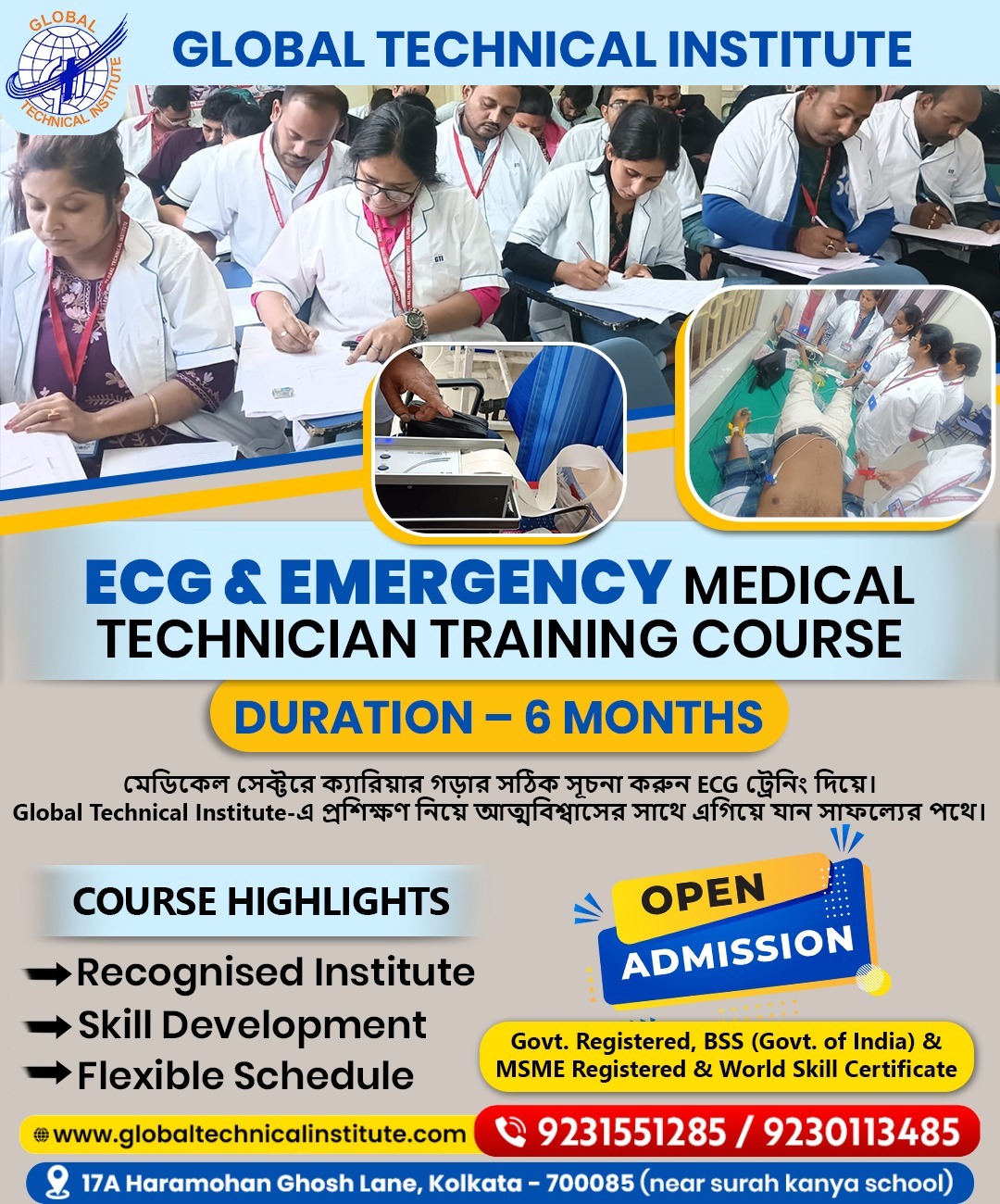
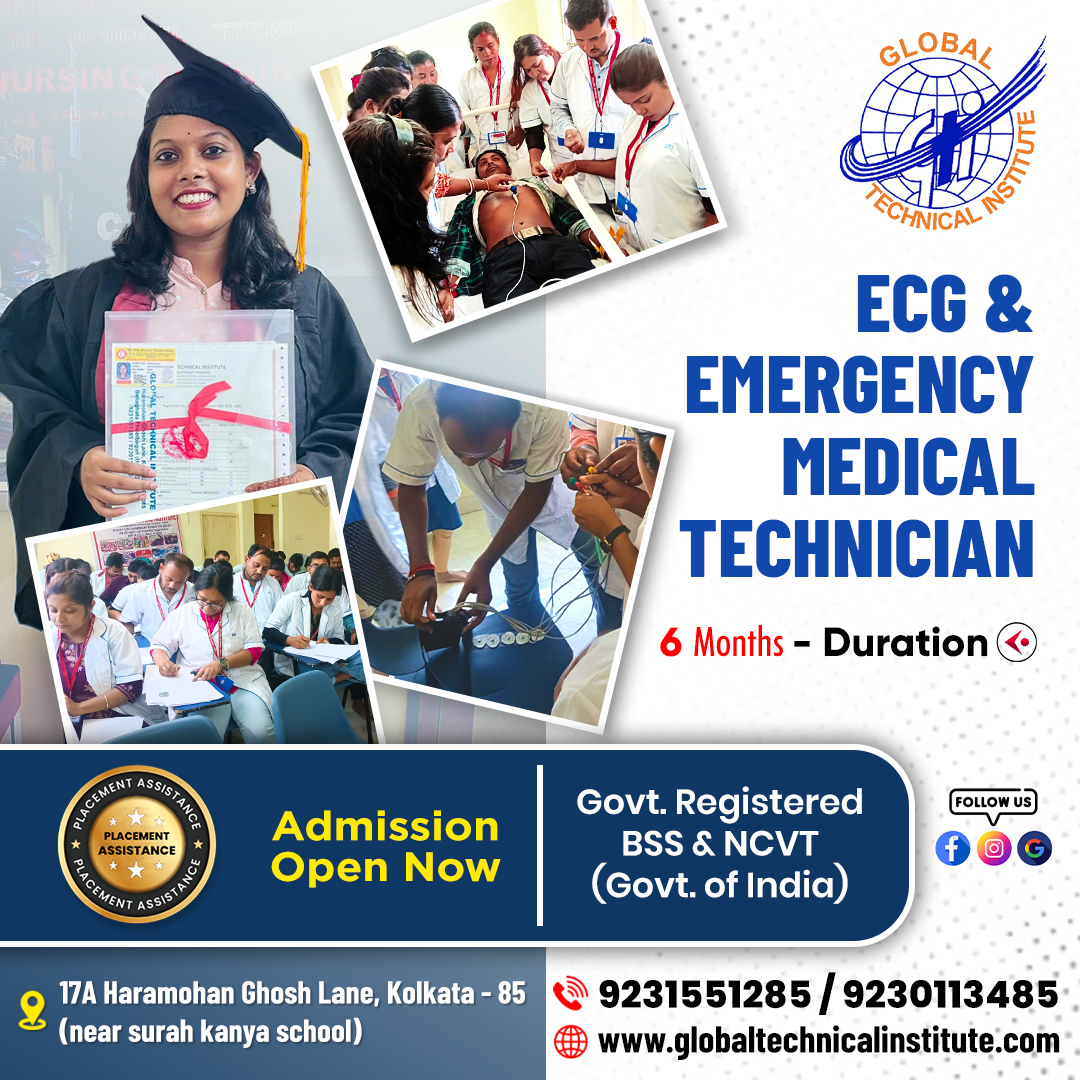
Global Technical Institute provides ECG Technician training for students who are interested in developing healthcare and diagnostic skills.
The institute has published a dedicated page for its ECG Technician training programme.
According to the published course information, the programme is designed to introduce students to ECG machine operation, ECG recording and basic interpretation-related concepts.
Course Details Published by Global Technical Institute
| Course information | Details published on the website |
| Course names | Certificate Course in ECG Technician / Diploma in ECG Technician |
| Certificate | Certificate in ECG Technician / Diploma in ECG Technician |
| Duration | 6 months / 1 year |
| Class frequency | 1 class per week |
| Admission sessions | April, August and December |
| Minimum qualification | Madhyamik |
| Skill development | Personality development and grooming |
| Additional training features | Hands-on practical classes, workshops and clinical assessment |
| Affiliation information displayed | Central Bharat Sevak Samaj (BSS), World Skill Council (WSC) |
| Institute information | ISO-certified Global Technical Institute |
These details are based on the institute’s published course page. Students should confirm the current availability and exact structure of each programme before admission.
What Will Students Learn?
The course page describes training related to:
- ECG machine operation.
- ECG recording.
- Basic understanding of ECG readings.
- Identification of recording abnormalities.
- Practical learning.
- Clinical assessment.
- Personality development.
- Professional communication.
The exact syllabus and practical hours should be requested from the institute.
Practical Learning
Hands-on learning is important in ECG technology.
Students should ask the admission team how practical classes are organised, which ECG equipment is used, how many recording sessions are included and how practical skills are assessed.
They should also confirm whether the programme includes hospital-based clinical exposure or classroom and laboratory practice only.
Personality Development and Grooming
The GTI course page mentions personality development and grooming sessions.
These sessions can help students develop communication, interpersonal skills and professional behaviour.
Such skills are useful when interacting with patients and working with healthcare teams.
Admission Sessions
The institute’s published page lists three admission sessions:
- April.
- August.
- December.
Students should contact the institute to confirm the next available batch and current admission dates.
Documents Required at Global Technical Institute
According to the published page, students should prepare:
- Six recent passport-size photographs.
- Attested copies of the last passed marksheet.
- Madhyamik admit card.
- Valid photo identity proof.
Confirm the current document requirements before submitting an application.
Important Information About Course Recognition
Students should carefully understand the difference between a private training certificate and a formal recognised ECG qualification.
Global Technical Institute’s published page mentions Central Bharat Sevak Samaj (BSS), World Skill Council (WSC) and ISO certification.
These should be understood as separate organisational or institutional claims. ISO certification does not, by itself, establish that a particular ECG course is a government-recognised professional qualification. Similarly, an affiliation claim should not automatically be treated as equivalent to approval by the State Medical Faculty of West Bengal or professional registration eligibility.
The State Medical Faculty of West Bengal separately lists a Diploma in Electrocardiographic Technique (ECG Technician) with two years of study and six months of compulsory post-examination training.
The 2026 NCAHP registration regulations list the ECG Technologist/Echocardiogram Technologist qualification entry as “To be updated”. Students should therefore confirm the latest applicable professional registration requirements rather than assume that every ECG certificate or diploma provides registration eligibility.
Before admission, we encourage students to ask Global Technical Institute for:
- The exact certificate or diploma name.
- The awarding organisation.
- The complete syllabus.
- Course duration.
- Total practical hours.
- Examination and assessment details.
- The current affiliation documents.
- The professional roles for which the qualification is intended.
- Any applicable recognition or registration details.
This will help you understand the programme clearly before making a decision.
Contact Global Technical Institute
For current course information, fees and admission details, students can contact:
Name: Global Technical Institute- ECG Technician Training Institute in Kolkata
Address: 16 c, Hara Mohan Ghosh Ln, Phool Bagan, Beleghata, Kolkata, West Bengal 700085
Phone Number: 8961008489
Map:
Please confirm the current address, admission sessions, course duration and fee details directly with the institute.
21. Is ECG Technician Training a Good Career Option?
ECG technology may be a suitable career path for students who are interested in healthcare, diagnostic procedures and medical equipment.
It can be a useful option for people who prefer practical and technical work in a healthcare environment.
However, students should understand the responsibilities before joining.
This career may suit you if:
- You are interested in heart-related healthcare.
- You want to learn about diagnostic equipment.
- You enjoy practical learning.
- You can follow instructions carefully.
- You are comfortable communicating with patients.
- You can maintain privacy and confidentiality.
- You are interested in working in hospitals or diagnostic centres.
- You are willing to continue learning new technical skills.
A successful career requires the right qualification, practical competence, professional behaviour and an understanding of the limits of the job role.
22. Difference Between an ECG Technician and a Cardiologist
Students sometimes confuse the work of an ECG Technician with that of a cardiologist.
Both are connected to heart-related healthcare, but their qualifications and responsibilities are very different.
| ECG Technician | Cardiologist |
| Performs ECG recording according to training and assigned duties | A medical doctor who specialises in heart-related conditions |
| Operates ECG equipment | Diagnoses and manages cardiac conditions |
| Prepares patients and places electrodes | Examines patients and reviews investigations |
| Ensures correct recording and documentation | Interprets medical findings and makes treatment decisions |
| Works under the appropriate clinical supervision | Provides specialist medical care |
An ECG Technician does not become a cardiologist after completing an ECG course.
23. Common Mistakes to Avoid Before ECG Course Admission
Before selecting an ECG Technician Institute in Kolkata, avoid these common mistakes.
Mistake 1: Choosing Only by Course Fees
A low fee does not automatically mean that the course is suitable for your career plans.
Mistake 2: Not Checking the Certificate
Always ask for the exact qualification name and awarding organisation.
Mistake 3: Confusing Private Training with a Recognised Diploma
A short private certificate and a formal recognised diploma may have different academic and professional status.
Mistake 4: Ignoring Practical Training
ECG recording is a practical skill. Ask about equipment access, practical hours and assessment.
Mistake 5: Believing Every Course Guarantees a Job
Employment depends on qualifications, practical skills, experience and employer requirements.
Mistake 6: Not Checking the Complete Fee
Ask for the total amount, including examination and certificate charges.
Mistake 7: Assuming an ECG Technician Can Diagnose Heart Disease
An ECG Technician records the test. Medical interpretation and diagnosis are the responsibility of qualified clinicians.
Mistake 8: Not Checking the Latest Rules
Professional qualification and registration rules can change. Always check the current official information before admission.
24. Frequently Asked Questions About ECG Technician Training in Kolkata
1. What is an ECG Technician course?
An ECG Technician course teaches students how to operate an ECG machine, prepare patients, place electrodes, record heart activity and maintain proper test documentation.
2. Which is the best ECG Technician Institute in Kolkata?
The best institute depends on your career objective. Compare course recognition, syllabus, practical training, faculty experience, fees, awarding body and student support before taking admission.
3. What is the eligibility for an ECG Technician course?
Eligibility depends on the course. Global Technical Institute’s published page lists Madhyamik as the minimum qualification for its ECG training programme. Formal recognised diploma programmes may have separate eligibility requirements.
4. Can I join an ECG Technician course after Class 10?
Some private training programmes accept students after Class 10. However, students should check the exact certificate and understand whether it supports their intended job role.
5. Can I join ECG Technician training after Class 12?
Yes. Students who have completed Class 12 can explore suitable ECG training programmes, subject to the course-specific admission rules.
6. Is Science compulsory for an ECG Technician course?
The requirement depends on the programme. Science knowledge is useful for understanding anatomy, physiology and cardiac electrical activity. Formal qualifications may specify particular subjects.
7. What is the duration of an ECG Technician course?
The duration varies by programme. Global Technical Institute’s page lists a six-month certificate and a one-year diploma option. The State Medical Faculty of West Bengal lists its formal ECG diploma as two years plus six months of compulsory post-examination training.
8. What are the ECG Technician course fees in Kolkata?
Fees vary by institution and qualification. Contact the institute for the latest written fee structure and check whether practical, examination and certificate charges are included.
9. What subjects are taught in ECG Technician training?
Common learning areas include heart anatomy, physiology, ECG principles, ECG machine operation, electrode placement, waveform basics, patient preparation, infection control and documentation.
10. What is a 12-lead ECG?
A 12-lead ECG is a standard recording that provides twelve views of the heart’s electrical activity using ten physical electrodes.
11. How many electrodes are used in a 12-lead ECG?
A standard 12-lead ECG uses ten physical electrodes: four limb electrodes and six chest electrodes.
12. Is practical training included in ECG Technician courses?
Practical training depends on the programme. Students should confirm the number of practical sessions, equipment used, supervision and any clinical exposure before admission.
13. What does an ECG Technician do in a hospital?
An ECG Technician prepares the patient, operates the ECG machine, places electrodes, records heart activity, checks recording quality and maintains the required documentation.
14. Can an ECG Technician interpret ECG reports?
An ECG Technician may learn basic waveform concepts and recording-quality checks. Medical interpretation and diagnosis must be performed by appropriately qualified healthcare professionals.
15. What is the difference between an ECG Technician and a Cardiologist?
An ECG Technician records the electrical activity of the heart using an ECG machine. A cardiologist is a specialist doctor who diagnoses and treats heart-related conditions.
16. Where can I work after ECG Technician training?
Depending on the qualification and employer requirements, opportunities may be available in hospitals, cardiac departments, diagnostic centres, clinics and other healthcare facilities.
17. What is the salary of an ECG Technician in Kolkata?
Salary depends on qualification, experience, employer, job responsibilities and practical skills. Students should check current job advertisements for realistic salary information.
18. Is an ECG Technician certificate valid for government jobs?
Government recruitment depends on the qualification specified in the official job notification. A private training certificate is not automatically accepted for every government ECG Technician vacancy.
19. Is a private ECG Technician diploma the same as a State Medical Faculty diploma?
No. The course title may sound similar, but the awarding body, duration, syllabus and recognition may differ. The State Medical Faculty of West Bengal lists its own Diploma in Electrocardiographic Technique with a two-year course and six months of compulsory training.
20. Does ISO certification mean an ECG course is government-recognised?
No. ISO certification relates to an organisation’s management systems or processes within the scope of its certification. It does not automatically establish government recognition of a specific educational qualification.
21. Does BSS or World Skill Council affiliation automatically provide professional registration?
No. Students must verify the exact qualification, awarding organisation and applicable registration rules. An affiliation claim should not be treated as automatic professional registration eligibility.
22. Does Global Technical Institute offer ECG Technician training in Kolkata?
Yes. Global Technical Institute has published a dedicated ECG Technician training page listing a six-month certificate and a one-year diploma option. Students should contact the institute to confirm the current programme details.
23. When are ECG Technician admission sessions at Global Technical Institute?
The published GTI course page lists April, August and December sessions. Confirm the next available batch directly with the institute.
24. How many classes are conducted at Global Technical Institute?
The published course page lists one class per week. Students should confirm the current timetable and practical class schedule before admission.
25. What documents are required for admission at Global Technical Institute?
The published page lists six passport-size photographs, an attested copy of the last passed marksheet, the Madhyamik admit card and valid photo identity proof. Confirm the latest requirements with the admission team.
26. Does Global Technical Institute provide personality development classes?
Yes. Its published ECG course page mentions personality development and grooming sessions as additional skill-development modules.
27. Is ECG Technician training suitable for working professionals?
Some programmes may offer flexible class schedules. Global Technical Institute’s page lists one class per week. Students should confirm attendance requirements and practical training arrangements before joining.
28. Can I study further after an ECG Technician course?
Further study depends on the qualification you complete. Check the admission requirements of the next programme and whether your existing certificate or diploma is accepted.
29. What should I check before paying the ECG Technician admission fee?
Check the exact course name, awarding body, recognition, eligibility, duration, syllabus, practical training, total fee, examination process and refund policy. Collect written confirmation and an official receipt.
30. Is ECG Technician training a good option for students interested in healthcare?
It may be a suitable option for students interested in diagnostic procedures, cardiac healthcare and medical equipment. The right programme should provide appropriate theoretical learning and practical skill development.
25. Final Checklist Before Joining an ECG Technician Institute
Before taking admission, use this checklist to make a well-informed decision.
- I have selected the right ECG course.
- I meet the course eligibility requirements.
- I understand the course duration.
- I know the exact certificate or diploma name.
- I have checked the awarding organisation.
- I have verified the recognition status.
- I have reviewed the syllabus.
- I have asked about practical training.
- I know which ECG equipment is used.
- I have checked the faculty qualifications.
- I have received the complete fee structure.
- I understand the examination process.
- I have checked placement support.
- I have read the admission and refund conditions.
Conclusion: Choose the Right ECG Technician Institute in Kolkata for Your Future
ECG technology is an important part of modern healthcare and cardiac diagnostics. An ECG Technician supports doctors and other healthcare professionals by preparing patients, operating ECG equipment and recording the electrical activity of the heart. This work requires technical knowledge, practical skills, attention to detail and good communication.
If you want to build a career in this field, choosing the right ECG Technician Institute in Kolkata is an important first step. Before taking admission, compare the available courses, eligibility, duration, fees, syllabus, practical training and career opportunities. Most importantly, check the exact certificate or diploma, awarding body and professional recognition so that your training matches your future career plans.
At Global Technical Institute, we aim to help students understand ECG Technician training and develop practical skills for healthcare-related work. Students can contact our admissions team to learn about the published certificate and diploma options, admission sessions, class schedule, fees and training facilities.
A successful career in diagnostic healthcare begins with the right learning, regular practice and a responsible approach to patient care. Take time to understand your options, ask the right questions and choose a training programme that supports your long-term goals.