Blog
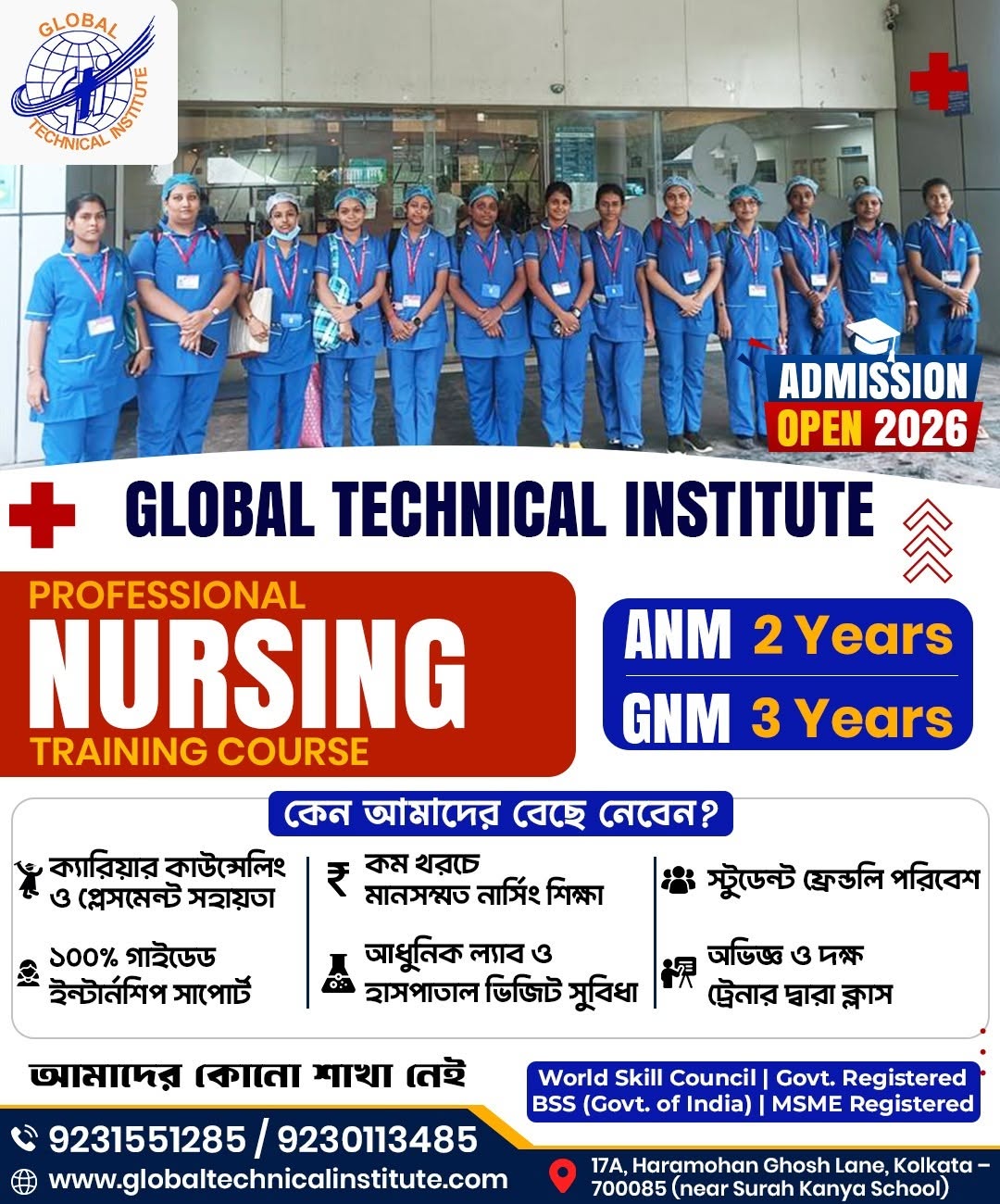
Choosing a career in healthcare is a meaningful decision. It gives you an opportunity to learn useful skills, support people during difficult times and build a career in a growing sector. Nursing and patient care are important parts of the healthcare system. Hospitals, nursing homes, clinics, rehabilitation centres and home healthcare services all need trained professionals who understand patient care and basic healthcare practices.
If you are planning to start a career in this field, choosing the right Nursing Training in Kolkata is an important first step. Before taking admission, you should understand the different courses, educational requirements, course duration, fees, practical training, certificates and future career options.
Many students and parents also have questions about the difference between ANM, GNM, B.Sc Nursing and private patient care training courses. These programmes may have different admission rules and career outcomes. Therefore, it is important to understand what each qualification offers before making a decision.
At Global Technical Institute, we understand that students need clear information before choosing a healthcare training programme. In this guide, we explain the important points you should know about nursing education and patient care training in Kolkata. Our aim is to help you compare your options, understand the admission process and make an informed decision.
1. What Is Nursing Training?
Nursing training is a form of healthcare education that prepares students to support patients and healthcare professionals. It helps learners understand basic patient care, hygiene, safety, communication and the responsibilities involved in working in a healthcare environment.
Depending on the programme, nursing education may include classroom lessons, laboratory practice, clinical training and supervised hospital experience.
A professional nursing programme can teach students about:
- Basic human anatomy and physiology.
- Personal hygiene and patient comfort.
- Infection prevention and control.
- Patient observation and reporting.
- Basic first aid and emergency awareness.
- Communication with patients and their families.
- Patient safety and healthcare ethics.
- Nutrition and general health awareness.
- Community health and health education.
- Professional behaviour in healthcare settings.
The subjects and practical responsibilities depend on the course and its recognition status. A short patient care certificate, for example, should not be treated as equal to a regulated nursing qualification.
2. Why Is Nursing Training Important?
Healthcare professionals work with people who may be unwell, injured, elderly or recovering from surgery. They need knowledge, patience, discipline and practical skills.
Proper training helps students understand how to work safely and responsibly.
2.1 Develops Practical Healthcare Skills
Healthcare work requires more than theoretical knowledge. Students need to understand how to follow instructions, maintain hygiene, communicate with patients and support daily care activities.
Practical learning helps students become familiar with common healthcare situations under appropriate supervision.
2.2 Builds Confidence
Many students feel nervous when they first enter a healthcare environment. Training introduces them to basic procedures, professional behaviour and patient communication. This can help them become more confident when performing tasks within their permitted role.
2.3 Teaches Patient Safety
Patient safety is one of the most important parts of healthcare. Students should learn why hand hygiene, cleanliness, correct identification, safe movement and infection control matter.
They should also understand when to report a change in a patient’s condition to a qualified healthcare professional.
2.4 Improves Communication Skills
Patients may feel anxious, uncomfortable or confused. Healthcare workers must communicate in a calm and respectful way.
Training can help students develop listening skills, empathy, teamwork and professional communication.
2.5 Introduces Career Opportunities
The healthcare sector includes many types of work. Depending on the qualification, recognition, registration and employer requirements, trained candidates may explore opportunities in hospitals, clinics, care facilities and home healthcare services.
3. Types of Nursing Courses in Kolkata
Students can find different types of healthcare and nursing-related courses in Kolkata. However, not every course provides the same qualification or professional eligibility.
Before taking admission, understand the purpose and recognition of each programme.
3.1 Auxiliary Nursing and Midwifery (ANM)
ANM stands for Auxiliary Nursing and Midwifery. It is a regulated nursing programme that focuses on basic nursing care, maternal health, child health and community healthcare.
Students learn about healthcare support, health education, mother and child care, hygiene and community-level health services.
Course duration: The West Bengal Nursing Council lists the revised ANM programme as two years.
Educational eligibility: The Indian Nursing Council’s published eligibility criteria specify 10+2 in eligible streams from a recognised board, with the prescribed age and medical fitness requirements. The applicable admission notification should always be checked.
Important: A student should confirm that the specific institution and ANM programme are approved by the relevant nursing authorities for the applicable academic session. A course title or certificate description alone does not establish eligibility for nursing registration.
3.2 General Nursing and Midwifery (GNM)
GNM stands for General Nursing and Midwifery. It is a regulated nursing diploma programme that provides education in general nursing, patient care and midwifery.
The programme is more extensive than a short patient care certificate. It includes theoretical learning and supervised clinical experience.
Students may study areas such as:
- Fundamentals of nursing.
- Medical-surgical nursing.
- Community health nursing.
- Child health nursing.
- Mental health nursing.
- Midwifery and maternal health.
- Nursing ethics and professional responsibilities.
Course duration: The West Bengal Nursing Council lists GNM as a three-year programme.
Educational eligibility: The INC eligibility information includes 10+2 with English and the prescribed minimum marks. Other eligible routes and conditions may apply. Students should check the current official admission bulletin.
GNM is a professional nursing qualification. Students should confirm the programme’s approval, examination arrangements and registration pathway before enrolling.
3.3 B.Sc Nursing
B.Sc Nursing is an undergraduate nursing degree. It offers a broader academic and professional foundation in nursing science, patient care, clinical practice and healthcare management.
Students generally study subjects such as:
- Anatomy and physiology.
- Nutrition and biochemistry.
- Nursing foundations.
- Medical-surgical nursing.
- Child health nursing.
- Community health nursing.
- Mental health nursing.
- Midwifery and obstetrical nursing.
- Nursing research and management.
Course duration: The basic B.Sc Nursing programme is generally four years.
Educational eligibility: The INC eligibility information specifies 10+2 with Physics, Chemistry, Biology and English, with the required aggregate marks and other conditions. The current entrance and admission rules must be checked before applying.
In West Bengal, students should review the relevant WBJEEB admission information and the approved college and seat details.
3.4 Post Basic B.Sc Nursing
Post Basic B.Sc Nursing is designed for eligible candidates who have already completed GNM and hold the required nursing registration.
It provides an opportunity to continue nursing education at degree level.
Typical duration: Two years.
Admission requirements include the prescribed GNM qualification and registration as a nurse and midwife with the relevant State Nursing Registration Council. Candidates must verify the current university and admission rules.
3.5 M.Sc Nursing
M.Sc Nursing is a postgraduate programme for eligible nursing graduates who want to develop advanced knowledge in a specialised area.
Common specialities include:
- Medical-Surgical Nursing.
- Child Health Nursing.
- Community Health Nursing.
- Obstetrical and Gynaecological Nursing.
- Mental Health Nursing.
Typical duration: Two years.
Candidates generally need a recognised B.Sc Nursing or Post Basic B.Sc Nursing qualification, the required marks and nursing registration. Work experience may also be required under the applicable rules.
3.6 Patient Care Assistant or Patient Care Training
Patient care training is different from a regulated nursing programme. It generally focuses on supporting patients with daily care needs under the direction of qualified healthcare professionals.
Depending on the course syllabus, training may cover:
- Patient hygiene and comfort.
- Bed preparation.
- Safe patient movement.
- Basic observation and reporting.
- Infection prevention.
- Communication with patients.
- Assistance with daily activities.
- Professional behaviour in healthcare settings.
A patient care certificate does not automatically make someone an ANM, GNM or registered nurse. It should not be used as a substitute for a recognised nursing qualification.
Students interested in this type of training should check the exact certificate awarded, awarding body, assessment method and job role for which the training is intended.
4. Difference Between ANM, GNM, B.Sc Nursing and Patient Care Training
Understanding the difference between these programmes can help you select a course that matches your education and career plans.
| Course | Typical duration | Main focus |
| ANM | 2 years | Basic nursing, maternal health and community healthcare |
| GNM | 3 years | General nursing, patient care and midwifery |
| B.Sc Nursing | 4 years | Degree-level nursing education and clinical practice |
| Post Basic B.Sc Nursing | 2 years | Degree-level progression for eligible GNM nurses |
| M.Sc Nursing | 2 years | Advanced nursing education and specialisation |
| Patient Care Training | Depends on programme | Basic patient support and care assistance |
The durations above are general programme information. The approved course structure, academic calendar and current regulations of the relevant authority should be checked before admission.
Which course should you choose?
- If you want to become eligible for a regulated nursing pathway, investigate recognised ANM, GNM or B.Sc Nursing programmes.
- If you already hold GNM and meet the requirements, you may explore Post Basic B.Sc Nursing.
- If you have completed a nursing degree and meet the entry conditions, you may consider M.Sc Nursing.
- If your goal is to learn patient support skills, compare patient care training programmes carefully and understand their limited professional scope.
5. Nursing Course Eligibility in Kolkata
Eligibility depends on the course you select. Students should not assume that the same educational qualification is accepted for every nursing programme.
ANM Eligibility
The Indian Nursing Council’s published criteria include:
- 10+2 from a recognised board in the eligible streams.
- Minimum age of 17 years by 31 December of the admission year.
- The prescribed upper age limit and applicable relaxations.
- Medical fitness.
- Other conditions specified by the relevant admission authority.
The exact rules should be checked in the current official admission bulletin.
GNM Eligibility
The INC’s published criteria include:
- 10+2 with English.
- The prescribed minimum marks in the qualifying examination.
- Eligibility through specified recognised vocational routes, where applicable.
- Medical fitness.
- The applicable age and other admission conditions.
Science may be preferable under the published criteria. Students should read the current admission notice instead of relying only on general course descriptions.
B.Sc Nursing Eligibility
Candidates generally need:
- 10+2 with Physics, Chemistry and Biology.
- English as a subject.
- The prescribed minimum aggregate marks.
- The required minimum age.
- Medical fitness.
- Qualification in the applicable entrance and admission process.
Patient Care Training Eligibility
Entry requirements for patient care training can vary between training providers and awarding bodies. Some programmes may accept candidates with secondary-level education, while others may require higher secondary education.
Always ask the institute for the written eligibility criteria for the exact course you are considering.
6. Course Duration: How Long Does Nursing Training Take?
The duration depends on the programme and its regulatory requirements.
- ANM: Generally two years.
- GNM: Generally three years.
- Basic B.Sc Nursing: Generally four years.
- Post Basic B.Sc Nursing: Generally two years.
- M.Sc Nursing: Generally two years.
- Patient care training: Depends on the course, syllabus and awarding body.
Do not compare courses only by duration. A shorter course does not necessarily provide the same qualification, clinical exposure or professional eligibility as a longer regulated nursing programme.
Before admission, ask for the official course calendar, class schedule, practical training plan and examination details.
7. Nursing Course Fees in Kolkata
Nursing course fees vary according to the course, institution, facilities, clinical training arrangements, examination charges and awarding body.
There is no single fixed fee for every nursing institute in Kolkata.
For this reason, students should request a written fee structure before paying any admission amount.
What Is Usually Included in Course Fees?
Depending on the institute and programme, the total cost may include:
- Registration or application fee.
- Admission fee.
- Tuition fee.
- Examination fee.
- Practical or laboratory fee.
- Study materials.
- Uniform and accessories.
- Clinical training or placement-related charges, where applicable.
- Certificate or assessment fee.
- Other compulsory charges mentioned in the admission agreement.
Not every institute charges all these items separately. Some may include certain expenses in the total programme fee.
How to Compare Nursing Course Fees
Do not select an institute only because it advertises a low price. A low fee is not useful if the course does not match your career objective.
Before taking admission, ask:
- What is the total course fee?
- Is the fee payable in instalments?
- Are examination fees included?
- Are practical training charges included?
- Are uniforms and study materials included?
- Are there any additional charges?
- What is the refund policy?
- What certificate will be awarded?
- Who is the awarding or examining body?
- Does the programme have the approval required for its stated qualification?
What are the nursing course fees at Global Technical Institute?
Students should contact Global Technical Institute directly for the latest written fee structure for the programme they are interested in. The published nursing course page does not provide a complete fee amount, so students should confirm the total payable cost before making a payment.
8. Nursing Admission Process in Kolkata
The admission process depends on whether you are applying for a regulated nursing programme or a private patient care training course.
Admission Process for Regulated ANM and GNM Courses
In West Bengal, the West Bengal Joint Entrance Examinations Board conducts the ANM(R) and GNM entrance examination and counselling process for the relevant admission sessions.
The broad process is:
Step 1: Check Eligibility
Read the current admission bulletin. Confirm your educational qualification, age, marks and other conditions.
Step 2: Complete the Application
Apply through the official WBJEEB portal within the notified dates.
Step 3: Appear for the Entrance Examination
Follow the examination instructions and attend the test as scheduled.
Step 4: Check the Result and Rank
Review your result and rank through the official portal.
Step 5: Participate in Counselling
Follow the counselling instructions, review available institutes and courses, and submit your choices.
Step 6: Seat Allotment and Verification
If a seat is allotted, follow the reporting and document-verification process within the given deadline.
Step 7: Complete Admission
Pay the prescribed fees and complete admission formalities at the allotted institute.
The exact process, dates, reservation rules and seat availability can change each year. Always use the latest WBJEEB notification.
Admission Process for Private Patient Care Training
A private patient care training programme may have a different admission process.
A student should generally:
- Contact the institute.
- Ask for the exact course name and syllabus.
- Check the eligibility requirements.
- Understand the certificate and awarding body.
- Ask about practical training.
- Review the complete fee structure.
- Submit the required documents.
- Read the admission and refund terms.
- Collect an official payment receipt.
- Keep a copy of the admission confirmation.
Students should not confuse admission to a private training course with admission to a recognised ANM, GNM or B.Sc Nursing programme.
9. Documents Required for Nursing Admission
The required documents depend on the course and admission authority.
Commonly requested documents may include:
- Recent passport-size photographs.
- Class 10 marksheet and certificate.
- Class 12 marksheet and certificate, where applicable.
- School leaving or transfer certificate, if required.
- Valid photo identity proof.
- Date-of-birth proof.
- Address proof.
- Caste certificate, if applicable.
- Disability certificate, if applicable.
- Medical fitness certificate, if required.
- Entrance examination rank card or allotment letter, where applicable.
For regulated nursing admissions, follow the exact document list in the official information bulletin.
Documents Listed by Global Technical Institute
The GTI nursing course page currently lists:
- Six passport-size photographs.
- Attested copies of the last passed marksheet.
- Madhyamik admit card.
- Any valid photo identity proof.
Students should confirm the latest list directly with the institute before submitting documents. The published list should not be treated as a replacement for the document requirements of a regulated nursing admission process.
10. What Do Students Learn During Nursing Training?
The subjects depend on the programme. Regulated nursing courses have prescribed syllabi and practical requirements. Patient care training programmes may follow a different syllabus.
Some common learning areas are explained below.
10.1 Anatomy and Physiology
Students learn about the structure and functions of the human body. This includes major organs, body systems and basic health processes.
10.2 Fundamentals of Nursing
This area introduces the basic principles of nursing care, patient comfort, hygiene, observation and professional responsibility.
10.3 Nutrition and Diet
Students learn about balanced nutrition, food groups and the role of diet in general health and recovery.
10.4 Infection Prevention and Control
Healthcare workers must understand how infections can spread. Training may cover hand hygiene, cleaning, safe waste handling and the use of protective equipment.
10.5 First Aid and Emergency Awareness
Students may learn basic first aid principles and how to respond safely when someone needs urgent assistance. They must also understand when to call for qualified medical help.
10.6 Maternal and Child Health
Regulated nursing programmes such as ANM include learning related to maternal health, newborn care, child health and community health.
10.7 Communication and Patient Relations
Students learn how to speak respectfully with patients, listen carefully, maintain privacy and communicate concerns to the appropriate healthcare professional.
10.8 Healthcare Ethics
Ethical learning includes dignity, confidentiality, consent, professional boundaries and respect for patients.
11. Why Is Practical Training Important?
Practical training is an important part of healthcare education. It helps students connect classroom learning with real situations.
However, practical training must be appropriate to the programme and supervised by qualified professionals.
Depending on the course, practical learning may include:
- Demonstrations of hand hygiene.
- Bed preparation and patient comfort.
- Safe movement and positioning.
- Use of basic healthcare equipment.
- Infection-control procedures.
- Patient observation and reporting.
- Communication exercises.
- Simulation-based practice.
- Supervised clinical experience, where included in the approved course.
Students should ask the institute where practical training takes place, who supervises it and how practical performance is assessed.
For a regulated nursing programme, clinical training must follow the requirements of the relevant nursing authorities. A classroom demonstration or short workshop should not be presented as a substitute for the required clinical hours.
12. Skills Required to Build a Career in Nursing and Patient Care
A healthcare career requires both technical knowledge and personal qualities.
Communication
Clear communication helps healthcare workers understand patient needs and share important information with the team.
Patience
Patients may need extra time, support and reassurance. Patience helps maintain a respectful care environment.
Empathy
Healthcare workers should treat patients with dignity and understand that every patient has different needs.
Attention to Detail
Careful observation is important. Changes in a patient’s behaviour or condition should be reported to the appropriate professional.
Teamwork
Healthcare services depend on doctors, nurses, technicians, attendants and other staff working together.
Discipline
Punctuality, hygiene, correct uniform and following instructions are important in healthcare environments.
Emotional Strength
Healthcare work can involve difficult situations. Students should learn to remain calm, follow professional guidance and seek support when needed.
13. Career Opportunities After Nursing Training
Career opportunities depend on the qualification, recognition, registration, practical experience and employer requirements.
A regulated nursing qualification may lead to nursing roles after the candidate meets the relevant registration requirements. A patient care certificate may support applications for suitable assistant or support roles, but it does not provide registered nurse status.
13.1 Hospitals
Hospitals have different departments that require qualified nursing professionals and support staff. The role offered depends on the candidate’s recognised qualification and eligibility.
13.2 Nursing Homes
Nursing homes provide medical care and support to patients. They may recruit eligible nursing professionals and patient care support staff.
13.3 Clinics and Healthcare Centres
Clinics and healthcare centres may need staff for patient assistance, basic coordination and other support duties.
13.4 Community Healthcare
Community health services focus on health awareness, prevention, maternal and child health and other public health activities. Eligibility depends on the specific role and recruitment rules.
13.5 Home Healthcare
Home healthcare services provide care to patients in their homes. Opportunities may be available for appropriately trained support workers and qualified nursing professionals.
13.6 Rehabilitation and Elder Care Centres
These facilities support people who need assistance during recovery or with daily activities. Candidates must work within the responsibilities permitted by their training and role.
13.7 Further Education
Eligible candidates may continue their education through higher nursing qualifications, specialisation or other recognised healthcare programmes.
14. Expected Salary After Nursing Training
Salary depends on the qualification, employer, location, experience, job responsibilities and registration status.
There is no single salary that applies to every nursing or patient care course.
A registered nurse with an approved qualification may have different salary opportunities from a patient care assistant or healthcare support worker.
Before making a career decision, students should:
- Check current job advertisements.
- Compare the qualifications required by employers.
- Review the responsibilities of the advertised role.
- Understand whether professional registration is required.
- Compare entry-level and experienced salary offers.
- Avoid institutes that guarantee a fixed salary without reliable evidence.
A good training programme should help students understand the skills and qualifications required for their chosen career. It should not promise a job or salary that it cannot substantiate.
15. How to Choose the Best Nursing Training Institute in Kolkata
Choosing the right Nursing Training Institute in Kolkata requires careful research. A good-looking website or a low admission fee is not enough to judge the quality of a programme.
Use the following points before making your decision.
15.1 Check Course Recognition and Approval
This should be your first priority.
For a regulated nursing programme, verify the institution, course, academic session, sanctioned seats and approval status with the relevant authorities.
Check the official Indian Nursing Council and West Bengal Nursing Council information. Do not rely only on verbal promises or general affiliation claims.
15.2 Understand the Certificate
Ask for the exact name of the certificate or qualification that you will receive.
Also ask:
- Who awards the certificate?
- Which body conducts the examination?
- Is the course approved for the stated qualification?
- Does it lead to professional registration?
- What jobs can the certificate support?
15.3 Review the Course Syllabus
A clear syllabus helps you understand what you will learn. Ask for subject details, practical components, assessment methods and the complete course structure.
15.4 Ask About Practical Training
Healthcare education needs appropriate practical learning. Find out whether the programme includes demonstrations, simulation, supervised clinical exposure or other practical activities.
15.5 Check Faculty Qualifications
Ask about the qualifications and professional experience of the people who teach the programme. For regulated nursing education, faculty must meet the applicable regulatory requirements.
15.6 Understand the Fee Structure
Ask for the full fee in writing. Confirm whether examination, practical, uniform, certificate and other charges are included.
15.7 Review Student Support
Ask whether the institute provides academic guidance, doubt-clearing sessions, attendance support and help with course-related queries.
15.8 Visit the Institute
If possible, visit the campus. Speak with the admission team, review the facilities and ask to see the course documents.
15.9 Verify Placement Claims
If an institute advertises placement support, ask for details. Understand whether it provides interview assistance, job referrals or guaranteed employment. These are different services.
Do not treat a placement claim as proof of a course’s regulatory recognition.
16. Nursing Training at Global Technical Institute, Kolkata
Global Technical Institute provides training programmes for students who want to develop practical skills for the workplace.
The institute has published a nursing training page that describes its Auxiliary Nursing Midwifery-related offering and patient care training information.
According to the published page, the programme details include:
- Course name displayed: Auxiliary Nursing Midwifery.
- Course duration displayed: Two years.
- Certificates mentioned: Diploma in Patient Care and a certificate described on the page as a Government-Registered Certificate in Auxiliary Nursing Midwifery.
- Class schedule displayed: Two classes per week.
- Additional module: Personality development and grooming sessions.
- Affiliation information displayed: Bharat Sevak Samaj (BSS), ISO certification and an NSDC-affiliated partner claim.
Students should verify the exact course status and certificate before admission. In particular, they should ask for documentary proof of the approval required for a regulated ANM programme, including the relevant nursing authority, institution details, sanctioned seats and registration pathway.
The institute’s published page also lists Class 10 as the minimum qualification. This should be clarified directly with the institute because the published eligibility criteria for the regulated ANM programme require 10+2. Students seeking recognised ANM admission should follow the current official eligibility rules rather than relying on a private course-page statement.
Why Should Students Contact Global Technical Institute?
Students can contact the institute to understand the course structure, admission requirements, class schedule, training approach and fee details.
Before enrolling, we recommend asking the admission team for:
- The exact course name and qualification.
- The full written syllabus.
- The name of the awarding and examining body.
- Documentary evidence of the relevant course approval, if it is being offered as regulated ANM.
- The eligibility criteria for the specific programme.
- The complete fee structure.
- Details of practical training and supervision.
- Examination and certificate details.
- The refund and cancellation policy.
This will help you understand whether the programme matches your educational background and career plans.
Name: Global Technical Institute – Nursing Training Institute in Kolkata
Address: 17a, Hara Mohan Ghosh Ln, Phool Bagan, Beleghata, Kolkata, West Bengal 700085
Phone Number: 9231551285
Map:
17. Nursing Training for Students After Class 10 and Class 12
Students often ask whether they can start nursing training after Class 10 or Class 12.
The answer depends on the programme.
After Class 10
Students who have completed Class 10 can explore suitable healthcare skill-development or patient care programmes if they meet the provider’s eligibility requirements.
However, Class 10 alone does not meet the published educational requirement for the regulated ANM programme described by the Indian Nursing Council and West Bengal Nursing Council.
Students should not assume that a private patient care course is equivalent to ANM or GNM.
After Class 12
Students who have completed Class 12 may explore regulated nursing programmes, subject to the course-specific eligibility criteria.
For example:
- ANM has its prescribed 10+2 eligibility requirements.
- GNM has its prescribed 10+2 and English requirements.
- B.Sc Nursing generally requires Physics, Chemistry, Biology and English, along with the required marks and admission conditions.
Students should check the current official rules before applying.
18. Is Nursing Training Suitable for Everyone?
Nursing and patient care can be rewarding, but they also involve responsibility.
Students should think about whether they are comfortable with:
- Supporting people who are unwell.
- Working with different age groups.
- Following hygiene and safety rules.
- Communicating with patients and families.
- Working as part of a healthcare team.
- Maintaining confidentiality.
- Following instructions from qualified professionals.
- Working shifts, where required by the job.
You do not need to know everything before starting a course. A suitable programme should help you build the knowledge and skills required for your intended role.
However, interest in healthcare should be combined with a clear understanding of the course and its professional scope.
19. Common Mistakes to Avoid Before Nursing Admission
Many students focus only on the course fee or the name of the institute. This can lead to confusion later.
Avoid these common mistakes:
Mistake 1: Not checking recognition
Always verify the course and institution with the appropriate authority.
Mistake 2: Confusing patient care training with nursing qualification
A patient care certificate and a regulated nursing qualification are not interchangeable.
Mistake 3: Believing every course guarantees a job
Employment depends on the qualification, skills, experience, registration and employer requirements.
Mistake 4: Not checking the complete fee
Ask for all compulsory charges in writing.
Mistake 5: Ignoring practical training
Understand how practical learning is delivered and supervised.
Mistake 6: Relying only on verbal promises
Request official documents, written terms and payment receipts.
Mistake 7: Not checking eligibility
Confirm your educational qualification, age and other conditions before paying an admission fee.
20. Frequently Asked Questions About Nursing Training in Kolkata
1. Which is the best nursing training institute in Kolkata?
The best institute depends on your career goal and the course you want to study. Compare course recognition, faculty qualifications, syllabus, practical training, fees and student support. For regulated nursing programmes, verify the institute and course approval with the relevant nursing authorities before admission.
2. What is the minimum qualification for nursing training in Kolkata?
It depends on the course. The published INC eligibility for ANM requires 10+2 in eligible streams. GNM also has 10+2 and English requirements. B.Sc Nursing generally requires 10+2 with Physics, Chemistry, Biology and English. Some private patient care training programmes may have different entry requirements.
3. Can I do an ANM course after Class 10?
The published Indian Nursing Council eligibility criteria for the regulated ANM programme specify 10+2. A private course that accepts Class 10 students should not automatically be treated as a recognised ANM qualification. Confirm the exact certificate and approval before admission.
4. What is the duration of an ANM course?
The West Bengal Nursing Council lists the revised ANM programme as two years. Students should confirm the approved course structure and current admission details.
5. What is the duration of a GNM course?
The West Bengal Nursing Council lists GNM as a three-year programme. The current approved syllabus and admission rules should be checked before applying.
6. How long does B.Sc Nursing take?
Basic B.Sc Nursing is generally a four-year undergraduate programme. Admission is subject to the required educational qualification, entrance process and applicable rules.
7. What are the nursing course fees in Kolkata?
Fees vary by course and institution. Ask for the full written fee structure, including tuition, examination, practical training, uniform, study materials and other compulsory charges. There is no single fee that applies to all institutes.
8. What documents are required for nursing admission?
Common documents include photographs, Class 10 and Class 12 marksheets, identity proof, age proof and other certificates where applicable. Regulated courses may require additional documents. Always follow the official admission notice.
9. Is an entrance examination required for nursing admission in West Bengal?
Admission requirements depend on the programme. WBJEEB conducts the ANM(R) and GNM entrance examination and counselling process for the relevant academic session. B.Sc Nursing admission has its own applicable entrance and admission process. Check the current WBJEEB notifications.
10. Can students from Arts apply for ANM?
The INC’s published ANM eligibility criteria include 10+2 in specified Arts subjects, Science or eligible Health Care Science vocational streams. Candidates must also meet the other applicable conditions. Always check the latest official admission bulletin.
11. Is Science compulsory for GNM?
The INC’s published GNM eligibility information includes 10+2 with English and the prescribed marks. It also states that Science is preferable. Other eligible routes may apply. Students should check the current official criteria.
12. Can male students study nursing?
Nursing course eligibility depends on the applicable regulations and admission notification. Students should check the current course-specific rules and seat availability rather than relying on general assumptions.
13. What subjects are taught in nursing courses?
Subjects vary by programme. They may include anatomy, physiology, nutrition, nursing fundamentals, medical-surgical nursing, community health, child health, maternal health, mental health, infection control and nursing ethics.
14. Is practical training important in nursing?
Yes. Practical learning helps students understand how to apply classroom knowledge in healthcare situations. The required clinical training for regulated programmes must follow the applicable regulatory syllabus and supervision rules.
15. Can I get a hospital job after patient care training?
Some patient care training programmes may help candidates apply for suitable support roles, depending on the employer’s requirements. A patient care certificate does not automatically qualify someone to work as a registered nurse.
16. What is the difference between ANM and GNM?
ANM is a two-year programme focused on basic nursing, maternal health and community healthcare. GNM is a three-year general nursing and midwifery programme with a broader nursing curriculum. Both have specific eligibility and regulatory requirements.
17. Does a private nursing training certificate allow me to register as a nurse?
Not automatically. Registration depends on the recognised qualification, approved institution and course, and the rules of the relevant State Nursing Registration Council. Always verify the registration pathway before admission.
18. Does ISO certification mean a nursing course is approved?
No. ISO certification and nursing programme approval are different things. Students should check the relevant nursing
Conclusion: Choose the Right Nursing Training in Kolkata for a Better Future
Choosing the right Nursing Training in Kolkata is an important step towards building a career in the healthcare sector. Before taking admission, understand the different courses, eligibility criteria, duration, fees, syllabus, practical training and career opportunities. Most importantly, check the course recognition and certificate details to ensure that the programme matches your career goals.
At Global Technical Institute, we aim to help students understand healthcare training opportunities and develop the knowledge and skills needed for their chosen path. Whether you are exploring nursing education or patient care training, take time to understand the course structure, training approach and future opportunities before making your decision.
A successful healthcare career begins with the right education, practical knowledge, dedication and compassion. Make an informed choice today and take your first step towards a meaningful future in healthcare.
Read More: What to Check Before Enrolling in an ANM or GNM Nursing Programme