Blog, X-Ray and Imaging Technology
Healthcare today depends on technology in many ways, and medical imaging is an important part of patient care. X-rays and other imaging methods help healthcare professionals examine internal structures of the body and support the diagnosis and treatment process.
For students who are interested in healthcare and technology, X-Ray & Imaging Technology can offer an opportunity to develop both technical knowledge and practical skills. A structured training programme can introduce students to anatomy, imaging principles, equipment, patient positioning and radiation safety.
If you are searching for an X-Ray & Imaging Technology Institute in Kolkata, understanding the course content, practical exposure and potential career pathways can help you choose a suitable programme.
What Is X-Ray & Imaging Technology?
X-Ray & Imaging Technology is a healthcare-related field that focuses on the technical aspects of producing medical images. X-ray equipment uses controlled radiation to create images of specific areas of the body, which healthcare professionals can use as part of the diagnostic process.
Training generally combines classroom learning with practical sessions. Students can learn the basic principles behind imaging, how equipment is used, how patients are prepared and positioned, and why safety procedures are essential.
The exact subjects and practical components depend on the institute and course structure.
What Do Students Learn During X-Ray Training?
A well-organised programme can introduce students to several important areas of medical imaging.
| Learning Area | What It Covers |
| Human Anatomy | Basic knowledge of body structures |
| Physiology | Understanding normal body functions |
| X-Ray Fundamentals | Basic principles of X-ray imaging |
| Equipment Knowledge | Introduction to X-ray equipment and components |
| Patient Positioning | Basic positioning concepts for imaging |
| Radiation Safety | Safe practices and protective measures |
| Image Quality | Factors that influence useful image production |
| Patient Care | Communication and preparation of patients |
This combination of subjects helps students understand both the technical and patient-focused aspects of the field.
Building Knowledge from the Basics
Students generally begin with fundamental concepts before moving towards practical applications. This step-by-step approach can make technical subjects easier to understand.
Understanding Anatomy and Body Structures
Basic anatomy is important because students need to understand the body area being examined. Learning about bones, organs and anatomical positions can help learners understand why particular imaging views and positions are used.
Learning the Fundamentals of X-Ray Imaging
Students can learn the basic concepts behind X-ray production and image formation. This provides the foundation needed to understand how imaging equipment works.
Understanding Patient Positioning
Patient positioning is an important part of an imaging procedure. Training can introduce students to positioning concepts and explain how appropriate positioning can contribute to producing useful images.
Becoming Familiar with Equipment
Students may receive demonstrations or supervised practical exposure to relevant equipment. This can help them understand equipment components, basic operating procedures and the importance of following established protocols.
Learning Radiation Protection
Radiation safety is a key part of X-ray education. Students are introduced to protective practices designed to minimise unnecessary radiation exposure and maintain a safe working environment.
Why Practical Training Is Important
Theoretical knowledge gives students the foundation, but practical learning helps them understand how that knowledge is applied in a professional setting.
For example, reading about patient positioning is different from observing or practising positioning under appropriate supervision. Similarly, learning about imaging equipment in a classroom can be supported by demonstrations and practical exposure.
| Classroom Learning | Practical Exposure |
| Anatomy and physiology | Understanding body positioning |
| Imaging principles | Equipment demonstrations |
| Radiation safety concepts | Following safety procedures |
| Image-quality concepts | Observing imaging workflows |
| Patient-care theory | Practising professional communication |
Students considering an X-Ray Training Institute in Kolkata should therefore ask about the practical components included in the programme.
Benefits of Studying X-Ray & Imaging Technology
There are several reasons students may consider training in this field.
1. Combination of Healthcare and Technology
X-ray and imaging training brings together healthcare knowledge and technical learning. This can appeal to students who enjoy both science and technology.
2. Practical Skill Development
Students can develop an understanding of equipment, positioning, safety procedures and professional workflows through appropriate practical training.
3. Patient-Care Awareness
The field involves interaction with patients, so students can also develop communication skills and learn the importance of comfort, privacy and professional behaviour.
4. Foundation for Further Education
A suitable training programme can provide foundational knowledge that students may use when pursuing additional education or specialised learning in healthcare technology.
5. Exposure to Healthcare Work Environments
Training can help students understand how imaging services function within hospitals, diagnostic centres and other healthcare settings.
How to Select an X-Ray Technician Institute in Kolkata
Choosing the right training institute requires careful comparison. Students should not focus only on fees or course duration.
Consider the following factors before enrolling:
| Factor | Questions to Consider |
| Course Content | Does the curriculum cover essential imaging topics? |
| Practical Training | Are practical sessions included? |
| Faculty Support | Are students given proper academic guidance? |
| Facilities | Are suitable learning resources available? |
| Course Duration | Is the duration clearly mentioned? |
| Eligibility | Do you meet the admission requirements? |
| Certification | What certification is provided after completion? |
| Career Guidance | Does the institute provide career-related guidance? |
It is also advisable to confirm the latest course structure, admission criteria and certification details directly with the institute.
Career Opportunities After X-Ray Training
X-ray and imaging training can help students develop knowledge relevant to healthcare imaging environments. Depending on the qualification, additional education, experience and applicable requirements, learners may explore opportunities in:
- Hospitals
- Diagnostic centres
- Imaging departments
- Healthcare clinics
- Medical imaging facilities
- Other healthcare organisations
The responsibilities and eligibility requirements for specific job roles can vary, so students should understand the requirements associated with their intended career path.
Why Consider Global Technical Institute?
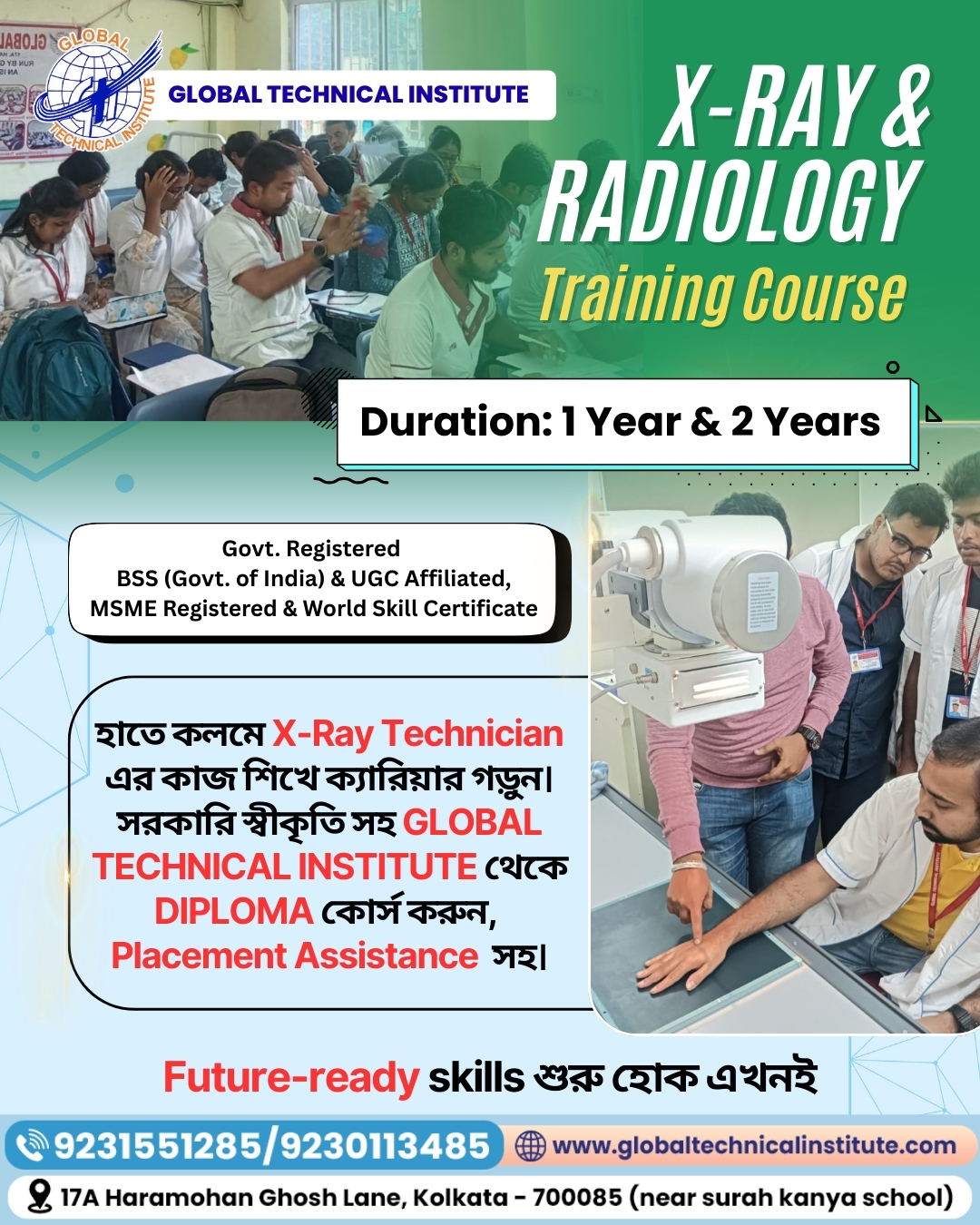
Global Technical Institute provides career-oriented training programmes in different healthcare-related fields. Its approach focuses on helping students develop subject knowledge along with practical understanding.
Students interested in X-Ray & Imaging Technology can explore the available programme, course curriculum, eligibility criteria and practical learning opportunities at Global Technical Institute.
The institute can be considered by students searching for an X-Ray & Imaging Technology Institute in Kolkata and looking for structured healthcare education.
Before making an admission decision, students should review the current programme details and understand what the course includes.
Name: Global Technical Institute – Radiology Training Institute
Address: 17A, Hara Mohan Ghosh Ln, Phool Bagan, Beleghata, Kolkata, West Bengal 700085
Phone number: 92315 51285
How Students Can Prepare for X-Ray Training
Students can make their training experience more productive by developing a few useful habits:
- Attend theoretical and practical classes regularly.
- Revise anatomy and physiology concepts.
- Pay close attention to safety instructions.
- Ask questions whenever a technical concept is unclear.
- Participate actively in supervised practical sessions.
- Develop clear and respectful communication with patients.
- Keep track of course assessments and practical requirements.
Consistent learning and active participation can help students build confidence throughout their training.
Frequently Asked Questions
What is X-Ray & Imaging Technology?
X-Ray & Imaging Technology is a healthcare-related field that focuses on the technical principles, equipment, procedures and safety practices involved in medical imaging.
What subjects are covered in X-ray technician training?
Depending on the programme, students may study anatomy, physiology, X-ray principles, patient positioning, equipment basics, image quality, radiation safety and patient care.
Is practical training included in X-ray courses?
Many training programmes include practical learning or demonstrations. Students should check the specific practical components offered by the institute before admission.
How do I choose an X-Ray Technician Institute in Kolkata?
Compare the curriculum, practical exposure, faculty support, facilities, eligibility, certification, course duration and career guidance offered by different institutes.
What are the career options after X-ray training?
Depending on the qualification and applicable requirements, students may explore opportunities in hospitals, diagnostic centres, imaging facilities and other healthcare environments.
Why consider Global Technical Institute?
Global Technical Institute offers healthcare-focused training designed to develop theoretical knowledge and practical skills. Students can contact the institute for current information about its X-Ray & Imaging Technology programme.
Start Your X-Ray & Imaging Technology Training
X-Ray & Imaging Technology brings together healthcare knowledge, technical understanding and practical skills. For students interested in medical imaging, structured training can provide a foundation in anatomy, imaging principles, equipment awareness, patient positioning and radiation safety.
If you are looking for an X-Ray Technician Institute in Kolkata or an X-Ray Training Institute in Kolkata, compare the available programmes carefully and check their curriculum, practical training and eligibility requirements.
Explore X-Ray & Imaging Technology training at Global Technical Institute and take the next step towards developing your healthcare skills. Contact Global Technical Institute to learn more about the current course, eligibility and admission process.
Read More: X-Ray & Imaging Technology Career Pathways: Skills, Training and Work Environments