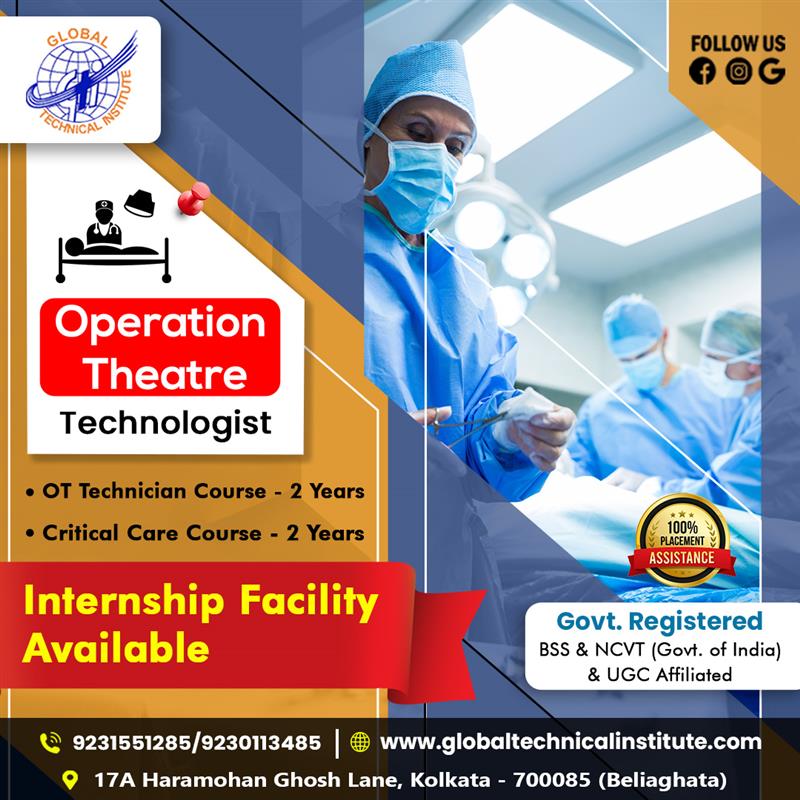
OT Technician training in Kolkata

Choosing a healthcare career is a major decision. The healthcare sector offers different career paths for students who want to work in hospitals and support patient care. One such career option is Operation Theatre Technology.
An operation theatre is one of the most important departments in a hospital. Every surgical procedure requires a clean and properly prepared environment, organised instruments, working medical equipment and a trained healthcare team. Doctors and surgeons perform the medical procedures, while Operation Theatre Technicians help prepare and maintain the operation theatre and support the surgical team within their professional responsibilities.
If you are interested in this field, choosing the right OT Technician Training Institute in Kolkata is an important first step. Before taking admission, you should understand the course types, eligibility, duration, fees, syllabus, practical training, admission process and career opportunities.
Students often have questions such as:
- What is an OT Technician course?
- What qualification is required?
- Can I join after Class 10 or Class 12?
- How long does OT Technician training take?
- What subjects are taught?
- Is practical hospital training included?
- What are the course fees?
- What jobs can I get after completing the course?
- Is the certificate recognised?
- How can I choose the right OT Technician Institute in Kolkata?
In this complete guide, we explain these points in simple language. We also discuss the training information published by Global Technical Institute so that students can understand the programme and know what to verify before admission.
Our aim is to help you make an informed decision about your healthcare education and future career.
1. What Is an OT Technician?
An OT Technician, also known as an Operation Theatre Technician or Operating Theatre Technician, is a trained healthcare support professional who helps prepare and maintain the operation theatre before, during and after surgical procedures.
The technician works as part of a surgical team. Their work supports surgeons, anaesthesiologists, nurses and other healthcare professionals.
An operation theatre must follow strict cleanliness, safety and infection-control rules. Surgical instruments and medical equipment must be properly arranged. The operating area must be prepared according to the procedure.
An OT Technician receives training to understand these responsibilities and perform assigned tasks under the supervision of qualified healthcare professionals.
Main Responsibilities of an OT Technician
The responsibilities may vary according to the hospital, qualification and job role. Common responsibilities include:
- Preparing the operation theatre before surgery.
- Checking the availability of surgical instruments and supplies.
- Arranging equipment according to the procedure.
- Supporting the maintenance of a sterile environment.
- Following infection-prevention procedures.
- Checking the basic readiness of OT equipment.
- Helping prepare the operating table and required supplies.
- Supporting patient transfer and positioning as instructed.
- Assisting the surgical team with instruments within the permitted role.
- Supporting cleaning, disinfection and restocking after surgery.
- Maintaining equipment and inventory records.
- Following biomedical waste management rules.
An OT Technician does not replace a surgeon, doctor, anaesthesiologist or registered nurse. The technician works within the limits of their training and assigned responsibilities.
2. Why Is an OT Technician Important in a Hospital?
An operation theatre is a controlled medical environment. Even a small mistake in preparation, cleanliness or equipment handling can affect patient safety.
An OT Technician helps the surgical team maintain an organised and prepared environment.
2.1 Operation Theatre Preparation
Before surgery, the OT must be ready with the required instruments, equipment, supplies and furniture. The technician helps arrange these items according to the instructions of the surgical team.
2.2 Sterilisation and Infection Control
Surgical instruments and equipment must be processed according to approved procedures. OT technicians learn about cleaning, disinfection, sterilisation, sterile storage and infection prevention.
2.3 Equipment Readiness
An operation theatre uses different types of medical equipment. The technician helps check equipment availability and readiness according to the hospital’s procedures.
2.4 Support During Surgery
During a procedure, the technician may support the surgical team by arranging and supplying required instruments and materials, depending on the assigned role and training.
2.5 Post-Surgery Preparation
After a procedure, the OT needs cleaning, waste segregation, equipment handling and restocking. The technician supports these tasks so that the room can be prepared for the next procedure.
2.6 Patient Safety
Patient safety is the main priority in every healthcare department. Following instructions, maintaining cleanliness, checking supplies and reporting problems are important parts of the OT Technician’s responsibilities.
3. What Is an OT Technician Training Course?
An OT Technician training course is a healthcare or allied health-related programme that introduces students to the operation theatre environment, surgical instruments, medical equipment, sterilisation and patient safety.
The course combines theoretical learning with practical skill development. Depending on the qualification, it may also include supervised clinical training or internship.
Students may learn about:
- Human anatomy and physiology.
- Basic medical terminology.
- Introduction to surgical procedures.
- Operation theatre preparation.
- Surgical instruments and their uses.
- Sterilisation and disinfection.
- Aseptic techniques.
- Anaesthesia equipment awareness.
- Infection control.
- Biomedical waste management.
- Patient preparation and transfer.
- Emergency procedures and safety.
- Documentation and inventory management.
- Professional behaviour in hospitals.
The exact subjects, training hours and clinical requirements depend on the course and awarding body.
Before enrolling, students should ask for the complete syllabus and verify whether the qualification is approved or recognised for the professional role they want to pursue.
4. Types of OT Technician and Operation Theatre Technology Courses
There are different educational pathways related to operation theatre technology. Students should understand the difference before choosing a programme.
A course title alone does not confirm its academic level or professional recognition.
4.1 Certificate in OT Technician Training
A certificate programme generally focuses on selected practical and technical skills related to operation theatre support.
Depending on the awarding body, the syllabus may include:
- Introduction to the operating theatre.
- Basic anatomy.
- Medical terminology.
- Surgical instrument identification.
- Cleaning and disinfection.
- Infection-control practices.
- Basic equipment awareness.
- Patient-care support.
- OT safety.
Certificate courses can vary in duration and learning hours. Students should check the awarding body, assessment method and the job roles for which the certificate is intended.
A private certificate should not automatically be treated as a recognised diploma or degree in Operation Theatre Technology.
4.2 Diploma in Operation Theatre Technology (DOTT)
Diploma in Operation Theatre Technology is a structured programme that focuses on operation theatre preparation, surgical instruments, equipment, sterilisation, patient safety and clinical procedures.
In West Bengal, the State Medical Faculty of West Bengal lists Diploma in Operation Theatre Technology (DOTT) as a course with a duration of two years plus six months of compulsory post-examination training.
Students interested in this route should check the current admission information, affiliated institution list, examination arrangements and eligibility criteria of the State Medical Faculty of West Bengal.
4.3 Diploma in Anaesthesia and Operation Theatre Technology
The Diploma in Anaesthesia and Operation Theatre Technology is a related professional pathway that includes operation theatre and anaesthesia technology.
The National Commission for Allied and Healthcare Professions (NCAHP) published its registration regulations in 2026, which list a Diploma in Anaesthesia and Operation Theatre Technology with a duration of two years and six months and a minimum of 2,000 hours.
The regulations specify that this diploma must be a government-approved or government-recognised programme. Diplomas awarded by non-government boards or bodies are not accepted under the stated qualification entry.
This is an important point for students. Before paying an admission fee, confirm the exact qualification, institution recognition and registration eligibility.
4.4 B.Sc. in Operation Theatre Technology
B.Sc. in Operation Theatre Technology is a degree-level programme that provides broader academic and practical education in operation theatre technology.
Depending on the approved course structure, students may study:
- Anatomy and physiology.
- Microbiology.
- Medical terminology.
- Surgical procedures.
- Operation theatre management.
- Surgical instruments.
- Anaesthesia technology.
- Sterilisation and infection control.
- Patient preparation.
- Clinical practice.
- Healthcare ethics and safety.
The 2026 NCAHP registration regulations list recognised degree nomenclatures in Operation Theatre and Anaesthesia Technology, including B.Sc. Operation Theatre and Anaesthesia Technology and related allied health qualifications. The listed course duration for relevant degree pathways is generally three years and six months, depending on the exact qualification.
Students must verify the applicable course name, institution recognition and current admission rules.
4.5 Bachelor of Anaesthesia and Operation Theatre Technology
The 2026 NCAHP registration regulations also list the Bachelor of Anaesthesia and Operation Theatre Technology, with a four-year duration.
This is a different academic pathway from a short-term OT Technician certificate. It should be selected by students who want to pursue the relevant degree-level qualification and meet its admission requirements.
Comparison of Different OT-Related Courses
| Programme | Typical duration or published duration | Main focus |
| Certificate in OT Technician Training | Varies by provider | Basic OT support skills |
| Diploma in Operation Theatre Technology (DOTT), West Bengal | 2 years + 6 months training | Operation theatre technology |
| Diploma in Anaesthesia and Operation Theatre Technology | 2 years and 6 months; minimum 2,000 hours under 2026 regulations | OT and anaesthesia technology |
| B.Sc. Operation Theatre and Anaesthesia Technology | 3 years and 6 months for listed qualification pathways | Degree-level allied health education |
| Bachelor of Anaesthesia and Operation Theatre Technology | 4 years under the 2026 regulations | Degree-level OT and anaesthesia technology |
These are not interchangeable qualifications. The correct choice depends on the student’s educational background, career objective and the recognition requirements for the intended role.
5. OT Technician Course Eligibility in Kolkata
Eligibility depends on the programme, awarding body and current admission rules.
Students should not assume that every OT Technician Institute in Kolkata follows the same admission requirements.
Educational Qualification
Many OT-related training providers ask students to complete Class 12. Science subjects are often preferred for programmes involving medical science, anatomy, physiology and equipment.
However, the exact requirement must be checked against the approved course prospectus.
For a recognised diploma or degree pathway, follow the eligibility rules issued by the relevant authority or university.
Minimum Marks
Some institutions and universities may specify minimum marks in Class 12. The required marks can vary according to the course and admission authority.
Ask the institute for the written eligibility criteria before applying.
Age Requirement
Age requirements depend on the course and admission authority. Some programmes may specify a minimum age or other conditions.
Do not rely on a general age limit without checking the current admission notification.
Science Background
Students with Physics, Chemistry and Biology may find it easier to understand subjects such as anatomy, physiology, microbiology and medical science.
For degree-level programmes, subject requirements must be checked in the relevant admission prospectus.
Can I Join an OT Technician Course After Class 10?
Some private skill-training programmes may accept students after Class 10, depending on the course and awarding body.
However, students should not assume that a short certificate after Class 10 is equivalent to a recognised diploma or degree in Operation Theatre Technology.
If your goal is to work in a regulated allied healthcare profession, verify the required qualification and registration pathway before admission.
Can I Join an OT Technician Course After Class 12?
Students who have completed Class 12 can explore certificate, diploma and degree-level options, depending on their subjects and marks.
For a professional programme, check:
- Required educational qualification.
- Required subjects.
- Minimum marks.
- Age conditions.
- Entrance examination requirements.
- Institution approval.
- Course recognition.
- Clinical training requirements.
6. OT Technician Course Duration
The duration depends on the qualification.
A short certificate course may have a different duration from a recognised diploma or degree programme.
For example:
- Certificate training: Depends on the provider and awarding body.
- DOTT in West Bengal: Two years plus six months of compulsory post-examination training, as listed by the State Medical Faculty of West Bengal.
- Diploma in Anaesthesia and Operation Theatre Technology: Two years and six months, with a minimum of 2,000 hours under the 2026 NCAHP regulations.
- Relevant B.Sc. Operation Theatre and Anaesthesia Technology qualification: Three years and six months under the 2026 regulations.
- Bachelor of Anaesthesia and Operation Theatre Technology: Four years under the 2026 regulations.
Students should request the official course calendar before admission. It should explain the theory period, practical hours, clinical training, examination schedule and internship requirements.
7. OT Technician Course Fees in Kolkata
The fees for an OT Technician course vary from one institution to another.
The total cost depends on:
- Type of qualification.
- Course duration.
- Awarding body.
- Institution facilities.
- Practical training arrangements.
- Clinical placement.
- Examination charges.
- Study materials.
- Uniform and other required items.
There is no single fixed fee for every OT Technician Training Institute in Kolkata.
What Is Included in OT Technician Course Fees?
Before taking admission, ask for a complete written fee structure. It may include the following:
1. Registration Fee
Some institutions charge a registration fee during the application process.
2. Admission Fee
This is the amount paid when the student confirms admission.
3. Tuition Fee
This covers classroom teaching and academic instruction.
4. Practical Training Fee
Some programmes charge separately for practical sessions, laboratory facilities or clinical training.
5. Examination Fee
This may include internal assessments, external examinations and practical examinations.
6. Study Materials
Books, notes, manuals and other learning materials may be included or charged separately.
7. Uniform and Equipment
Students may need an appropriate uniform and basic training materials.
8. Certificate or Assessment Charges
Some awarding bodies may have separate assessment or certificate fees.
How to Compare OT Technician Course Fees
Do not choose an institute only because it offers the lowest fee.
Compare the complete course structure and understand what you will receive.
Ask these questions:
- What is the total course fee?
- Is the fee payable in instalments?
- Are practical training charges included?
- Are examination fees included?
- Is the uniform included?
- Are there any additional charges?
- What is the refund policy?
- Which organisation awards the certificate?
- Is the course recognised for the intended professional role?
What Are the OT Technician Training Fees at Global Technical Institute?
Global Technical Institute’s published OT Technician training page describes the programme and its training features but does not display a complete fee amount.
Students should contact the institute directly for the latest fee structure, instalment options and any additional charges.
Always request the total fee in writing before making a payment.
8. OT Technician Course Syllabus: What Will You Learn?
The syllabus is one of the most important parts of an OT Technician training programme.
A well-planned course should cover both theoretical knowledge and practical skills. The exact subjects depend on the approved curriculum.
Below are common learning areas in operation theatre technology.
8.1 Human Anatomy and Physiology
Anatomy is the study of the structure of the human body. Physiology explains how different body systems work.
Students learn about:
- Bones and muscles.
- Heart and blood circulation.
- Respiratory system.
- Digestive system.
- Nervous system.
- Urinary system.
- Reproductive system.
- Basic body functions.
This knowledge helps students understand the medical environment and surgical procedures.
8.2 Medical Terminology
Healthcare professionals use specific medical terms when discussing patients, procedures and equipment.
Students learn common medical words, abbreviations and terms used in hospitals.
8.3 Introduction to Surgery
This subject introduces students to the purpose of surgery and different categories of surgical procedures.
Students may learn about general surgery, orthopaedic surgery, gynaecological surgery, neurological surgery and other specialities.
8.4 Surgical Instruments
Students learn to identify common surgical instruments and understand their general purpose.
Examples include:
- Scissors.
- Forceps.
- Retractors.
- Clamps.
- Needle holders.
- Surgical trays.
- Suction equipment.
Correct identification, handling, counting and processing of instruments are important parts of OT work.
8.5 Sterilisation and Disinfection
Surgical instruments and equipment must be processed according to approved infection-control procedures.
Students learn the difference between cleaning, disinfection and sterilisation.
They may also study autoclaves, sterile storage, instrument handling and the importance of following hospital protocols.
8.6 Operation Theatre Preparation
Students learn how an operation theatre is prepared before surgery.
This may include:
- Checking the room.
- Arranging required instruments.
- Checking supplies.
- Preparing the operating table.
- Supporting equipment readiness.
- Following the surgical checklist.
- Maintaining the required environment.
8.7 Anaesthesia Equipment Awareness
Students are introduced to common anaesthesia equipment and its purpose.
The training may include awareness of anaesthesia machines, breathing circuits, monitoring devices and suction equipment.
Any clinical task involving anaesthesia must be performed only within the technician’s authorised role and under qualified supervision.
8.8 Infection Control
Infection control is essential in the operation theatre.
Students learn about:
- Hand hygiene.
- Personal protective equipment.
- Aseptic techniques.
- Safe instrument handling.
- Cleaning and disinfection.
- Biomedical waste segregation.
- Prevention of cross-contamination.
8.9 Biomedical Waste Management
Hospitals generate different types of biomedical waste. Students learn the importance of segregation, handling, storage and disposal according to applicable rules and hospital procedures.
8.10 Patient Preparation and Transfer
Students learn how patients are prepared for transfer to and from the operation theatre.
They are introduced to patient identification, safe movement, privacy and communication with the healthcare team.
8.11 Documentation and Inventory Management
An operation theatre uses many instruments, consumables and medical supplies.
Students learn why proper documentation, stock checking, instrument counts and equipment records are important.
8.12 Emergency Awareness
The operation theatre is a critical-care environment. Students learn about emergency awareness, safety procedures and the importance of quickly informing qualified professionals when a problem occurs.
9. Importance of Practical Training in an OT Technician Course
Practical training is one of the most important parts of operation theatre education.
Students cannot fully understand the operation theatre environment through textbooks alone. They need supervised exposure to equipment, instruments, safety procedures and hospital workflows.
Practical training helps students understand how theoretical knowledge is used in a real healthcare setting.
What Can Students Learn During Practical Training?
Depending on the programme and approved clinical arrangement, students may receive training in:
- Identifying surgical instruments.
- Preparing instrument trays.
- Understanding sterilisation procedures.
- Arranging OT supplies.
- Learning equipment checks.
- Following infection-control protocols.
- Understanding patient transfer procedures.
- Maintaining records.
- Supporting cleaning and restocking.
- Observing surgical team coordination.
Why Is Hospital Exposure Important?
Hospital exposure helps students understand:
- How an operation theatre functions.
- How different healthcare professionals work together.
- Why communication is important.
- How equipment is arranged.
- How safety procedures are followed.
- How the OT is prepared between procedures.
- How professional discipline is maintained.
Students should ask whether practical training is conducted in a laboratory, simulation facility or hospital. They should also ask who supervises the training and how the practical hours are recorded.
For a recognised qualification, practical and clinical training must meet the applicable curriculum and regulatory requirements.
10. Admission Process for OT Technician Training in Kolkata
The admission process depends on the course and institution.
Some recognised diploma and degree programmes may follow a formal admission or counselling process. Private skill-training programmes may have a direct application process.
Step 1: Choose the Right Course
First, decide whether you want to pursue a certificate, diploma or degree in operation theatre technology.
Understand the difference between these qualifications.
Step 2: Check Eligibility
Review the educational qualification, subjects, marks and age requirements.
Step 3: Verify Recognition
Check whether the institution and programme have the approval or recognition required for the qualification.
For recognised allied healthcare programmes, verify the relevant NCAHP requirements and applicable institutional recognition.
Step 4: Contact the Institute
Ask about course duration, fees, class schedule, syllabus, practical training and examination arrangements.
Step 5: Submit the Application
Complete the application form and provide the required documents.
Step 6: Attend Counselling or an Admission Interview
Some institutes may conduct counselling or an interview to understand the student’s educational background and course preference.
Step 7: Confirm the Fee Structure
Read the fee details and payment conditions before paying.
Step 8: Complete Admission
Submit the required documents, pay the applicable fee and collect an official admission confirmation and receipt.
Step 9: Attend Classes and Practical Sessions
Follow the course schedule, attendance requirements and practical training instructions.
11. Documents Required for OT Technician Admission
The exact document list depends on the institute and course.
Commonly requested documents may include:
- Class 10 marksheet.
- Class 10 certificate.
- Class 12 marksheet.
- Class 12 certificate.
- Passport-size photographs.
- Government-issued photo identity proof.
- Address proof.
- Date-of-birth proof.
- Transfer certificate, if required.
- Caste certificate, if applicable.
- Other documents mentioned in the admission notice.
For degree or recognised diploma programmes, additional documents may be required.
Before submitting original certificates, ask whether the institute needs the original document for verification or only an attested copy.
Always collect a receipt for submitted documents and payments.
12. Career Opportunities After OT Technician Training
After completing an appropriate OT-related qualification, candidates may explore different healthcare roles.
The exact job opportunities depend on the qualification, recognition, registration requirements, practical experience and employer conditions.
12.1 Operation Theatre Technician
An Operation Theatre Technician supports the operation theatre team by helping prepare the room, arrange equipment and follow safety procedures.
12.2 OT Assistant
An OT Assistant supports the operation theatre team with preparation, cleaning, supplies and other assigned responsibilities.
The duties depend on the employer and the candidate’s training.
12.3 Surgical Instrument Technician
A surgical instrument technician may work with instrument preparation, identification, cleaning, processing and storage.
12.4 Scrub Technician
A scrub technician works within the sterile field and supports the surgical team with instruments and supplies, according to their training and authorised responsibilities.
12.5 Central Sterile Supply Department (CSSD) Technician
The CSSD is responsible for processing, sterilising, storing and distributing reusable medical instruments and supplies.
Candidates with relevant training may explore CSSD-related roles.
12.6 Anaesthesia Technology Support
Candidates with the appropriate anaesthesia and operation theatre technology qualification may explore roles involving support for anaesthesia equipment and related procedures under qualified professionals.
12.7 Surgical Centre Support
Multispeciality hospitals and surgical centres may recruit eligible technical staff to support their operation theatre departments.
12.8 Medical Equipment Industry
Some candidates may explore suitable technical support, product demonstration or equipment-related roles with medical device and surgical equipment companies. Requirements vary by employer.
13. Where Can an OT Technician Work?
OT-related professionals may find opportunities in different healthcare facilities, depending on their qualifications and experience.
Government Hospitals
Government hospitals have operation theatres for general and specialised surgical procedures. Recruitment usually follows the qualification and eligibility rules in the official job notification.
Private Hospitals
Private hospitals may recruit OT technicians and other operation theatre support professionals for surgical departments.
Multispeciality Hospitals
These hospitals have different surgical departments and may require technical staff with relevant training and experience.
Nursing Homes
Some nursing homes operate surgical facilities and may recruit eligible OT support staff.
Day-Care Surgical Centres
These centres perform selected procedures that do not always require a long hospital stay.
Speciality Surgical Centres
Candidates with relevant experience may explore opportunities in facilities focused on orthopaedics, cardiac care, neurology, gynaecology and other specialities.
Central Sterile Supply Departments
CSSD departments support hospitals by processing and managing reusable instruments and medical supplies.
14. OT Technician Salary in Kolkata
Salary is an important consideration for students planning a healthcare career.
However, there is no single fixed salary for every OT Technician.
Salary depends on:
- Educational qualification.
- Course recognition.
- Professional registration, where applicable.
- Practical training.
- Hospital type.
- Job responsibilities.
- Location.
- Work experience.
- Specialised technical skills.
An entry-level support role may offer a different salary from a position requiring a recognised diploma or degree and relevant clinical experience.
What Affects an OT Technician’s Salary?
Qualification: Employers may set different salary levels for certificate, diploma and degree holders.
Experience: Candidates with practical experience may qualify for more responsibilities.
Hospital Type: Large hospitals, speciality centres and smaller healthcare facilities may have different salary structures.
Technical Skills: Knowledge of instruments, equipment, sterilisation and safety procedures can support career development.
Job Role: An OT Assistant, CSSD Technician and qualified Operation Theatre Technologist may have different responsibilities and salary ranges.
How Can Students Improve Their Career Prospects?
- Complete an appropriate recognised qualification.
- Develop strong practical skills.
- Learn correct instrument handling.
- Understand sterilisation and infection control.
- Improve communication skills.
- Follow professional safety standards.
- Gain relevant supervised clinical experience.
- Continue learning about new equipment and procedures.
Students should compare current job advertisements in Kolkata to understand actual salary offers. Avoid relying on unverified salary promises.
15. Skills Required to Become a Good OT Technician
An OT Technician works in a highly organised environment. Technical knowledge is important, but personal qualities also matter.
Attention to Detail
Every instrument, supply and piece of equipment must be handled carefully. Students should develop the habit of checking details.
Discipline
Operation theatre work follows strict schedules and safety rules. Punctuality and professional behaviour are essential.
Teamwork
OT technicians work with surgeons, nurses, anaesthesiologists and other healthcare staff. Good teamwork supports smooth operation theatre activities.
Communication
Clear communication helps prevent confusion and supports safe teamwork.
Calmness Under Pressure
Surgical environments can be demanding. Students should learn to remain calm and follow instructions during challenging situations.
Responsibility
Patient safety is a serious responsibility. Technicians must follow their training and report any issue to the appropriate professional.
Technical Interest
An interest in medical equipment, instruments and healthcare technology can help students learn more effectively.
16. How to Choose the Best OT Technician Training Institute in Kolkata
Choosing the right OT Technician Training Institute in Kolkata requires careful research.
A good institute should provide clear information about its course, faculty, syllabus, practical training, certificate and career support.
Use these points before taking admission.
16.1 Check Course Recognition
This is one of the most important steps.
Ask whether the course is a recognised qualification or a private skill-training certificate.
If the course is advertised as a recognised diploma or degree, ask for documentary proof of the institution’s approval and the qualification’s recognition.
16.2 Verify the Awarding Body
Find out which organisation awards the certificate or diploma.
Ask whether the awarding body is authorised to provide the qualification and whether the course is accepted for the intended professional role.
16.3 Review the Syllabus
Ask for a detailed syllabus. It should explain the subjects, practical sessions, assessment method and clinical training requirements.
16.4 Check Practical Training Facilities
Practical training is important in operation theatre technology.
Ask whether the institute provides laboratory demonstrations, simulation training or supervised hospital exposure.
16.5 Check Faculty Qualifications
Ask about the qualifications and relevant experience of the faculty members.
For a professional programme, verify that teaching and clinical supervision meet the applicable requirements.
16.6 Understand the Complete Fees
Ask for the full fee structure in writing.
Check whether tuition, practical training, examination, study materials, uniform and certificate charges are included.
16.7 Ask About Placement Support
Some institutes may provide career guidance, interview preparation or placement assistance.
Ask what support is actually available. Placement assistance is not the same as guaranteed employment.
16.8 Visit the Institute
If possible, visit the campus and speak with the admission team.
Review the facilities, ask questions and request course-related documents.
16.9 Read the Admission Terms
Understand the attendance requirements, examination rules, refund policy and certificate conditions before paying.
17. OT Technician Training at Global Technical Institute, Kolkata
Global Technical Institute provides training programmes for students interested in developing practical and career-related skills.
The institute has published a dedicated page titled Certified OT Technician Training Institute with Practical Operation Theatre Training.
According to the published page, the programme focuses on operation theatre preparation, surgical instruments, sterilisation, anaesthesia equipment awareness, infection control, emergency protocols and documentation.
The page also describes practical operation theatre exposure and guidance from experienced teaching professionals.
What Does the Published Programme Cover?
The course information on the GTI website mentions the following learning areas:
- Human anatomy and physiology.
- Surgical terminology and basic surgical knowledge.
- Sterilisation and disinfection.
- Aseptic techniques.
- Surgical instrument identification and handling.
- Operation theatre preparation.
- Anaesthesia equipment awareness.
- Infection control and biomedical waste management.
- Emergency protocols.
- Documentation and inventory management.
- Professional conduct in surgical settings.
These areas are important for students who want to understand how an operation theatre functions.
Practical Operation Theatre Training
The GTI page describes practical training and exposure to real operation theatre environments under the supervision of experienced surgical and OT teams.
Before admission, students should ask for the names of the clinical training facilities, the practical schedule, the number of training hours, the supervision arrangements and the method used to record practical attendance.
Faculty and Learning Support
The institute’s page describes faculty members with experience in surgical departments and operation theatres.
Students can ask about the qualifications, professional experience and teaching responsibilities of the faculty members before joining.
Placement Assistance
The GTI page mentions placement support, career counselling and employer connections.
Students should confirm the current placement assistance process, the employers involved, the types of roles offered and whether support means interview assistance or another service.
Placement assistance should not be understood as a guarantee of employment.
Who Can Contact Global Technical Institute?
The published programme page identifies the following types of students as potential candidates:
- Students who have completed Class 12, with a Science background preferred.
- Graduates interested in healthcare-related training.
- Existing healthcare support workers who want to explore operation theatre work.
- Students interested in surgical healthcare and medical technology.
The exact eligibility for the current programme should be confirmed directly with the institute.
Important Course Recognition Information
The GTI page describes its OT Technician training and certification. However, students should not assume that a private certificate is equivalent to a government-recognised diploma or degree in Operation Theatre Technology.
The 2026 NCAHP registration regulations specify recognised qualification pathways for Operation Theatre Technologists and related professionals. They also state that the listed Diploma in Anaesthesia and Operation Theatre Technology must be government-approved or government-recognised.
Before admission, students should request written details of:
- The exact name of the qualification.
- The awarding organisation.
- The institution’s approval or recognition.
- The course duration and total training hours.
- The practical and clinical training arrangements.
- The examination and assessment process.
- Whether the qualification meets the applicable professional registration requirements.
This information helps students understand what the course can and cannot qualify them to do.
Global Technical Institute Contact Details
Students can contact Global Technical Institute for current course information, eligibility, admission and fees.
Name: Global Technical Institute — OT Technician Training Institute in Kolkata
Address: 17 A, Hara Mohan Ghosh Ln, Phool Bagan, Beleghata, Kolkata, West Bengal 700085
Phone Number: 8961008489
Map:
18. Is an OT Technician Course Suitable for You?
An OT Technician course may be suitable for students who are interested in healthcare, medical technology and surgical environments.
Before joining, think about your interests and expectations.
This career may suit you if:
- You are interested in hospital work.
- You want to understand medical instruments and equipment.
- You can follow instructions carefully.
- You are comfortable working as part of a team.
- You can maintain discipline and cleanliness.
- You are interested in patient safety.
- You can work in a structured and demanding environment.
However, students should understand that operation theatre work is not always easy. It may involve long hours, emergency situations, strict hygiene requirements and close coordination with healthcare professionals.
A genuine interest in patient safety and professional responsibility is important.
19. Difference Between OT Technician and OT Nurse
Students sometimes confuse an OT Technician with an Operation Theatre Nurse.
Both work in the operation theatre, but their educational qualifications and responsibilities are different.
| OT Technician | OT Nurse |
| Trained in operation theatre technology or relevant technical support | A registered nurse with the required nursing qualification |
| Supports OT preparation and equipment readiness | Provides nursing care and performs nursing responsibilities |
| Helps with instruments, supplies and technical support within the assigned role | Supports patient care, monitoring and nursing procedures |
| Works within the scope of the technical qualification | Works within the scope of nursing education and registration |
An OT Technician is not automatically a nurse. A technical training certificate does not provide nursing registration.
Students should select their course based on the career they want to pursue.
20. Common Mistakes Students Should Avoid Before Admission
Before choosing an OT Technician Institute in Kolkata, avoid these common mistakes.
Mistake 1: Choosing Only by Course Fees
A low fee does not automatically mean a good course. Compare the syllabus, recognition, training facilities and certificate.
Mistake 2: Not Checking the Awarding Body
Always ask who will issue the final certificate or diploma.
Mistake 3: Confusing a Certificate with a Recognised Diploma
Different qualifications have different professional value. Check the recognition status before admission.
Mistake 4: Ignoring Practical Training
Ask about the practical schedule, clinical exposure and supervision.
Mistake 5: Believing Every Course Guarantees a Job
No training programme should be assumed to guarantee employment. Job opportunities depend on qualification, skills and employer requirements.
Mistake 6: Not Reading the Admission Terms
Check the fee, refund policy, attendance requirements and examination conditions.
Mistake 7: Not Checking Future Registration Requirements
If your goal is to work as a recognised allied healthcare professional, confirm the applicable qualification and registration pathway before enrolling.
21. Frequently Asked Questions About OT Technician Training in Kolkata
1. What is an OT Technician course?
An OT Technician course teaches students about operation theatre preparation, surgical instruments, medical equipment, sterilisation, infection control, patient safety and surgical team support.
2. Which is the best OT Technician Training Institute in Kolkata?
The right institute depends on your career goal. Compare course recognition, syllabus, faculty qualifications, practical training, fees, awarding body and placement support before taking admission.
3. What is the eligibility for an OT Technician course?
Eligibility depends on the programme. Many training providers ask for Class 12, with Science preferred. Recognised diploma and degree programmes may have specific subject, marks and age requirements. Check the current prospectus.
4. Can I do an OT Technician course after Class 10?
Some private skill-training programmes may accept Class 10 students. However, students must check whether the certificate is suitable for their intended job role. It should not automatically be treated as a recognised diploma or degree.
5. Can I join OT Technician training after Class 12?
Yes, students who have completed Class 12 can explore suitable OT-related certificate, diploma and degree programmes, subject to the applicable eligibility rules.
6. Is Science compulsory for an OT Technician course?
Science is preferred for many programmes because the syllabus includes anatomy, physiology and medical science. However, exact subject requirements depend on the qualification and awarding authority.
7. What is the duration of an OT Technician course?
The duration varies. The State Medical Faculty of West Bengal lists DOTT as two years plus six months of compulsory post-examination training. Other recognised qualifications have different durations.
8. What is the duration of a Diploma in Operation Theatre Technology in West Bengal?
The State Medical Faculty of West Bengal lists the Diploma in Operation Theatre Technology as two years plus six months of compulsory post-examination training. Students should check the latest admission information.
9. What is the duration of a Diploma in Anaesthesia and Operation Theatre Technology?
The 2026 NCAHP registration regulations list the Diploma in Anaesthesia and Operation Theatre Technology as two years and six months, with a minimum of 2,000 hours.
10. What are the OT Technician course fees in Kolkata?
Fees vary by institution, course duration, awarding body and practical training arrangements. Ask for the complete written fee structure before admission.
11. What subjects are taught in an OT Technician course?
Common subjects include anatomy, physiology, medical terminology, surgical instruments, sterilisation, infection control, operation theatre preparation, anaesthesia equipment awareness, biomedical waste management and documentation.
12. Is practical training included in OT Technician courses?
Practical training depends on the programme. Students should confirm the practical hours, training location, supervision arrangements and clinical requirements before admission.
13. What is the role of an OT Technician in a hospital?
An OT Technician helps prepare the operation theatre, arrange instruments and supplies, support equipment readiness, follow infection-control procedures and assist the surgical team within the permitted role.
14. Can an OT Technician assist during surgery?
An OT Technician may provide technical and instrument-related support during surgery according to their training, assigned responsibilities and hospital protocols. They do not perform the duties of a surgeon or independently make medical decisions.
15. What is the difference between an OT Technician and an OT Assistant?
The job titles can vary between hospitals. An OT Assistant may focus on general preparation, cleaning and support tasks, while an OT Technician may have additional technical training and responsibilities. The actual job description depends on the employer and qualification.
16. What is the difference between OT Technician and OT Nurse?
An OT Technician is trained in operation theatre technology and technical support. An OT Nurse is a registered nursing professional with nursing qualifications and responsibilities. One qualification does not replace the other.
17. Where can I work after OT Technician training?
Depending on the qualification and employer requirements, opportunities may be available in hospitals, nursing homes, surgical centres, day-care operation theatres and Central Sterile Supply Departments.
18. What is the salary of an OT Technician in Kolkata?
Salary depends on qualification, experience, hospital, job responsibilities and employer. Students should compare current job advertisements to understand the salary range for specific roles.
19. Is an OT Technician certificate valid for government jobs?
Government recruitment depends on the qualification and eligibility stated in the official job notification. A private certificate is not automatically accepted for every government OT Technician vacancy.
20. Is a private OT Technician certificate the same as a government-recognised diploma?
No. A private training certificate and a government-recognised diploma may have different academic and professional status. Students should verify the awarding body and recognition before admission.
21. Does an OT Technician need professional registration?
Registration requirements depend on the professional category and qualification under the applicable allied healthcare regulations. Students should check the current NCAHP rules and verify whether their specific qualification and institution meet the requirements.
22. Can I work in a CSSD department after OT Technician training?
Some candidates with suitable training may apply for CSSD-related roles. Employers may require specific CSSD training or experience, so students should check the job requirements.
23. Is OT Technician a good career option?
It may be a suitable career for students interested in surgical healthcare, medical equipment, infection control and hospital work. Career prospects depend on the quality and recognition of the qualification, practical skills and employer requirements.
24. Does Global Technical Institute offer OT Technician training in Kolkata?
Global Technical Institute has published a dedicated OT Technician training page that describes its course topics, practical operation theatre exposure and career support. Students should contact the institute to confirm the current course structure, eligibility, fees and certificate details.
25. How can I contact Global Technical Institute for OT Technician admission?
You can contact Global Technical Institute using the phone numbers 9231551285, 9230113485 or 8961008489. The institute is located at 17A, Hara Mohan Ghosh Lane, Beliaghata, Kolkata – 700085. Confirm the current admission details directly.
26. What documents are required for OT Technician admission?
Common documents include Class 10 and Class 12 marksheets, certificates, photographs, identity proof and address proof. The exact list depends on the institute and course.
27. Can I study further after completing an OT Technician course?
Further study options depend on the qualification you complete. Students should check whether their certificate or diploma meets the entry requirements for a recognised higher programme.
28. What should I check before paying the OT Technician admission fee?
Check the exact qualification, awarding body, institution recognition, eligibility, duration, syllabus, practical training, total fees, examination process and refund policy. Collect written confirmation and an official payment receipt.
22. Final Checklist Before Joining an OT Technician Training Institute
Before taking admission, use this checklist to make a better decision.
- I have selected the right OT-related course.
- I meet the educational eligibility requirements.
- I understand the course duration.
- I have checked the institution’s recognition status.
- I know which organisation awards the qualification.
- I understand whether the qualification supports professional registration.
- I have reviewed the complete syllabus.
- I have asked about practical and clinical training.
- I have checked the faculty qualifications.
- I have received the complete fee structure.
- I understand the examination process.
- I have checked the placement assistance details.
- I have read the refund and admission terms.
Conclusion: Choose the Right OT Technician Training Institute in Kolkata for Your Future
An OT Technician plays an important role in the healthcare sector by supporting the surgical team and helping maintain a safe and organised operation theatre environment. This career requires technical knowledge, practical skills, discipline, attention to detail and a strong sense of responsibility.
If you are planning to build a career in this field, choosing the right OT Technician Training Institute in Kolkata is an important first step. Before taking admission, compare the available courses, eligibility, duration, fees, syllabus, practical training and career opportunities. Most importantly, verify the course recognition, awarding body and professional registration requirements so that your qualification matches your future goals.
At Global Technical Institute, we aim to provide students with information about OT Technician training, practical learning and healthcare career opportunities. Students can contact our admissions team to understand the published programme, current eligibility, fee structure and training arrangements.
A successful career in operation theatre technology begins with the right education and a commitment to patient safety. Take time to understand your options, ask the right questions and choose a training programme that supports your long-term career plans.
Read More: Nursing Training in Kolkata: A Complete Guide to Courses, Eligibility, Fees & Career Opportunities