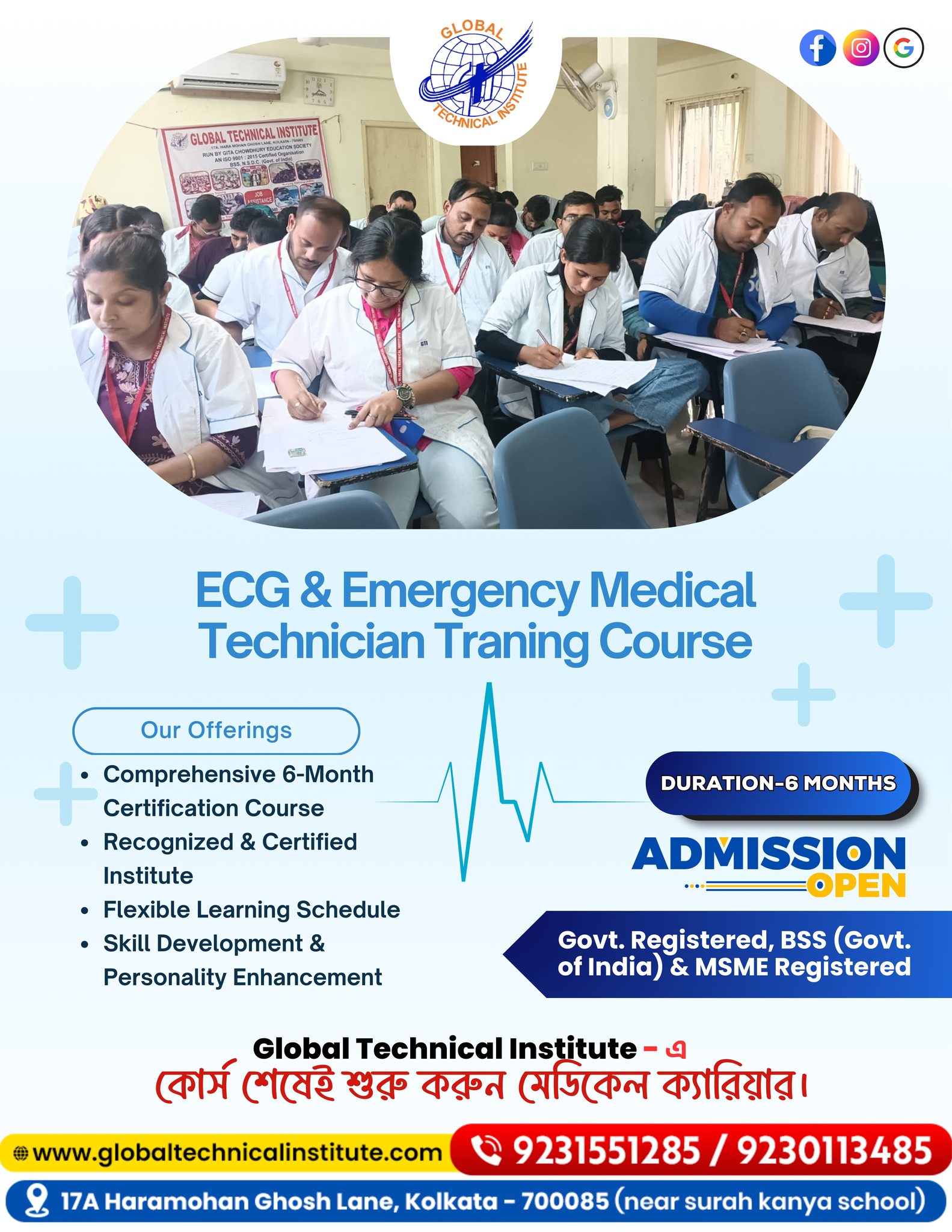
ECG technician training in Kolkata
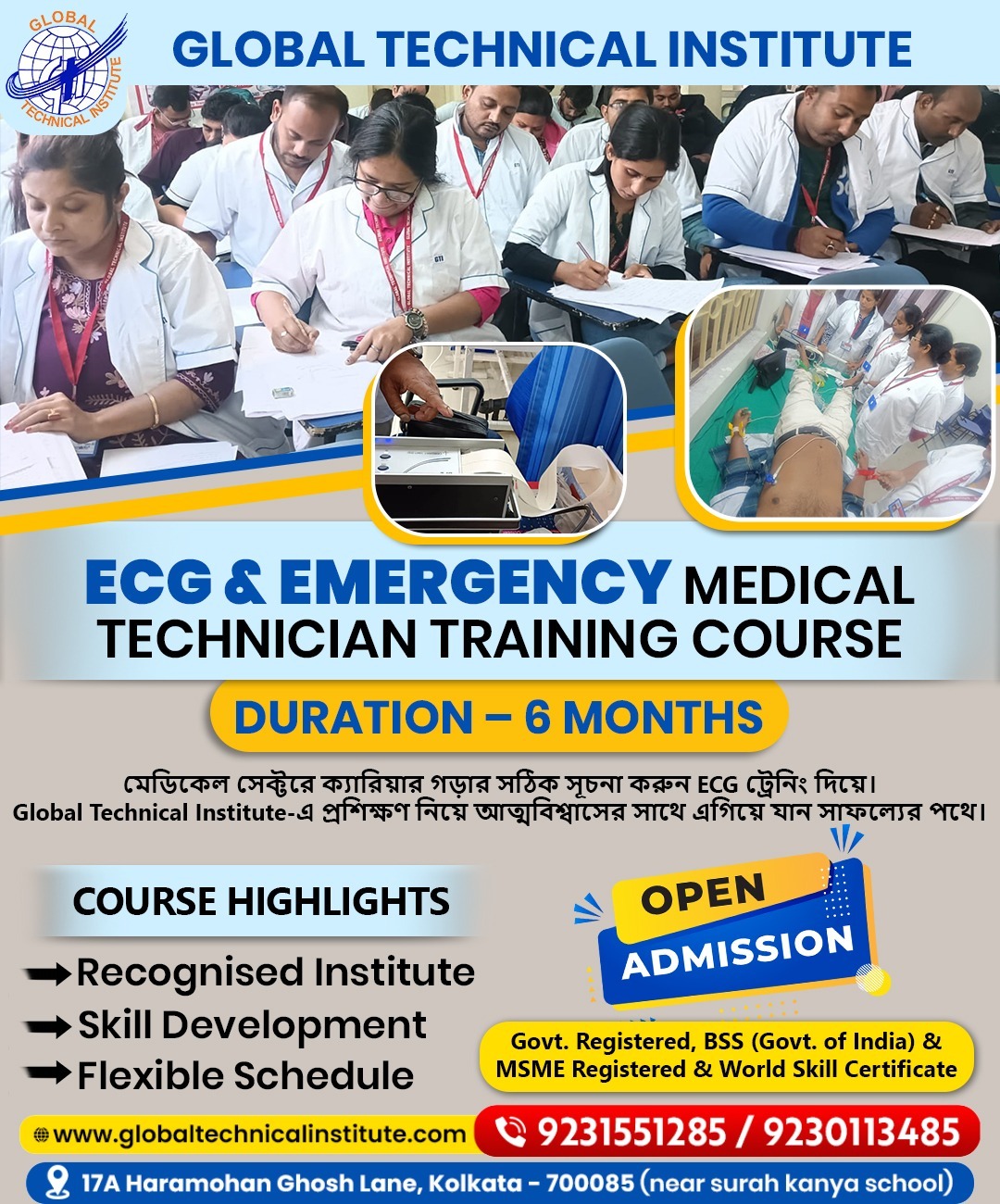
So, you have decided to pursue a career as an ECG Technician — great choice. But before you enrol at any ECG Technician Training Institute in Kolkata, it is natural to ask: what exactly will I be learning? Is the course comprehensive enough to prepare me for real hospital environments? Will I graduate with skills that employers actually value?
These are exactly the right questions to ask. In this blog, we break down the complete syllabus that a credible ECG Technician Institute in Kolkata like Global Technical Institute (GTI) covers — so you know what to expect before, during, and after your training.
Why the Right Syllabus Makes All the Difference
A well-designed syllabus is the backbone of any quality ECG Technician Training Institute. It ensures that students are not just memorising theory but are also developing practical, hands-on competencies that translate directly into the workplace. The best institutes in Kolkata align their curriculum with national healthcare training standards and real clinical requirements.
According to the Allied Health Sciences Council of India, structured training programmes that combine theory with supervised clinical practice are essential for producing job-ready allied health professionals — and the ECG technician curriculum at GTI is built exactly around this principle.
Module-by-Module: The Complete ECG Technician Syllabus in Kolkata
Here is a comprehensive look at the core subjects and topics covered across a full ECG Technician programme:
| Module 1: Human Anatomy & Physiology (Cardiac Focus) | |
| 1. | Structure and function of the human heart |
| 2. | Cardiac chambers, valves, and blood flow |
| 3. | The cardiac conduction system (SA node, AV node, Bundle of His, Purkinje fibres) |
| 4. | The cardiovascular system and its role in the body |
| 5. | Common cardiac conditions and terminology |
| Module 2: Basics of Electrocardiography | |
| 1. | Introduction to ECG — history and clinical importance |
| 2. | Understanding electrical activity of the heart |
| 3. | ECG leads: limb leads, precordial leads, and their placement |
| 4. | The standard 12-lead ECG system |
| 5. | Reading ECG paper, scales, and basic measurements |
| Module 3: ECG Machine Operation & Techniques | |
| 1. | Types of ECG machines and their components |
| 2. | Proper patient preparation and electrode placement |
| 3. | Step-by-step procedure for recording a 12-lead ECG |
| 4. | Troubleshooting common ECG artefacts and errors |
| 5. | Maintenance and calibration of ECG equipment |
| Module 4: ECG Interpretation — Waveforms & Rhythms | |
| 1. | Identifying P wave, QRS complex, T wave, and U wave |
| 2. | Normal sinus rhythm and its characteristics |
| 3. | Recognising common arrhythmias: bradycardia, tachycardia, atrial fibrillation |
| 4. | Bundle branch blocks and their ECG patterns |
| 5. | ST segment changes and signs of myocardial ischaemia |
| Module 5: Advanced Cardiac Monitoring Procedures | |
| 1. | Holter monitoring — setup, recording, and report preparation |
| 2. | Ambulatory ECG and its clinical uses |
| 3. | Exercise stress testing (Treadmill/TMT) — protocols and safety |
| 4. | Event monitoring and telemetry basics |
| 5. | Paediatric ECG recording techniques |
| Module 6: Clinical Practice & Patient Care | |
| 1. | Patient communication, consent, and ethical responsibilities |
| 2. | Infection control and biomedical waste management |
| 3. | Medical records, documentation, and report writing |
| 4. | Emergency response and basic life support (BLS) awareness |
| 5. | Hospital protocols and interdepartmental coordination |
| Module 7: Pharmacology & Pathology Basics | |
| 1. | Common cardiac medications and their effects on ECG |
| 2. | Electrolyte imbalances and their ECG manifestations |
| 3. | Overview of common cardiac diseases: MI, heart failure, pericarditis |
| 4. | Lab values relevant to cardiac patient care |
| 5. | Introduction to echocardiography and nuclear cardiology (overview) |
| Module 8: Internship & Supervised Clinical Training | |
| 1. | Supervised ECG recording in a real hospital or diagnostic lab setting |
| 2. | Observation and assistance in cardiology OPD and ICU |
| 3. | Practical assessment of ECG interpretation skills |
| 4. | Case study presentations and clinical report writing |
| 5. | Final clinical competency evaluation by qualified cardiologists |
Why GTI’s ECG Technician Syllabus Stands Out in Kolkata
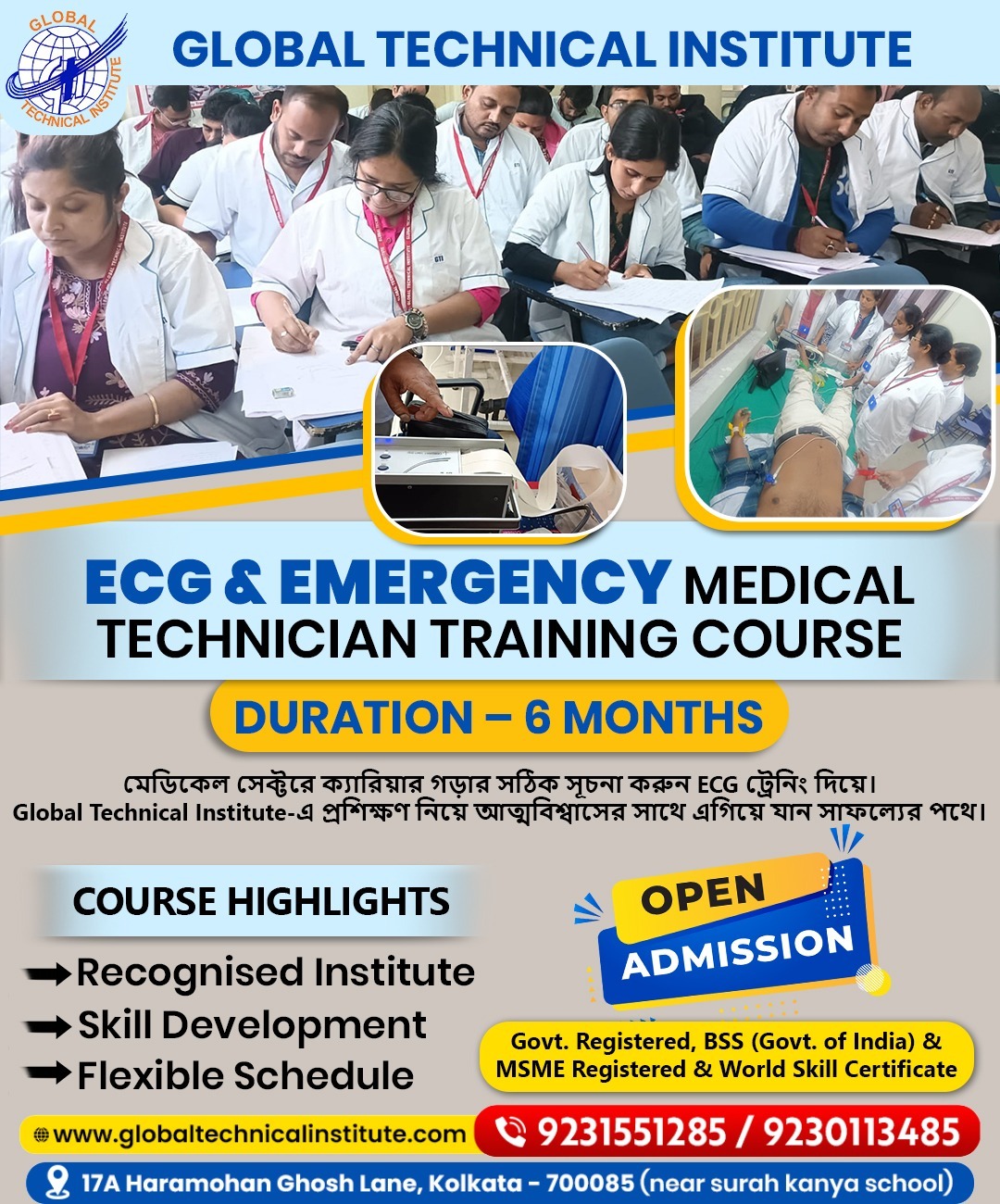
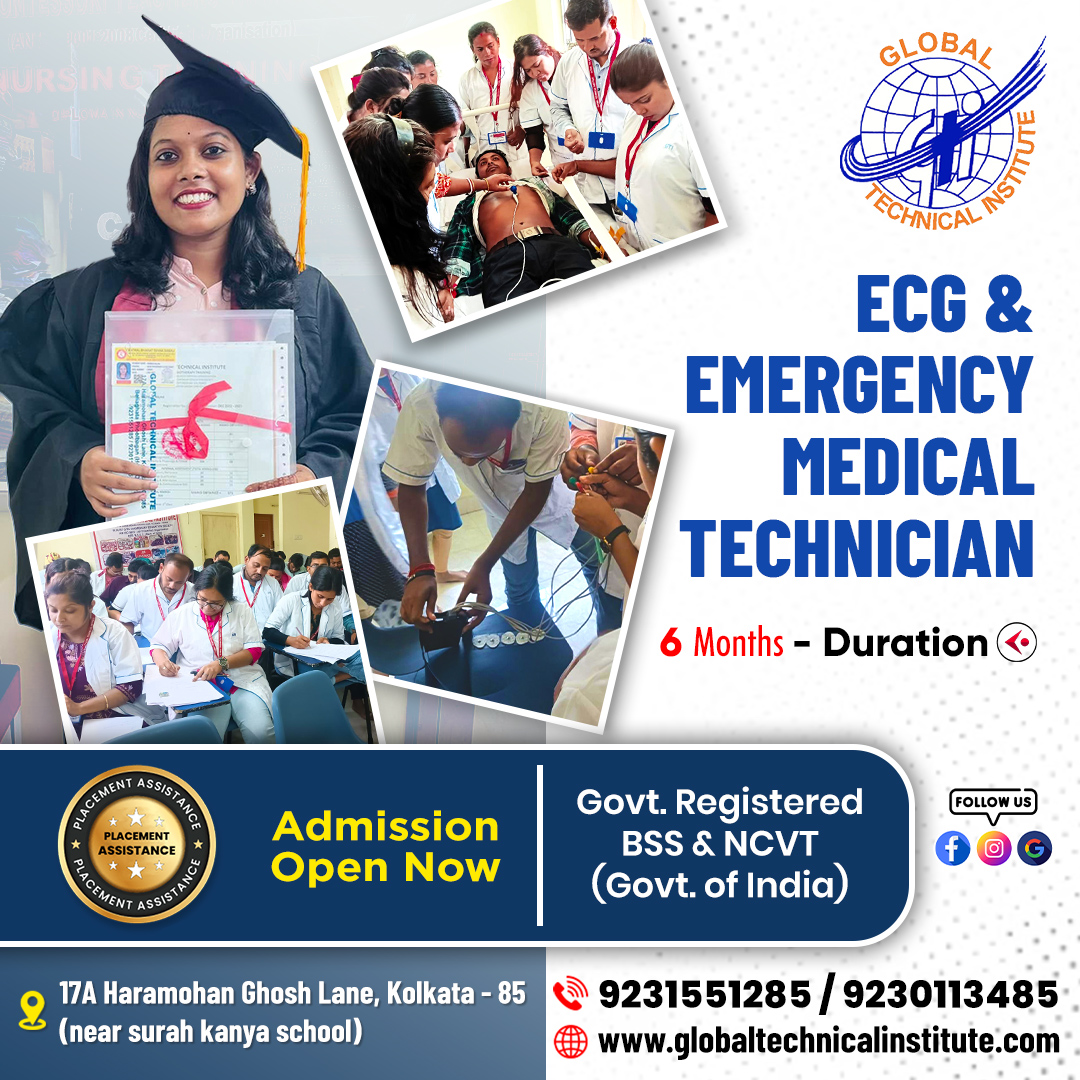
At Global Technical Institute, the ECG Technician Training syllabus is not just a list of topics on paper. It is a living curriculum taught by faculty with active clinical experience in cardiac care, reinforced by hands-on sessions in GTI’s dedicated ECG lab, and validated through hospital internship partnerships across Kolkata.
What sets GTI apart as an ECG Technician Training Institute in Kolkata is the balance it strikes between rigorous theory, hands-on equipment training, and real-world clinical exposure — all in one structured programme.
- Modern ECG lab with the latest cardiac monitoring equipment
- Clinical internships in partner hospitals across West Bengal
- Expert faculty with cardiology and allied health backgrounds
- Recognised certification respected by private and government healthcare employers
- Placement support to help you land your first job — visit GTI’s ECG Training page for details
Frequently Asked Questions (FAQs)
Q: Is the ECG Technician syllabus the same across all institutes in Kolkata?
A: Core subjects like anatomy, ECG recording, and interpretation are common across most institutes. However, the depth of clinical training, internship quality, and equipment exposure vary significantly. Always check the detailed syllabus before enrolling.
Q: Does the ECG Technician Training include practical lab sessions?
A: Yes. Reputed institutes like GTI include dedicated lab sessions and hospital internships as a core part of the syllabus — not as an add-on. Practical training is essential for workplace readiness.
Q: Will I learn to interpret ECG reports during the course?
A: Absolutely. ECG interpretation — including waveform analysis, rhythm identification, and recognising common arrhythmias — is a key module in the complete ECG Technician syllabus.
Q: Is basic life support (BLS) covered in the training?
A: Yes. Most comprehensive ECG Technician programmes, including GTI’s, include an overview of emergency response and BLS awareness as part of the clinical practice module.
Ready to Master the Complete ECG Technician Syllabus?
Knowing the syllabus in advance gives you a huge advantage — you enter the course with clarity, focus, and realistic expectations. And when that syllabus is delivered by experienced faculty, backed by real clinical training, and supported by a strong placement network, you graduate genuinely job-ready.
If you are looking for the most trusted ECG Technician Training Institute in Kolkata, Global Technical Institute is here to take you from curious beginner to confident cardiac diagnostics professional. Visit globaltechnicalinstitute.com/ecg-technician-training-kolkata to explore the course, meet the faculty, and secure your seat in the next batch.